Philippines' Rodrigo Duterte's 'war on drugs' under global scrutiny at ICC: Key facts
ICC to decide if Duterte will face full trial for alleged crimes against humanity
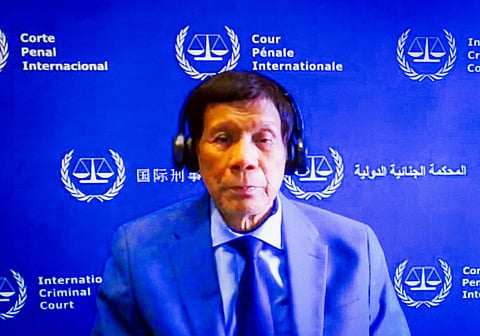
Dubai: Judges at the International Criminal Court (ICC) have opened a high-stakes confirmation of the charges for the hearing of former Philippine president Rodrigo Roa Duterte, a move that could pave the way for an international trial over the killings linked to his controversial "war on drugs".
The four-day proceedings, which began on February 23 and will run until the 27th, are taking place at the court’s headquarters in The Hague, where judges will decide whether prosecutors have presented enough evidence to move the case to trial.
A decisive moment
This stage of the process is not a trial, and it is not about deciding guilt or innocence. Instead, judges must determine whether there are "substantial grounds" to hold that Duterte committed the crimes alleged by prosecutors.
If the judges are satisfied that the evidence meets the required threshold, the case will move to a full trial before a different panel of judges. Otherwise, the charges could be dismissed or prosecutors may be asked to present more evidence.
Allegations spanning years
80-year-old Duterte is suspected of crimes against humanity of murder and attempted murder allegedly committed between November 1, 2011 and March 16, 2019. The time frame covers not only his presidency but also his earlier years as mayor and vice mayor of Davao, the largest city in southern Philippines.
According to the prosecution, the case centres on three sets of allegations. The first is related to the killings in or around Davao during his time as mayor, allegedly carried out by a group referred to as the "Davao Death Squad".
The second is involved in the targeting of so-called “high-value targets” during his presidency.
Meanwhile, the third is concerned on murders and attempted murders during barangay clearance operations. Barangays are local government units in the Philippines.
In court, prosecutors has alleged that Duterte and his co-perpetrators shared a common plan to "neutralise alleged criminals" in the country through violent crimes, including murder.
Presumption of innocence
To recall, an arrest warrant was issued as "secret" on March 7 last year, and was made public four days later on March 11. On March 12, Duterte was handed over to the ICC after being arrested by Philippine authorities.
Currently, he is being held at the ICC detention centre in Scheveningen, a coastal district of The Hague that houses suspects facing trial before the court.
Similar to all ICC suspects, Duterte is presumed innocent unless proven guilty beyond reasonable doubt at trial. At this stage, the burden lies entirely with the Office of the Prosecutor, which must convince judges that there is enough credible evidence for the case to proceed.
The prosecution team, led by deputy prosecutor Mame Mandiaye Niang, is presenting its evidence during the hearing.
On the other hand, Duterte’s defence, headed by lawyer Nicholas Kaufman, is expected to challenge the allegations and question the strength of the prosecution’s case.
Voices of victims
A total of 539 victims are participating in the proceedings through their legal representatives. Victim participation has been a distinctive feature of ICC cases, allowing those affected by the alleged crimes to present their views and concerns directly to the judges.
Their submissions form part of the broader picture the judges will consider before issuing their decision.
What comes next?
Within 60 days of the hearing’s conclusion, the judges are expected to deliver a written ruling. They can confirm all or some of the charges and commit the case to trial, decline to confirm the charges and halt the proceedings, or ask prosecutors to provide additional evidence.
Following global legal and political developments, the coming weeks will be critical. The judges’ decision will shape not only Duterte’s future, but also the international debate over accountability for large-scale anti-drug campaigns and the limits of state power.


![Environmental advocates warn that expanded commercial shipping along the Northern Sea Route could threaten the fragile Arctic ecosystem. [Illustrative image]](http://media.assettype.com/gulfnews%2F2026-08-22%2Ftpq7r8g0%2Farctic.jpg?w=320&auto=format%2Ccompress&fit=max)


