Where is Mojtaba? Absence at Khamenei funeral fuels questions
Three sons attend rites, reports cite security fears for his absence in Tehran funeral
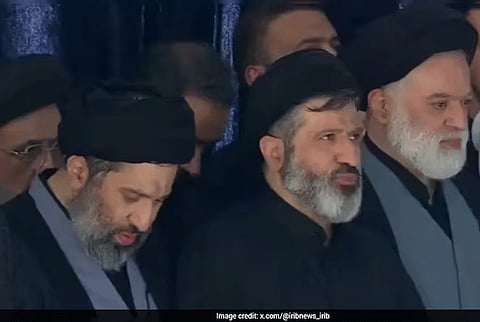
Dubai: Iran’s Supreme Leader Ayatollah Mojtaba Khamenei did not appear at the second day of funeral ceremonies for his father in Tehran, even as the country continued large-scale public mourning events marked by tight security and political symbolism.
Three sons of the late Iranian leader Ayatollah Ali Khamenei — Masoud, Meysam and Mostafa — were seen attending mass prayers, but Mojtaba Khamenei was absent. His whereabouts remain unclear, adding to speculation surrounding his condition following the February 28 strikes that targeted senior Iranian leadership.
According to a report by The New York Times, Mojtaba had also missed a memorial for his wife earlier in the week. The report cited unnamed Islamic Revolutionary Guard Corps (IRGC) members and individuals involved in planning the multi-day funeral, saying he had hoped to attend the burial in Mashhad but was reportedly advised against doing so due to security concerns that he could be targeted by Israel.
Face disfigured
There has still been no public sighting or image released of Mojtaba, said to have been injured in the attack that killed his father and family members on 28 February, when Israel and the US bombed Iranian targets at the start of the war. Mojtaba Khamenei’s face was disfigured and he suffered a significant injury to one or both legs, people close to his inner circle told Reuters.
State television broadcast images of the funeral proceedings at Tehran’s Imam Khomeini Mosalla, where the coffins of Ayatollah Ali Khamenei and four family members were laid out under glass in a vast courtyard. Senior Iranian officials, including President Masoud Pezeshkian and Parliament Speaker Mohammad Bagher Qalibaf, were seen praying behind the coffins.
Footage showed Masoud Khamenei visibly emotional, wiping tears with a keffiyeh as clerics led funeral prayers. Crowds of mourners packed the venue overnight, with many chanting and beating their chests in traditional expressions of grief.
Authorities said millions were expected to take part in a series of processions across Iran in the coming days, with state-organised transport, food and lodging provided to mourners. Tehran’s metro system reportedly recorded around seven million trips from Saturday night to Sunday morning as people travelled to the capital’s main mourning site.
The funeral programme is scheduled to extend across several cities and religious centres. After ceremonies in Tehran, the body will be moved to Qom, Iran’s theological hub, before being flown to Iraq for rites in the holy cities of Najaf and Karbala. It will then return to Iran for a final procession in Mashhad, where the burial is expected near the shrine of a revered Shiite imam.
The absence of Mojtaba Khamenei has added uncertainty to an already sensitive political moment. Analysts say the succession question, already shaped by the aftermath of the war, is now being played out against the backdrop of mass public mourning and heightened regional tensions.
Iranian authorities, however, have framed the ceremonies as a demonstration of unity and resilience following what they describe as a conflict that ultimately strengthened the country’s position after a ceasefire agreement with Washington.


