Missile scare over Turkey: How Iran war is testing NATO’s collective defence pledge
Here's what you need to know about the alliance and what the leaders say about Article 5
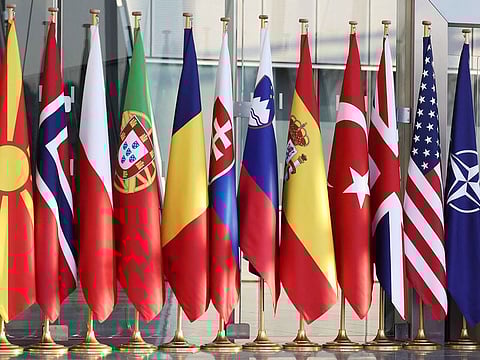
NATO has strengthened its missile defence posture after a ballistic missile launched from Iran and heading toward Turkey — a member of the alliance — was intercepted, raising fresh concerns about the widening fallout of the ongoing Iran war.
The alliance said its missile defence systems successfully shot down the projectile after identifying a threat to a NATO ally.
“In less than 10 minutes, NATO service members identified a threat to Allies, a ballistic missile, confirmed its trajectory, alerted land- and sea-based missile defence systems, and launched an interceptor to defeat the threat,” NATO spokesman Colonel Martin O’Donnell said.
The incident prompted NATO to increase its “alliance-wide ballistic missile defence posture”, with the alliance’s 32 member states agreeing during an ambassador-level meeting in Brussels to maintain the heightened alert level until the threat from Iran’s attacks subsides.
Turkey’s defence ministry said NATO defence systems intercepted and neutralised “a ballistic missile fired from Iran and detected heading towards Turkey”, though officials provided few further details.
NATO said the missile was targeting Turkey, but a Turkish official speaking anonymously suggested it may have been “aimed at a base in Greek Cyprus but veered off course”.
Italy’s Prime Minister Giorgia Meloni condemned the incident, calling it an attack on a NATO ally.
Meloni “expressed her solidarity and support... in the face of the unjustifiable missile attack” during a phone call with Turkish President Recep Tayyip Erdogan, her office said.
Despite the seriousness of the incident, US Defence Secretary Pete Hegseth said Washington did not believe the situation would trigger NATO’s collective defence clause.
NATO Secretary-General Mark Rutte echoed that assessment.
Also Read: Intense Israeli strikes hit Iran and Lebanon
“Nobody is talking about Article 5,” Rutte said, adding that the most important outcome was that NATO’s adversaries had seen the alliance is “so strong and so vigilant.”
The missile interception comes as Iran continues retaliatory strikes across the Middle East following US-Israeli attacks, with missiles and drones hitting cities and infrastructure across the region.
What is NATO?
The North Atlantic Treaty Organisation (NATO) is a military alliance founded in 1949 after World War II to provide collective security among its members.
Its core principle is that an attack on one member is considered an attack on all, ensuring that countries in the alliance respond collectively to external threats.
The alliance today plays a central role in transatlantic security and coordinates military cooperation, intelligence sharing and defence planning among its members.
Which countries are members of NATO?
NATO was created by 12 countries from Europe and North America on 4 April 1949.
NATO currently has 32 member states.
These include the United States, Canada and most European countries, such as the United Kingdom, France, Germany, Italy, Spain, Poland and Turkey.
Recent expansions have included Finland and Sweden, reflecting NATO’s growing role in European security following Russia’s invasion of Ukraine.
Turkey has been a NATO member since 1952 and occupies a strategically important position between Europe, the Middle East and the Black Sea region.
What is Article 5 of the NATO treaty?
Article 5 of the North Atlantic Treaty forms the basis of NATO’s collective defence principle.
Under the clause, an armed attack against one or more NATO members in North America or Europe is considered an attack against all allies.
If such an attack occurs, each member must assist the attacked country by taking “such action as it deems necessary,” including the possible use of armed force.
The provision reflects the right to individual or collective self-defence recognised under Article 51 of the United Nations Charter.
Is Article 5 automatically triggered?
Article 5 is not automatically activated when an incident occurs.
Two key conditions generally apply:
A NATO member must have suffered an armed attack.
The country involved must request or consent to collective action.
NATO’s main decision-making body, the North Atlantic Council, then meets to assess whether the situation qualifies for collective defence.
A consensus among all member states is required before Article 5 can be invoked.
What happens if Article 5 is invoked?
If the clause is triggered, NATO allies must assist the attacked country in whatever way they consider necessary.
This does not automatically mean military action.
Support could include military, political or logistical assistance depending on consultations among allies.
NATO coordinates these efforts and helps establish a common response.
Has Article 5 ever been used before?
The collective defence clause has been invoked only once in NATO’s history.
It was triggered after the September 11, 2001 terrorist attacks in the United States.
Since then, most incidents involving security threats or attacks on NATO members have instead led to consultations under Article 4, which allows allies to discuss threats to security without committing to collective defence.
Turkey has historically been among the countries that most frequently request consultations under Article 4 due to its proximity to regional conflicts.
Why the Turkey incident matters
Even though NATO leaders say Article 5 is unlikely to be invoked, the interception highlights the risk that the Iran war could draw in countries beyond the immediate conflict zone.
Turkey’s membership in NATO means any direct attack on its territory carries wider implications for the alliance — and potentially for global security.


