Iran warns US: 'Neither war nor peace' cannot continue
Ghalibaf calls for 'sustainable deterrence' to ensure lasting security

Tehran signals that it wants to end the prolonged state of uncertainty with the US and Israel, arguing that lasting security requires "removing the military threat" against Iran.
Ghalibaf's November 22 statement should be presented as Iran's strategic position, not as confirmation that Tehran has decided to resume hostilities.
The distinction between deterrence, military preparation and an actual decision to attack is important.
Get it: Fast, verified news for FREE ... download the Gulf News app — simply click here
Iranian Parliament Speaker Mohammad Bagher Ghalibaf has warned that the country cannot remain indefinitely in a situation of "neither war nor peace", calling for what he describes as sustainable deterrence to prevent another military confrontation.
His statement signals that Tehran's position is not simply about avoiding an immediate resumption of hostilities.
It is also about changing the strategic conditions that Iran believes leave it vulnerable to further US and Israeli attacks.
Ghalibaf argued that the only way to eliminate the threat of war is to remove the underlying security threat against Iran.
"If we do not want the current situation to continue, we must remove the threat from our country," he said, adding that this could only be achieved through sustainable deterrence.
The remarks point to a central question in the ongoing confrontation: Can the United States, Israel and Iran establish a durable arrangement that prevents renewed fighting, or will the region remain trapped in an unstable ceasefire-like environment?
What does Ghalibaf mean by sustainable deterrence?
The phrase sustainable deterrence is important because it suggests Iran wants more than a temporary halt to military operations.
In strategic terms, deterrence means developing sufficient military capabilities and other forms of leverage to convince an adversary that attacking would carry unacceptable costs.
For Tehran, this could involve several objectives:
Military capability: Maintaining and strengthening missile, drone and air-defence capabilities to discourage another US-Israeli attack.
Strategic leverage: Preserving the ability to threaten or disrupt shipping through the Strait of Hormuz, a critical international oil and gas transit route.
Economic resilience: Reducing the impact of US sanctions, trade restrictions and the naval blockade on Iranian ports.
Diplomatic guarantees: Securing an agreement that prevents another military campaign and addresses Iran's security concerns.
This does not necessarily mean Iran is announcing plans to launch another offensive.
However, it indicates that Tehran does not consider a fragile ceasefire or an unresolved confrontation sufficient to guarantee its security.
Ghalibaf has also rejected the political argument that negotiations automatically amount to surrender or that advocating military resistance necessarily means wanting war.
His message is that Iran must establish conditions under which it cannot easily be attacked again.
Why the statement matters now
Ghalibaf's remarks come as diplomatic efforts to end the conflict face significant obstacles.
November 20 – Iran keeps diplomacy open: Foreign Minister Abbas Araghchi said Iran remained willing to pursue diplomacy but wanted assurances that any agreement would prevent renewed hostilities. Iran also maintained its position on retaining its enriched uranium stockpile.
November 21 – Qatar's diplomatic intervention: A Qatari delegation visited Tehran for discussions aimed at finding a diplomatic path out of the conflict. Iranian Deputy Foreign Minister Kazem Gharibabadi said Tehran remained in contact with mediators, including Qatar, per Reuters.
November 22 – Trump's position: US President Donald Trump said he wanted a permanent agreement but had described Iran's proposed terms as "unacceptable". He has also indicated that he is not rushing to decide on the next US military move.
Military escalation remains possible: Anadolu Agency reported on November 22 that Israel and US Central Command had agreed to develop joint plans for a possible escalation against Iran. The report said no decision to launch an attack had been made.
The situation is further complicated by the US naval blockade of Iranian ports, attacks involving shipping in the Gulf and Strait of Hormuz, and renewed military exchanges in the region.
Dangerous strategic stalemate
The confrontation has entered a phase in which neither side appears ready to accept the other's conditions.
The US wants an agreement that addresses Iran's nuclear programme and regional military activities. Tehran, meanwhile, wants sanctions relief, an end to the blockade and assurances that Washington and Israel will not resume attacks.
Iran has previously presented a seven-point proposal, reportedly transmitted through Qatar.
Its conditions include lifting the US blockade, easing oil sanctions and addressing other economic restrictions before further negotiations can progress.
Ghalibaf has been central to these diplomatic efforts. He has previously indicated that Iran wants Washington to respond formally to its proposals rather than continue negotiations under military and economic pressure.
But the military situation is complicating diplomacy.
An AP report published on November 17 documented renewed US-Iran military exchanges after a roughly two-month lull, including Iranian attacks on US military targets in Bahrain and a US strike against an Iranian missile-launch site on Qeshm Island.
Meanwhile, continued tensions around the Strait of Hormuz threaten international shipping, oil supplies and energy markets.
Why it matters to the world
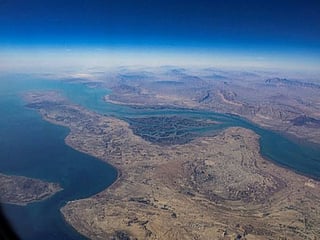
The Strait of Hormuz connects the Arabian Gulf to international markets and is one of the world's most important energy chokepoints.
Any prolonged disruption could increase oil prices, raise shipping insurance costs, disrupt supply chains and add inflationary pressure to economies dependent on imported energy.
For the Gulf states, the challenge is balancing national security, economic stability and diplomatic relations while avoiding a wider regional war.
Why Ghalibaf is telling Washington
Ghalibaf is effectively telling Washington that Iran does not want to live under the constant threat of another military attack. Tehran wants a new "strategic balance" in which its military capabilities, economic leverage and diplomatic position make renewed war more costly.
But there is a fundamental disagreement: what Iran calls sustainable deterrence could be viewed by the United States and Israel as an expansion of the very military capabilities they want to constrain.
That disagreement is at the heart of the current stalemate.