How Iran’s ‘dark fleet’ keeps oil flowing despite sanctions
Satellite imagery tracked dozens of covert oil transfers near Malaysian waters
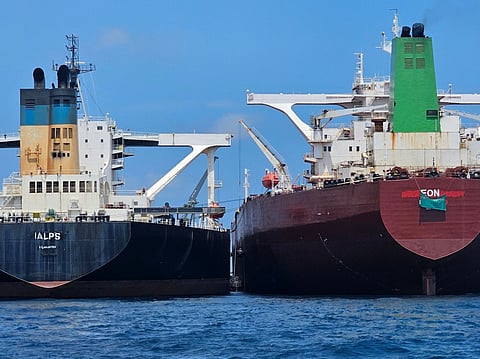
Dubai: Even as Iran faces mounting pressure from a US naval blockade and intensifying scrutiny over the Strait of Hormuz, Tehran appears to be quietly sustaining its oil exports through a vast network of shadow tankers and covert ship-to-ship transfers near Malaysian waters, according to an Associated Press investigation.
The report said dozens of Iranian-linked oil transfers have taken place in waters off Malaysia’s southern Johor state since the outbreak of the US-Iran conflict on February 28, highlighting how Tehran continues to exploit opaque maritime networks to bypass sanctions and keep crude flowing to buyers.
Satellite imagery reviewed by United Against Nuclear Iran (UANI), a US-based advocacy group, reportedly tracked at least 42 ship-to-ship transfers involving Iranian oil near the Eastern Outer Port Limits in the South China Sea — a key maritime zone lying between Iran and China, which buys roughly 90 per cent of Iranian crude exports.
The operations are part of what maritime experts increasingly describe as Iran’s “dark fleet” — aging tankers and loosely connected shipping networks that operate with minimal transparency and frequently evade detection.
How Iran bypasses sanctions
Iran has spent years building a complex sanctions-evasion network designed to keep oil exports flowing despite US restrictions targeting its energy sector.
Analysts say the system relies heavily on “shadow fleet” tankers — aging vessels that often operate with obscured ownership structures, frequently change flags and names, and disable transponders that normally allow ships to be tracked publicly.
Ship-to-ship transfers are a key part of the process. Iranian crude is often moved between vessels in international waters, making it harder for buyers and regulators to trace the oil’s origin.
Some tankers also manipulate location signals, falsify shipping documents or blend Iranian crude with oil from other sources before cargoes are delivered to buyers, primarily in China.
The United States has repeatedly sanctioned shipping firms, brokers, insurers and vessels allegedly linked to the trade, but maritime analysts say enforcement remains difficult because many operations take place in poorly monitored international waters involving layered ownership networks across multiple jurisdictions.
Why Malaysia matters:
Waters near Malaysia have emerged as a preferred transfer zone because they sit along one of the world’s busiest shipping routes between the Middle East and East Asia.
According to AP, many vessels involved in the transfers switch off tracking transponders, use false identities, operate at night and conceal ownership structures to avoid scrutiny.
The growing activity comes despite a US blockade on Iranian ports imposed in mid-April as Washington attempted to increase economic pressure on Tehran following weeks of conflict in the Gulf.
Malaysia says its powers are limited
Malaysia’s maritime enforcement agency pushed back against criticism that it was failing to crack down on the transfers, arguing many of the operations occur in international waters outside its legal jurisdiction.
Malaysian Maritime Enforcement Agency Director-General Mohamad Rosli Abdullah told AP that the criticism did not reflect the “operational realities” faced by authorities.
At a glance: How Iran evades oil sanctions
Ship-to-ship transfers in international waters
Tankers switch off tracking systems
Vessels frequently renamed or reflagged
False shipping documents used
Oil blended to obscure origin
China remains biggest buyer of Iranian crude
He said many shadow fleet vessels deliberately avoid detection by disabling tracking systems and exploiting legal grey zones near busy international shipping routes.
The ship-to-ship transfers have nevertheless triggered growing concern among shipping organisations and sanctions watchdogs, particularly because such operations are often conducted far from ports and safety oversight.
Industry experts warn that the use of aging vessels and unsupervised transfers significantly raises the risk of oil spills and maritime accidents along one of the world’s busiest shipping corridors.
Oil still moving despite blockade
Despite US pressure, Iranian-linked tankers continue operating in the region.
According to AP, at least two dozen Iranian-linked tankers were recently observed anchored or loitering near the transfer zone off Johor.
Charlie Brown, a senior adviser at UANI, told the news agency the activity suggested it was still “business as usual” for much of Iran’s sanctions-evasion network.
“Because of Malaysia’s inaction, it is facilitating this business model by Iran and China and dark fleet actors,” he said.
The report also noted that some vessels previously detained over unauthorised oil transfers had later reappeared near Malaysian waters conducting fresh operations involving suspected Iranian crude.
Wider regional concerns
The issue is also drawing attention from neighbouring Indonesia, whose maritime zone borders the transfer area.
Indonesia’s Foreign Ministry said authorities were reviewing the legality of the activities, while reaffirming that Indonesian waters must not be used for unlawful operations.
The revelations come at a time when Iran is simultaneously trying to tighten control over shipping through the Strait of Hormuz, where Tehran has sought to impose new routing rules and transit tolls on commercial vessels.
Analysts say the combination of shadow fleet operations in Asia and pressure tactics in Hormuz underscores Tehran’s broader strategy of using maritime leverage to withstand sanctions and maintain critical oil revenues despite growing international pressure.


