Drones, automation and speed: How Iran’s new playbook is crushing protests
Surveillance, internet shutdowns and rapid violence signal hardened regime response
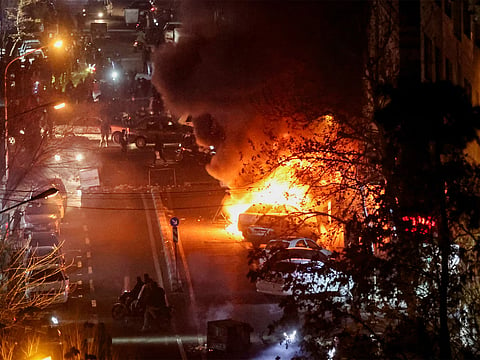
Dubai: Iran has rolled out a far more aggressive and technologically advanced strategy to crush nationwide protests, signalling a major shift in how the Islamic Republic views domestic dissent — no longer as sporadic unrest, but as an extension of its recent war with Israel, CNN reported.
What began as familiar riot-control tactics quickly escalated into a coordinated campaign combining surveillance drones, communications blackouts, psychological operations and lethal force. Experts say the regime’s response reflects lessons learned from both past uprisings and the deep Israeli infiltration that embarrassed Tehran during the 12-day war in June.
Iranian officials now frame the latest unrest as the “thirteenth day of war” with Israel, portraying protesters as foreign-backed agents rather than citizens voicing grievances, according to analysts cited by CNN.
Drones, surveillance and fear
The regime’s crackdown has relied heavily on surveillance. Protesters were monitored through street cameras, but authorities also targeted those who attempted quieter forms of dissent — such as chanting anti-regime slogans from their homes.
How Iran’s crackdown has changed
Surveillance: Use of drones to identify protesters inside homes
Communications: Near-total internet shutdown and jamming of Starlink
Speed: Crackdown deployed within hours, not weeks
Force: Rapid mobilisation of Basij paramilitary units
Narrative: Protests framed as foreign-backed warfare, not civil unrest
Iranian police circulated a video titled “Identifiable Sounds”, showing drones hovering outside apartment windows to locate people chanting slogans like “death to the dictator.” The footage, set to ominous music, depicted drone operators peering into residential buildings, followed by security forces placing warning stickers on doors and, in some cases, arresting residents.
“We received information that someone in your building was chanting — and it came from your apartment,” a security officer is heard telling a man in a blurred video shared by Iranian media. The accompanying caption declared: “Everything is under surveillance.”
Unprecedented communications blackout
Alongside physical surveillance, the regime imposed one of the most severe communications shutdowns Iran has ever experienced. For days, the country was largely cut off from the outside world.
Even Starlink satellite internet terminals, used by Iranians to bypass state restrictions, were reportedly jammed using what experts described as military-grade technology.
“I haven’t seen anything like this before,” said Amir Rashidi, an Iranian cybersecurity expert and director at the New York-based digital rights group Miaan. “This was not ordinary jamming. They are using advanced equipment.”
Iran has previously shut down the internet — during the 2019 fuel price protests and the 2022 women-led demonstrations — but analysts say the latest blackout showed a far higher degree of automation and speed.
“This was near-total and almost instantaneous,” said Alp Toker, founder of internet monitoring group NetBlocks. “It ranks among the most severe disruptions we’ve seen globally,” he told CNN.
Violence escalates rapidly
The protests, which have continued for two weeks, intensified sharply on January 10, when crowds — some of them violent — took to the streets demanding the overthrow of the regime.
The crackdown that followed lasted nearly three days and may have resulted in one of the highest death tolls since Iran’s 1979 revolution, according to rights groups cited by CNN. Iranian authorities have not acknowledged killing protesters, instead claiming deaths were caused by “rioters” allegedly backed by the United States and Israel.
Analysts note the rapid mobilisation of the Basij paramilitary force, which had also been deployed internally during the war with Israel, marked a dramatic escalation.
“In previous uprisings, this level of response took weeks to organise,” said Matthew Levitt, a counterterrorism expert at the Washington Institute for Near East Policy. “Now it happens almost instantly. The regime is fighting its own people.”
Propaganda and intimidation
Following the war, Iranian officials openly admitted that Israeli strikes exposed serious vulnerabilities. That acknowledgement, experts say, has reshaped how the state perceives internal threats.
State-run media have worked aggressively to instil fear. Television broadcasts warned citizens they were under constant surveillance, while one unusually grim report showed rows of body bags in a morgue — widely interpreted as an attempt to deter potential protesters.
Authorities also publicised deaths among security forces, aired images of blindfolded detainees lined against walls, broadcast forced confessions, and displayed seized weapons said to belong to protesters.
At the same time, massive state-sanctioned rallies were organised to project loyalty to the Islamic Republic, while officials insisted order had been restored.
By Monday, protests in Tehran appeared smaller following the crackdown, though the communications blackout made verification difficult. Iran’s foreign minister said the situation was “under control.”
What comes next
Whether the unrest has truly subsided remains unclear. Protests could reignite following renewed calls from US President Donald Trump, who urged Iranians to keep demonstrating and vowed that “help is on the way.”
“KEEP PROTESTING — TAKE OVER YOUR INSTITUTIONS!!!” Trump wrote on Truth Social.
For now, analysts say Iran’s new protest playbook reveals a regime more paranoid, more militarised and more willing than ever to use overwhelming force to silence dissent.


