What did the US envoy say on Israel’s territory to draw Arab fire?
Comments violate international law and risk further destabilising region, Arab states say
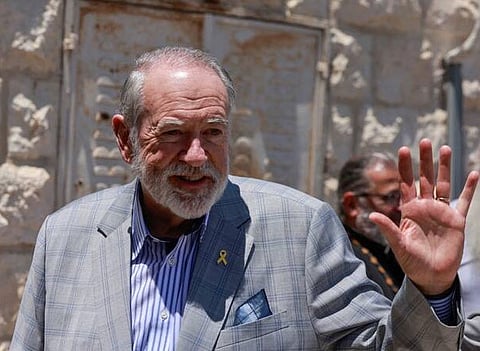
Dubai: More than a dozen Arab and Islamic countries, joined by three major regional organisations, have issued a joint condemnation of remarks attributed to the United States Ambassador to Israel, warning that the comments risk inflaming regional tensions and undermining international law.
In a joint statement released by the UAE, Egypt, Jordan, Indonesia, Pakistan, Turkey, Saudi Arabia, Qatar, Kuwait, Oman, Bahrain, Lebanon, Syria and the State of Palestine expressed “strong condemnation and profound concern” over statements by the US diplomat suggesting it would be acceptable for Israel to exercise control over territories belonging to Arab states, including the occupied West Bank.
The statement was also endorsed by the secretariats of the Organisation of Islamic Cooperation (OIC), the League of Arab States (LAS), and the Gulf Cooperation Council (GCC), underscoring broad regional alignment on the issue.
The Ministries of Foreign Affairs, according to WAM, described the remarks as “dangerous and inflammatory,” arguing that they constitute a “flagrant violation of the principles of international law and the Charter of the United Nations,” while posing a “grave threat” to regional security and stability.
Podcast comments trigger backlash
The diplomatic reaction follows comments made by US Ambassador Mike Huckabee during an appearance on the podcast of American commentator Tucker Carlson. During the interview, Carlson pressed Huckabee on interpretations of a biblical verse sometimes cited by religious nationalists as justifying expansive territorial claims for Israel stretching from the Nile to the Euphrates, media reports said.
Responding to the hypothetical scenario, Huckabee said: “It would be fine if they took it all,” later characterising the remark as “somewhat of a hyperbolic statement” and emphasising that Israel was “not asking to take all of that.”
Despite that clarification, the comments drew swift criticism across the Middle East.
‘No sovereignty over occupied lands’
In their joint response, the Arab and Islamic signatories firmly rejected any suggestion of Israeli sovereignty over occupied territories.
“The ministries reaffirmed that Israel has no sovereignty whatsoever over the Occupied Palestinian Territory or any other occupied Arab lands,” the statement said, reiterating opposition to any attempts to annex the West Bank or separate it from the Gaza Strip.
Also Read: Arab world pushes back on Trump's Gaza plan
The governments also warned that rhetoric appearing to legitimise control over the lands of others “undermines objectives of tolerance and peaceful coexistence,” instead “fueling tensions” and encouraging instability.
Reference to US diplomacy
Notably, the joint declaration framed the controversy as inconsistent with Washington’s stated diplomatic goals.
The ministries stressed that such remarks “directly contradict” the vision articulated by US President Donald J. Trump and the Comprehensive Plan to End the Gaza Conflict, which they said are aimed at containing escalation and creating a political pathway toward a comprehensive settlement.
They argued that statements perceived as endorsing territorial expansion “constitute incitement rather than advancing peace.”
Wave of national reactions
Even before the collective statement, several regional governments had issued unilateral rebukes.
Saudi Arabia labelled the ambassador’s words “reckless” and “irresponsible,” while Jordan described them as “an assault on the sovereignty of the countries of the region.” Kuwait cited a “flagrant violation of international law,” and Oman warned the comments threatened peace and stability.
Egypt’s foreign ministry reiterated that “Israel has no sovereignty over the occupied Palestinian territory or any other Arab lands,” a position echoed by Palestinian officials, who said the remarks contradicted US opposition to West Bank annexation.
Iran weighs in
Iran also entered the debate, with its foreign ministry accusing Huckabee on X of exposing what it called “American active complicity” in Israel’s policies. Tehran frequently uses such disputes to reinforce its longstanding criticism of US and Israeli actions in the region.
No direct retraction
While Huckabee later posted on X to clarify other aspects of the Carlson interview, he did not directly revisit his biblical-verse comment.
Meanwhile, Israeli Knesset Speaker Amir Ohana praised Huckabee’s broader pro-Israel stance and criticised Carlson, accusing the commentator of “falsehoods and manipulations.”
The episode adds to already fraught regional sensitivities, as governments continue to warn that rhetoric touching on borders, sovereignty, and occupation carries significant geopolitical consequences.


