US was told of plot to overthrow Saleh
washington failed to see president's support base eroding and continued to bank on him
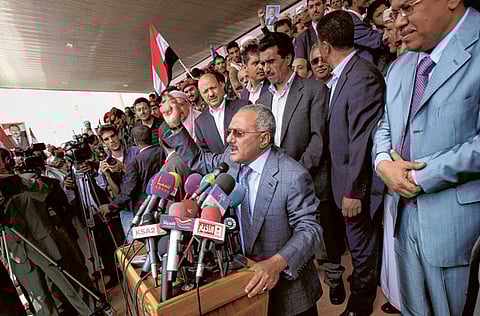
Washington A billionaire Yemeni shaikh met with a high-ranking officer from the US Embassy in Sana'a less than two years ago and revealed a secret plan to overthrow President Ali Abdullah Saleh, the country's longtime ruler.
Hamid Al Ahmar, an opposition party leader and prominent businessman, vowed to trigger the revolt if Saleh did not guarantee the fairness of parliamentary elections scheduled for 2011, according to a classified US diplomatic cable summarising the meeting.
Al Ahmar said he would organise massive demonstrations modelled on protests that toppled Indonesia's President Suharto a decade earlier. "We cannot copy the Indonesians exactly, but the idea is controlled chaos," Al Ahmar told the unnamed embassy official.
The embassy, however, was dismissive of the Al Ahmar, concluding that his challenge posed nothing more than "a mild irritation" for Saleh. Today, Saleh is barely clinging to power amid a popular uprising in Yemen that is unfolding more or less along the lines that Al Ahmar predicted.
Weak leader
Several previously undisclosed US diplomatic cables, provided by the anti-secrecy website WikiLeaks, show that influential Yemenis and US allies repeatedly warned US diplomats of Saleh's growing weakness in 2009 and 2010.
But despite those warnings, the Obama administration continued to embrace Saleh and became increasingly dependent on him to combat an Al Qaida affiliate that was plotting attacks against the United States from the Arabian Peninsula.
Al Ahmar, the de facto chief of Yemen's largest tribal confederation, told the US official in August 2009 that his scheme would hinge on persuading a powerful Yemeni general, Ali Mohsin Al Ahmar [no direct relation], to abandon the president and join the opposition.
Last month, the general did just that, with Hamid Al Ahmar, who is now considered a potential presidential contender, playing a key behind-the-scenes role.
Since January, spontaneous public revolts have seized the Arab world, sweeping aside autocrats in Tunisia and Egypt while threatening others in Libya, Bahrain and Syria. The classified cables from the embassy in Sana'a, however, make clear that Yemen's revolution was different: It was plotted and predicted long in advance.
Those same cables reveal that US officials were keenly aware of Yemen's political and economic straits but largely discounted the prospect that Saleh could be forced out, despite dire assessments of his standing from Arab and European counterparts, from members of Yemen's political opposition and even from Saleh's inner circle.
The US government has not explicitly called for Saleh's ouster, even though his security forces have been blamed for the shooting deaths of dozens of protesters. US officials and Arab diplomats have been mediating talks, however, between the Yemeni government and demonstrators that could lead to Saleh's exit.
Funding
Upon taking office, the Obama administration reviewed US policy toward Yemen and pledged to give more money for counterterrorism programmes and economic development.
But some independent analysts said the United States still didn't pay enough attention to the dismal state of affairs in Yemen and was unprepared for the revolt against Saleh. "Other allies have been talking about this with a lot more urgency and for a lot longer than the Americans have," said Christopher Boucek, a Yemen expert at the Carnegie Endowment for International Peace.
"Until a few weeks ago, most of the talk from the Obama administration was that there isn't an alternative to Saleh, that ‘we don't know what else to do'."
A senior Obama administration official defended the US approach. "Yemen is one of those places where we don't have a lot of good policy options," the official said. "We've had this emphasis on trying to bring about reform."
Multitude of threats
In addition to a stream of invective voiced against Saleh by his political rivals and opponents, the State Department cables show that even members of the president's inner circle were complaining to the US Embassy in Sana'a.
In December 2009, a member of parliament with close personal ties to Saleh told an embassy official that the president was "overwhelmed, exhausted by the war, and more and more intolerant of internal criticism."
According to a cable summarising the meeting, the legislator characterised "the multitude of threats facing Saleh as qualitatively different and more threatening to the regime's stability than those during any other time in Yemen's history."
Four months earlier, a member of Saleh's party who is a relative of the president suggested that it was time for Yemen's ruler to quit. "He doesn't listen to anyone," the relative told an embassy officer, adding that he was collaborating with the billionaire shaikh, Hamid Al Ahmar, to organise public protests.
The relative "hinted that if peaceful demonstrations were unsuccessful in achieving dramatic change, ‘we will use other means,'" the cable reported.
The embassy took careful note of the swell of anti-Saleh anger in cables transmitted back to Washington, but also dismissed many of the complaints as sour grapes. "It is unsurprising in a state dominated by a strong leader that those unhappy with their situation blame that individual," read a May 30, 2009, cable signed by Stephen Seche, the US ambassador at the time.
Seche declined to comment for this article. In a separate cable two months earlier, the ambassador played down a prediction from yet another Yemeni political insider that Saleh's demise was imminent.
"For thirty years, Saleh has ruled Yemen," Seche wrote. "Observers have been predicting disaster here for almost as long."
— Washington Post


