From palaces to prison cells: Ex-heads of state behind bars in 2025 — detained, restricted, and what happens next
Courts prosecuting ex-leaders for crimes ranging from corruption to money laundering
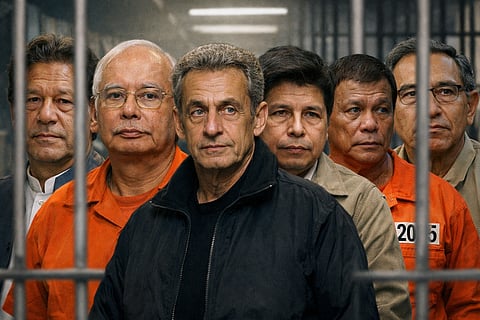
Once untouchable symbols of national power, a growing number of former heads of state are now behind bars or under detention — a striking reflection of how accountability, politics and justice are colliding across continents.
Some cases are hailed by supporters as long-overdue justice; others are fiercely contested by allies who see them as politically driven.


What unites these former presidents and prime ministers is the extraordinary reversal of fortune they represent. Many once commanded armies, shaped constitutions and dominated political life.
Today, they navigate prison cells, appeals courts and international tribunals. Their cases have become flashpoints at home, influencing elections, polarising societies and testing the independence of judicial systems.
Here are ex-heads of state or government currently in jail, or detention with brief background and context:
Pakistan – Imran Khan (Age 71)
Former Prime Minister Imran Khan is serving multiple prison sentences in Pakistan. In December 2025, a court handed him 17 years in jail alongside his wife Bushra Bibi in a graft case over the under-priced purchase of state gifts, part of a broader set of convictions including a 14-year term for land corruption.
Khan and his party, Pakistan Tehreek-e-Insaf (PTI), call the charges politically motivated and plan appeals. In 2026, his legal team will likely pursue higher appeals while political tensions persist, as his supporters mobilise and the party navigates its role in opposition.
Malaysia – Najib Razak (Age 72)
Former Malaysian Prime Minister Najib Razak was sentenced on December 26, 2025 to 15 years in prison and fined approximately 13.5 billion ringgit ($3.3 billion) for abuse of power and money laundering related to the 1MDB scandal.
This sentence will begin after his existing term ends. A Malaysian High Court recently denied his request to serve the remainder under house arrest. In 2026, Najib is expected to appeal the ruling and challenge the fines, which could prolong judicial review and impact his political influence within UMNO and national politics.
Peru – Martin Vizcarra (Age 63)
When he became president in November 2018, Martín Vizcarra vowed to "fight corruption at any cost". In November 2025, he was sentenced to 14 years in prison for accepting bribes during his time as governor before the presidency. He was also fined and barred from public office for nine years, and is serving his sentence at Barbadillo Prison in Lima.
In 2026, Vizcarra’s appeal process will continue while he remains incarcerated, and he will be ineligible for public office until at least 2033. His case highlights Peru’s ongoing crackdown on political corruption.
Peru – Pedro Castillo (Age 56)
Former President Pedro Castillo, ousted in 2022 after attempting to dissolve Congress, was sentenced to about 11.5 years in prison in late 2025 for conspiracy to commit rebellion.
He remains in custody in Lima and faces a ban on public office. In 2026, Castillo can pursue an appeal, though his convictions significantly diminish his political future. His case underscores Peru’s protracted political instability and legal reckoning with executive overreach.
Philippines – Rodrigo Duterte (Age 80)
Ex-President Rodrigo Duterte was arrested in March 2025 under an International Criminal Court (ICC) warrant for alleged crimes against humanity linked to his war on drugs.
He was flown to The Hague to face international proceedings and is detained at the ICC detention centre. In 2026, the ICC process will advance with pre-trial hearings and potential trial dates.
Interim release requests and procedural disputes will shape his legal status, but interim release remains unlikely under ICC rules, meaning he is expected to remain in custody throughout 2026, as per Human Rights Watch.
France – Nicolas Sarkozy (Age 70)
Former French President Nicolas Sarkozy began serving a five-year sentence in October 2025 for criminal conspiracy linked to illegal campaign financing from Libya in 2007.
He was jailed in Paris' La Santé Prison for conspiring to illegally finance his 2007 presidential campaign with funds from Libya's late dictator, Muammar Gaddafi. He became the first former French head of state, and the first ex-leader of a European Union state, to be imprisoned.
On November 10, 2025, an appeals court granted Sarkozy's request for release, ending his three-week stint in jail. Conditions of release: He was placed under strict judicial supervision, forbidden from contacting justice ministry officials, and barred from leaving France.
Post-release, Sarkozy announced he was writing a book, A Prisoner's Diary, about his time in prison, with an excerpt published on social media.
Sarkozy had earlier been found guilty of illegal attempts to secure favours from a judge.
Alejandro Toledo (Age 79)
Alejandro Toledo is a Peruvian economist and politician who served as President of Peru from 2001 to 2006. Born on March 28, 1946, Toledo emerged from humble origins in rural Peru to earn advanced degrees in the United States — including a doctorate — and became a key figure in restoring democratic governance after the authoritarian era of Alberto Fujimori.
Toledo’s presidency in the early 2000s focused on economic growth, poverty reduction, and integration into global markets. He later became embroiled in investigations related to the Odebrecht corruption scandal — part of the wider "Operation Car Wash" (Lava Jato) probe that implicated officials across Latin America. Peruvian prosecutors alleged he received $35 million in bribes from Odebrecht in exchange for favoring the company in the bidding for the Interoceánica Sur highway project, as per Infobae.
After years of legal battles, he was arrested in the United States in 2019 and fought extradition for several years. In 2022 he was extradited to Peru to face trial and was placed under custody in a special facility for former presidents in Lima. In October 2024:, he received a 20-year prison sentence for accepting bribes (colusión and money laundering) tied to the Odebrecht Interoceánica contract.
He is imprisoned in Peru’s Barbadillo Prison, with decades-long sentences underway. In September 2025, he was given an additional sentence of 13 years and 4 months in the Ecoteva case, relating to laundering proceeds allegedly from those same bribes used to buy properties, as per Radio Nacional.
Toledo has repeatedly denied wrongdoing and has cited his age and health concerns — including cancer and heart issues — in appeals for leniency or alternative treatment.
Ollanta Humala (Age 63)
Ollanta Humala is a Peruvian former army officer and politician who served as President of Peru from 2011 to 2016. Born on June 27, 1962, Humala built his early career as a military officer and later entered politics with a nationalist and left-leaning platform, eventually winning the presidency with promises to address poverty and inequality. Humala’s situation has shifted dramatically since his presidency:
In April 2025, a Peruvian court sentenced him to 15 years in prison for money laundering tied to illegal campaign contributions from the Brazilian construction company Odebrecht (now Novonor) and funds linked to the Venezuelan government during his 2006 and 2011 campaigns.
He was taken into custody immediately after the ruling, as per Sky News. The conviction makes him one of several former Peruvian presidents imprisoned on corruption charges; others include Alejandro Toledo, and Pedro Castillo, who are also incarcerated.
Humala reportedly remains in prison — likely at the Barbadillo Prison complex that houses high-profile political figures — as his legal defense pursues appeals, Merco Press reports.
His wife, former first lady Nadine Heredia, was also sentenced to 15 years but sought diplomatic asylum at the Brazilian embassy in Lima and subsequently traveled to Brazil.
South Korea - Yoon Suk Yeol (Age 65)
The former President of South Korea Yoon Suk Yeol was arrested on January 15, 2025 over his failed martial law bid. He's at the centre of multiple criminal cases linked to his brief attempt to impose martial law in December 2024 and related conduct during his presidency.
He has also been indicted on other charges, including alleged violations of the political fundraising law tied to political opinion polls provided to him and his wife, Kim Keon-hee, Reuters reported.
Prosecutors have requested a 10-year prison sentence on charges including obstruction of justice, abuse of power, falsifying records and hindering his own arrest. Aa Seoul Central District Court review is expected in January 2026.
He has denied all allegations and is currently detained pending trial proceedings, as per the Jurist.
A verdict on the first trial (with prosecutors seeking a decade term) was expected in January 2026.
2026 outlook: What to watch out for
Note: This list reflects publicly verified jail terms and detentions of former national leaders currently confirmed as imprisoned, or are under restricted movement, as of late 2025.
As 2026 approaches, the legal journeys of these leaders are far from over. Appeals, retrials and international proceedings could redefine their futures — and, in some cases, reshape their countries’ political landscapes once again.
In 2026, Sarkozy’s appeal trial is anticipated in the spring, and his legal team will push for a final overturn or reduced sentence. His case sets a modern precedent in France for prosecuting former heads of state, El Pais.
Additional detentions may be pending or under appeal, such as South Korea’s Yoon Suk Yeol faces jail-term requests. The 2026 ICC trial of Duterte, the first Philippine leader to be prosecuted by the international court, will be a closely-watched legal battle.


