Trump, Xi and Putin’s historic summit: Diplomacy or power play? 5 key takeaways
Behind the smiles, competing interests test prospects for cooperation after China talks
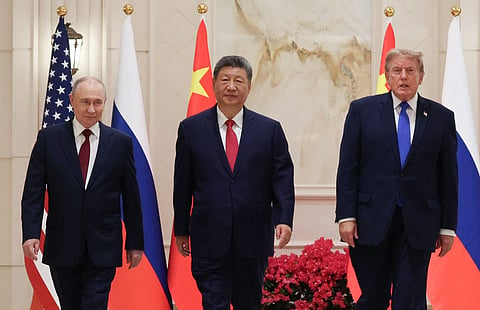
Dubai: Three of the world’s most powerful leaders sat around the same table, exchanged warm words and promised greater cooperation. But behind the historic meeting between Donald Trump, Xi Jinping and Vladimir Putin lay a more complicated question: Was the summit a genuine step towards peace or an exercise in global power politics?
The 81-minute meeting in Shenzhen produced a joint declaration on international security, energy supplies and nuclear risks. Yet its significance may lie less in what was agreed than in what each leader hoped to achieve.
CNN reported that officials had expected few major breakthroughs. The meeting itself, rather than any binding agreement, was the central diplomatic achievement.
Trump: A diplomatic opportunity
For Trump, the summit offered an opportunity to demonstrate his influence on the world stage following Republican losses in the US midterm elections.
He has struggled to deliver on promises to end the Ukraine war, while the prolonged confrontation with Iran has increased economic and political pressure at home.
Trump has sought closer personal relationships with both Xi and Putin, believing direct engagement can help overcome entrenched disagreements.
“I think as long as you and I are in charge of things, we’ll never have a problem,” he told Xi, according to CNN.
But personal diplomacy has yet to resolve the conflicts confronting Washington.
Xi: China at the centre
For Xi, hosting the unprecedented summit placed China at the centre of global diplomacy.
The meeting allowed Beijing to present itself as a major international power capable of bringing together Washington and Moscow despite their competing interests.
According to The New York Times, China secured the prestige of hosting the talks without accepting binding restrictions on its nuclear arsenal or endorsing a specific Ukraine peace plan.
Xi also avoided commitments that could complicate Beijing’s relationships with Russia and Iran.
His message was that major powers should cooperate rather than confront one another.
“History tells us that when great powers are at peace, the world is secure; when great powers clash, the world is in chaos,” Xi said.
Putin: Back on the world stage
For Putin, the summit marked a prominent return to international diplomacy after years of isolation by Western countries over Russia’s war in Ukraine.
Appearing alongside Trump and Xi reinforced Moscow’s claim to a central role in shaping international security.
The meeting also revived comparisons with the 1945 Yalta conference, when the Allied powers helped determine Europe’s postwar future.
Asked about the possibility of another Yalta, Putin responded: “What was so bad about Yalta?” according to The New York Times.
He argued that present-day conflicts would ultimately require recognition of realities on the ground.
But Putin’s subsequent refusal to negotiate with Ukraine following strikes on the Crimean Bridge exposed the limits of the summit’s peace rhetoric.
A new balance of power?
The meeting also highlighted the complex relationship between the three countries.
China and Russia have strengthened their strategic partnership, while Trump has attempted to improve relations with both governments despite disputes over trade, technology and security.
AFP and AP reported that the declaration contained broad commitments but no detailed framework for ending either the Ukraine or Iran conflict.
Neither Ukraine nor Iran participated in the trilateral discussions, raising questions about how far the three powers could advance peace without the countries directly involved.
For now, the summit has opened a channel for dialogue. Whether that produces meaningful agreements will depend on negotiations beyond Shenzhen.
In Kyiv, where Russian drones struck the city as the three leaders met in China, Ukrainians expressed anger at discussions about their country's future without their participation.
“What they want is to divide the whole world... they are all creating evil,” Gennadiy Bystrukhin, 68, told AFP, branding Trump, Xi and Putin “three losers”. One person was killed in the drone attacks, which also reportedly damaged the Dutch embassy and a landmark cathedral.
Oleg Obukhovsky, a 49-year-old Ukrainian war veteran, dismissed the summit's significance. “They are deciding nothing,” he told AFP. “This is not the Yalta Conference.” Referring to the conflicts confronting the three leaders, he added: “Trump has Iran. Xi has Taiwan. What can they possibly decide? It's nonsense.”
The central question remains whether the three leaders can turn their historic diplomatic engagement into practical cooperation — or whether competing national interests will ultimately prevail..
Five key takeaways
A diplomatic first, but limited agreements: Trump, Xi and Putin held their first trilateral summit, issuing a declaration covering energy, nuclear risks and international cooperation. No binding peace agreement emerged.
Trump seeks progress on two wars: The US president wants movement on Ukraine and Iran, but the meeting produced no announced ceasefire, timetable or peace framework for either conflict.
Xi strengthens China’s diplomatic profile: Hosting the summit allowed Beijing to present itself as a major global power without accepting significant new commitments on nuclear arms or Ukraine.
Putin returns to centre stage: The Russian president appeared alongside the US and Chinese leaders despite Western efforts to isolate him. His subsequent threat of retaliation over the Crimean Bridge highlighted continuing tensions.
The next steps matter more than the photographs: The declaration opens the possibility of further talks, but its significance will depend on whether the three governments establish concrete negotiations and deliver measurable results.


