Putin’s nuclear briefcase caught on camera in China: What does it actually do?
Rare on-camera confirmation offers glimpse into Russia’s secretive nuclear command system
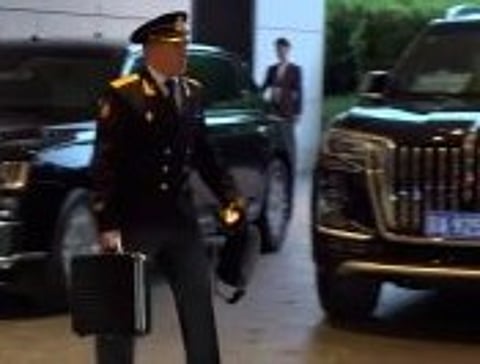
Dubai: A black briefcase carried by a Russian naval officer has attracted international attention after an unusually candid exchange with a television reporter during President Vladimir Putin’s visit to China.
The officer was accompanying Putin at the Asia-Pacific Economic Cooperation (APEC) summit in Shenzhen when a Russian state television journalist approached him and asked whether he was carrying the country’s nuclear briefcase.
“Yes,” the officer replied.
The briefcase, known as the Cheget, is part of Russia’s nuclear command system, which enables the president to communicate orders concerning the country’s vast nuclear arsenal.
The footage, broadcast by Russian state television and highlighted by CNN, emerged as Putin joined US President Donald Trump and Chinese President Xi Jinping for a trilateral summit where nuclear issues were on the agenda.
But what exactly is inside the briefcase, and could it really trigger a nuclear war?
What is Putin’s nuclear briefcase?
The Cheget is a portable communications terminal connecting the Russian president to the military’s nuclear command-and-control network.
Named after Mount Cheget in Russia’s Caucasus Mountains, it was developed during the Soviet era and is designed to allow the country’s leadership to communicate securely with nuclear forces during an emergency.
The briefcase accompanies the president wherever he travels, including on foreign visits.
Can Putin launch nuclear missiles by pressing a button?
Not directly.
Despite its popular description as a nuclear button, the Cheget is not a device that independently launches missiles.
It enables the president to transmit and authenticate nuclear commands through a secure military network. Those instructions must pass through Russia’s command structure before reaching the forces responsible for executing them.
The precise procedures remain classified.
Why does Russia have three nuclear briefcases?
Russia reportedly maintains three Cheget terminals: One for the president, another for the defence minister and a third for the chief of the General Staff.
The arrangement is intended to support communication and authentication within the nuclear command structure.
Some analysts describe it as a three-part authorisation system, although experts disagree about whether all three terminals must participate in approving a launch.
Who carries the briefcase?
The Cheget is traditionally carried by a specially assigned Russian naval officer who remains close to the president.
The officer’s responsibility is to keep the communications system available wherever the Russian leader travels.
A December 2025 investigation by Russia’s Dossier Center identified a secretive military unit responsible for carrying the briefcase and maintaining strategic communications.
Is this the first time Putin’s nuclear briefcase has appeared on camera?
No.
In October 2023, Reuters reported that Putin was filmed in Beijing accompanied by two naval officers carrying briefcases.
The footage showed the officers following him after a meeting with Xi Jinping.
What distinguishes the latest appearance is the direct exchange between the Russian journalist and the officer, who openly confirmed what he was carrying.
Does Trump also travel with a nuclear briefcase?
Yes.
The US president is accompanied by a military aide carrying an emergency satchel commonly known as the nuclear football.
It contains materials and communications capabilities needed to help the president direct a nuclear response away from the White House.
Like Russia’s Cheget, it is part of a wider command system rather than a self-contained missile launcher.
The American nuclear football had not been publicly spotted in Shenzhen when reports about the Russian briefcase emerged.
Why was Russia’s nuclear briefcase shown so openly?
The timing has drawn attention because the footage emerged during a high-profile gathering of three nuclear-armed powers.
Russian state television deliberately highlighted the briefcase, prompting questions about whether the display was intended to underline Moscow’s nuclear capabilities.
However, there is no publicly established evidence that the briefcase’s appearance signalled a change in Russia’s nuclear readiness or preparations for a strike.
Its presence alongside Putin is routine. The unusual element was the decision to draw public attention to it.
Does China's Xi Jinping also have a nuclear briefcase?
China possesses one of the world's largest nuclear arsenals, but unlike Russia and the United States, it has no publicly confirmed equivalent of the Cheget or the American nuclear football accompanying its leader.
President Xi Jinping chairs China's Central Military Commission, the country's highest military command body, which oversees its nuclear forces.
China's nuclear command-and-control arrangements remain highly secretive. There is no publicly verified evidence that Xi carries, or is accompanied by an aide carrying, a portable nuclear command briefcase similar to those used by the Russian and American presidents.
That does not mean such a device does not exist. It simply means its existence has not been publicly established.
A US National Defense University study supports this distinction: researchers found no evidence that an officer routinely accompanies Xi with a Chinese equivalent of the nuclear football


