Russia, Ukraine agree major prisoner swap at Abu Dhabi peace talks as US envoys head to meet Putin
US envoys head to Moscow to meet Putin as peace efforts gain momentum
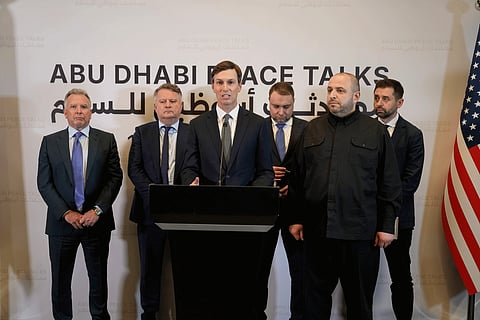
Two days of US-mediated peace talks in Abu Dhabi have produced a major humanitarian breakthrough, with Russia and Ukraine agreeing to a large prisoner exchange as American envoys prepare to meet President Vladimir Putin in Moscow on Thursday in a renewed push to end the nearly five-year war.
The agreement, described by US envoy Jared Kushner as potentially the biggest prisoner release of the conflict, emerged from the first direct negotiations between Russian and Ukrainian delegations in nine months.
Although the number of prisoners to be exchanged has yet to be finalised, the development marked a tangible outcome from the UAE-hosted discussions, which also opened the door to further high-level diplomacy.
“One of the positives is we agreed that we’re going to have the biggest humanitarian release of prisoners, which we’re going to finalize the numbers tomorrow,” Kushner said after the talks concluded on Wednesday.
The announcement came despite continuing differences between Moscow and Kyiv over territory, security guarantees and Europe’s role in any eventual peace settlement.
Putin meeting next
Kushner and fellow US envoy Steve Witkoff will travel to Moscow on Thursday to brief Putin on the Abu Dhabi negotiations and explore possible compromises.
The two envoys will subsequently travel to Dublin, where they are expected to meet Ukrainian President Volodymyr Zelensky during a week of European summits.
Kushner said the meeting with Putin would review the proposals discussed in Abu Dhabi and seek further progress.
“We see some openings,” he told reporters, adding that the discussions had identified areas where compromises might be possible.
Ukrainian negotiator David Arakhamia described the talks as having “good momentum”, although he acknowledged that sensitive issues remained unresolved.
Russia’s chief negotiator Vladimir Medinsky also indicated that negotiations would continue.
The talks, mediated by Kushner and Witkoff, brought Russian and Ukrainian representatives together in the UAE capital for the first time since February, when the US war with Iran interrupted diplomatic efforts.
UAE provides platform for diplomacy
Abu Dhabi served as the neutral venue for negotiations involving representatives of the United States, Russia and Ukraine.
The discussions focused on humanitarian issues, including prisoner exchanges, the return of Ukrainian civilians held in captivity and children taken from Ukraine.
The prisoner exchange agreement provided an immediate humanitarian outcome even as efforts to reach a broader ceasefire remained difficult.
Zelensky described Tuesday’s discussions as “constructive and quite substantive”, while US Secretary of State Marco Rubio called the negotiations “very productive”.
However, Rubio cautioned that achieving a breakthrough to end the war would take time.
Europe remains a sticking point
One of the major disagreements concerns the participation of European governments in future negotiations.
Ukraine wants its European allies involved in discussions about its security and the continent’s post-war arrangements.
Representatives from Britain, France, Germany and Italy, along with NATO and the European Union, travelled to Abu Dhabi for consultations on the sidelines.
Russia, however, questioned Europe’s role.
“We don’t really understand what there is to talk about with them,” Medinsky said, arguing that European governments had not presented concrete peace proposals.
Kushner said he would raise the possibility of including European representatives in the negotiating format during his meeting with Putin.
He also urged European governments to identify a single representative who could speak on their behalf.
Major differences over territory
Despite the diplomatic progress, Russia and Ukraine remain far apart on the central issues preventing an end to the war.
Moscow is demanding that Ukrainian forces withdraw from parts of eastern Ukraine they still control and wants a broader agreement addressing Europe’s security arrangements.
Kyiv insists that a ceasefire must come before negotiations over territory and has called for direct talks between Zelensky and Putin.
The Kremlin has rejected such a meeting on Ukraine’s preferred terms.
Washington is also exploring a wider security framework involving Russia, Ukraine and Europe, although the details remain uncertain.
The negotiations took place against the backdrop of continued fighting, with both sides launching missile and drone attacks even as their representatives met in Abu Dhabi.
Russia’s war on Ukraine in February 2022 has killed hundreds of thousands of people and displaced millions, making it Europe’s deadliest conflict since World War II.
While a comprehensive peace agreement remains elusive, the Abu Dhabi talks have delivered a concrete humanitarian commitment and established the basis for another round of high-level negotiations.
The next test will come in Moscow, where US envoys hope to turn the openings identified in the UAE capital into progress towards ending the war.
-- With AP and AFP inputs


