Filipino workers sent $14.1 billion home from Jan-May 2026 as remittances defy global slowdown, America still leads
Remittances rise 3.5% to $12.7 billion, reinforcing key lifeline for PH economy
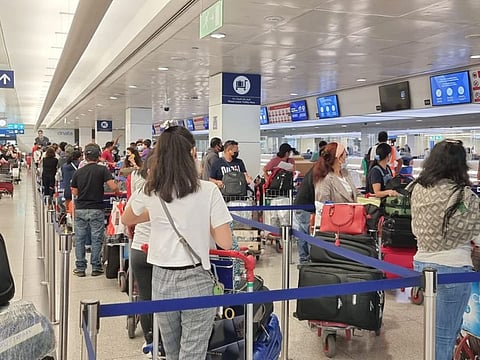
Filipino cash remittances from overseas hit approximately $14.1 billion to $14.2 billion for the five-month period based on data from the Bangko Sentral ng Pilipinas (BSP).
The remittance growth hovered at modest single-digit percentages (around 2.5% to 3.5%) month-over-month, reflecting the overall resilience of overseas Filipino workers (OFWs) despite challenging global economic conditions.
Even as economic growth slowed across parts of the world and geopolitical tensions weighed on labor markets, overseas Filipinos continued to send billions of dollars home.
This underscores the resilience of one of the Philippine economy's most dependable lifelines.
The BSP data is only based on remittances coursed through banks from January to May 2026, which saw a steady upward trajectory.
For the period from January to April, personal remittances reached $12.70 billion in the January-April 2026 period, up 2.7% from $12.37 billion a year earlier, according to BSP.
Cash remittances coursed through banks — the largest component of overseas transfers — rose 2.6% to $11.40 billion during the same period, during the January-April 2026 period.
In April alone, personal remittances climbed to $3.04 billion, while cash remittances increased to $2.72 billion, continuing a steady, if slower, pace of growth that economists say reflects both the resilience of Filipino workers abroad and the importance of overseas labor to the Philippine economy.
The BSP said the US remained the largest source of remittance inflows, followed by Singapore and Saudi Arabia, maintaining a geographic pattern that has remained largely unchanged for years despite shifts in global migration and employment.
Top sources of Philippine remittances in 2026 (January-April)
The BSP notes that the figures are based on the country from which remittances are transmitted through financial institutions and do not necessarily represent the country where Filipino workers are employed, as many international money-transfer companies route transactions through regional financial hubs.
The latest figures build on another record year.
In 2025, cash remittances reached an all-time high of $35.63 billion, while total personal remittances climbed above $39 billion, reinforcing overseas Filipino workers' role as one of the country's largest and most stable sources of foreign exchange.
For decades, remittances have acted as an economic stabiliser, helping finance household consumption, education, healthcare, housing and small businesses while supporting the country's balance of payments and cushioning the peso during periods of global uncertainty.
Geopolitical risks
The continued increase in remittances has come despite softer economic activity in several host countries and persistent geopolitical risks affecting parts of the Middle East, where hundreds of thousands of Filipinos are employed.
Analysts say the diversity of the Filipino diaspora — with workers spread across North America, Europe, Asia and the Gulf — has helped reduce dependence on any single overseas labour market.
The United States' continued dominance as the Philippines' largest remittance source reflects not only its large Filipino-American community but also its concentration of highly skilled Filipino professionals in healthcare, engineering, information technology and other sectors.
Singapore has emerged as a major regional financial hub for remittance transfers.
Saudi Arabia and the United Arab Emirates remain two of the largest employers of Filipino workers in construction, healthcare, hospitality and domestic services.
Remittances remain one of the Philippines' strongest external buffers alongside exports of business-process outsourcing services.
Together, they provide a steady inflow of US dollars that helps finance imports, support domestic consumption and bolster the country's international reserves — an increasingly valuable cushion as global trade and financial markets face renewed uncertainty.


