Built for the storm: Typhoon-proof wind turbines rise in Laguna — Philippines opens energy floodgates
A new generation of typhoon-resistant wind turbines signal leap in renewable technology
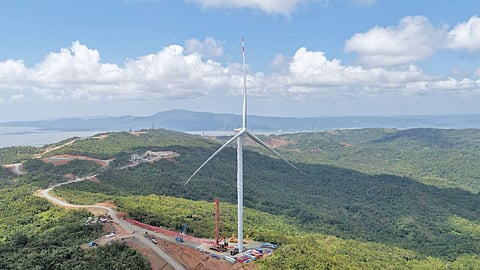
Manila: A new generation of typhoon-resistant wind turbines is taking root in the Philippines — marking not just a technological leap, but a structural shift in the country’s energy future.
Spanish firm Acciona Energía has installed the first turbine for its 101-MW Kalayaan 2 wind farm in Laguna, marking a milestone in designing infrastructure that can withstand the country’s most destructive force: tropical cyclones.
Electricity produced in this site will feed the Luzon power grid.
Engineering for extreme weather
Unlike conventional turbines, Kalayaan 2’s 17 units are purpose-built for storm-prone environments:
Reinforced tower structures to withstand extreme wind loads
Smart control systems that adjust blade pitch and rotation during high winds
Advanced sensors that trigger automatic shutdown and protection modes
In a country hit by an average of 20 typhoons annually, this isn’t optional —it’s survival engineering.
Wind power in a fossil-heavy grid
The Philippines remains heavily reliant on coal and imported fuels, with renewables contributing roughly 30% of the power mix.
Momentum is shifting.
The government is targeting 35% renewable share by 2030.
Multiple wind corridors — from Ilocos to Mindoro — are currently being developed.
Projects like Kalayaan 2 and the 108-MW Daanbantayan solar plant are part of the Green Energy Auction Program (GEAP).
Once operational by end-2026, Kalayaan 2 alone is expected to:
Power thousands of homes
Avoid ~250,000 tons of CO₂ annually
Strengthen energy security in a volatile fuel market
Investment surge: 100% foreign ownership opens the gates
The real game-changer is policy.
These reforms are designed to unlock billions in investment while integrating local firms — especially MSMEs — into global energy value chains.
Acciona alone is investing ₱15 billion across its wind and solar pipeline, with 1.5 GW of projects planned in the region.
The company’s broader footprint — from water systems to transport — signals how energy is converging with infrastructure development.
Meanwhile, Danish firm Copenhagen Infrastructure Partners (CIP) is investing $3 billion (around ₱181 billion) to develop the 1-gigawatt (GW) San Miguel Bay offshore wind farm in Camarines Sur, about 12 hours by car southeast of the capital Manila.
This project, developed in partnership with ACEN, is poised to be the country's largest offshore wind project, with completion expected by 2028.
Storm-ready power plants
The Philippines is no longer just building wind farms — it’s building storm-hardened energy systems for a climate-challenged future.
An average of 20 tropical cyclones (typhoons and storms) hit the Philippines per year, with about 8 to 9 passing through or making landfall, making it one of the most storm-prone countries in the world.
Peak typhoon season is July to October, though they can occur year-round.
With typhoon-proof turbines, liberalised ownership rules, and rising demand for clean power, the country is positioning itself as one of Southeast Asia’s most compelling renewable energy frontiers — where extreme weather meets next-generation engineering, and policy meets capital at scale.
FACT FILE: Renewable Energy Reforms
Law: Public Service Act (amended)
Key Change: Allows 100% foreign ownership in renewable energy
Impact: Removes long-standing 40% cap on foreign equity
Target: Accelerate capital inflow, technology transfer, and grid expansion
Policy shift: Green Energy Auction Program (20-year supply contracts)

