Pakistan: 2025 a turning point in country’s war on terror
DG ISPR cites surge in operations, rising terrorist losses and regional dynamics
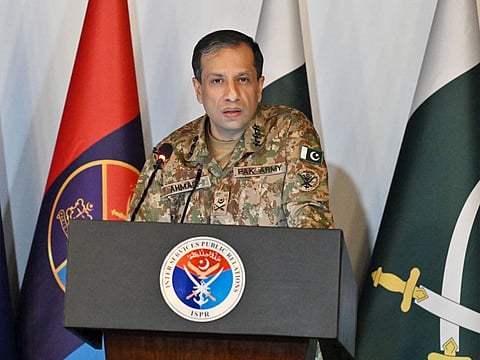
Dubai: Pakistan’s military on Tuesday described 2025 as a “landmark and consequential year” in the country’s long-running fight against terrorism, pointing to unprecedented counter-terrorism operations, greater national clarity on the threat, and a shift in the operational balance against militant networks operating from across the border.
Addressing a press conference in Islamabad, Inter-Services Public Relations (ISPR) Director General Lieutenant General Ahmed Sharif Chaudhry said the sole purpose of the briefing was to present a comprehensive overview of counter-terrorism measures undertaken over the past year, stressing that terrorism remains “the single biggest threat” to Pakistan’s security.
“This press conference is only about counterterrorism,” he said, urging focus on what he described as a decisive phase in the state’s fight against militant violence.
Operational intensity
The DG ISPR said law enforcement agencies, including the Pakistan Army, police, Federal Constabulary and intelligence services, conducted 75,175 intelligence-based operations (IBOs) across the country in 2025, averaging 206 operations per day.
Of these, 14,658 operations were carried out in Khyber Pakhtunkhwa, 58,778 in Balochistan, and 1,739 in other parts of the country.
Despite the high operational tempo, Pakistan recorded 5,397 terror incidents last year. According to official data shared at the briefing, 71% of the incidents occurred in Khyber Pakhtunkhwa, while 29% were reported from Balochistan.
KP worst hit
A total of 2,597 terrorists were killed during counterterror operations in 2025, compared to 1,235 civilians and law enforcement personnel who were martyred, reflecting what the military described as a significant improvement in operational outcomes.
Lt. Gen. Chaudhry said Khyber Pakhtunkhwa remained the worst-affected province due to what he described as a politically conducive environment and a political-criminal-terror nexus that has enabled militant groups to regroup and operate.
He noted that the ratio of terrorists killed to security personnel martyred had improved significantly since 2021, when terrorism resurged following developments in the region.
“In 2021, for every terrorist killed, three of our personnel were martyred. In 2025, that ratio has reversed,” he said.
Operational base
Linking the resurgence of terrorism to regional developments, the DG ISPR said Afghanistan had become a base of operations for multiple terrorist organisations following the 2021 transition.
He said commitments to prevent the use of Afghan soil for terrorism were not fulfilled, allowing banned groups including the Tehreek-i-Taliban Pakistan (TTP) to establish training, planning and facilitation networks.
The military spokesperson also said advanced weapons and equipment left behind after the international withdrawal from Afghanistan had entered illicit markets and were being used by terrorist groups.
Border actions
The DG ISPR said Pakistan carried out targeted actions near the Pak-Afghan border in October 2025 against terrorist elements involved in attacks inside Pakistan.
He stressed that these actions targeted militants only and were followed by border management measures, which he said led to a noticeable decline in terrorist movement and facilitation.
“In the three months following these measures, the number of terrorists killed increased significantly, indicating operational pressure on militant networks,” he said.
National consensus
Lt Gen Chaudhry said Operation Azm-i-Istehkam, launched in 2024, draws its mandate from the reinvigorated National Action Plan (NAP), which he said now enjoys broad political and societal consensus.
While acknowledging gaps in implementation, he said the past year marked a point where the state and society achieved greater clarity on the nature of terrorism and the necessity of confronting it decisively.
“This is not the army’s war alone. This is the war of the people of Pakistan,” he added.
Tribute to martyrs
DG ISPR also paid tribute to civilians and security personnel who lost their lives in terror attacks, calling their sacrifice a shared national responsibility in Pakistan’s ongoing fight against terrorism.
Also In This Package


