Japan quake: Rescuers dig through rubble after powerful tremor collapses shopping mall
Desperate search on for survivors trapped beneath collapsed mall
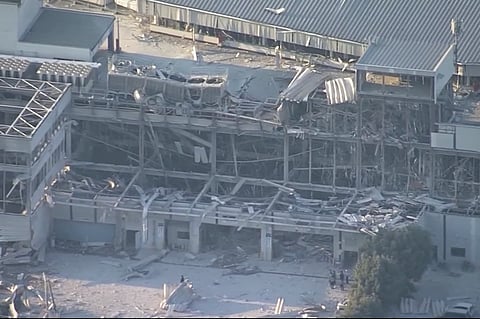
Rescue crews worked through Tuesday night and into Wednesday in a desperate search for survivors trapped beneath a collapsed shopping mall after a powerful 6.8-magnitude earthquake struck Japan. The quake killed at least 13 people, injured dozens more and damaged thousands of buildings across several prefectures.
More than 2,000 firefighters, police officers and Self-Defense Forces personnel have been deployed to the disaster zone, using heavy machinery, sniffer dogs and drones to search for people believed to be trapped beneath concrete and twisted steel.
Get updated faster and for FREE: Download the Gulf News app now - simply click here
Over 9,000 people remained in evacuation centres early Wednesday, according to the government.
"We have received reports of seven people with serious injuries and 29 with minor injuries. Furthermore, as of 7:00 am today (2200 GMT Tuesday), 9,186 people have sought refuge in 506 evacuation centres across five prefectures, including Kumamoto and Fukuoka," government spokesman Minoru Kihara said.
Several are reported dead after a 6.8-magnitude earthquake hit Japan’s southern Kumamoto prefecture.
Many people are reportedly trapped after a shopping mall partially collapsed, as per Japan's fire service, a witness reported the second floor collapsing
Multiple people are also unaccounted at the collapsed mall and at a paper factory after a chimney collapsed.
A highway bridge has buckled.
Two people have died following the shopping mall collapse, according to the country’s public broadcaster NHK.
NHK previously said 20 to 30 employees couldn’t be contacted after the collapse.
The earthquake - estimated at 6.8 magnitude by the US Geological Survey - hit inland on Kyushu island at 16:27 local time (07:27 GMT) on Tuesday
Officials said the multi-storey shopping complex suffered a catastrophic structural failure during the quake, trapping shoppers and employees inside.
Authorities have rescued several people alive from the debris, but warned that many others remain unaccounted for as aftershocks continue to hamper rescue efforts.
Emergency response
Prime Minister Shigeru Ishiba pledged that "saving lives remains our highest priority," ordering the full mobilisation of emergency resources and dispatching additional military units to the affected region.
Hospitals across northeastern Japan have activated emergency response plans as ambulances continue transporting the injured.
Temporary shelters have opened in schools and community centres for residents whose homes were destroyed or deemed unsafe.
Authorities also reported widespread disruption to transport and utilities. Sections of the high-speed Shinkansen rail network were suspended for safety inspections, while thousands of households temporarily lost electricity and water service.
The Japan Meteorological Agency warned that powerful aftershocks could continue for days, increasing the risk of landslides and further building collapses. Residents have been urged to avoid damaged structures and remain prepared for additional seismic activity.
Japan sits atop the seismically active Pacific Ring of Fire, where several tectonic plates meet, making it one of the world's most earthquake-prone countries.
The country's strict building standards have significantly reduced casualties in many earthquakes, but older structures remain vulnerable to severe shaking.
Impact by the numbers
Authorities are continuing to update casualty and damage figures as search operations expand.
Search-and-rescue teams deployed: More than 2,000
Shopping mall: Collapsed during the earthquake
Thousands of buildings reported damaged
High-speed rail services suspended in affected areas
Thousands of households experienced power outages
Multiple evacuation centres opened
Tracking the earthquake's impact
The earthquake's effects stretched across northeastern Japan, with the strongest shaking concentrated near the epicentre.
Affected areas include:
Severe structural damage near the epicentre
Transport disruptions across regional rail lines
Localised power and water outages
Building collapses and landslides in mountainous areas
Coastal communities monitored for possible tsunami-related hazards, though authorities later lifted major warnings
Emergency officials said the first 72 hours after a major building collapse are considered the most critical for finding survivors, prompting round-the-clock rescue operations despite dangerous aftershocks.
Authorities cautioned that casualty figures are likely to change as rescue teams gain access to heavily-damaged structures and continue searching through the rubble.


