Vijay stakes claim: Can TVK cross the line in Tamil Nadu?
Single largest party seeks time as numbers game begins
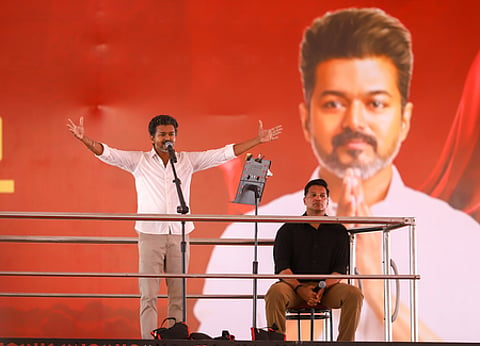
Chennai: Actor-politician C. Joseph Vijay has formally staked his claim to become Chief Minister of Tamil Nadu, setting the stage for intense post-poll negotiations after a fractured electoral verdict left the state without a clear majority.
Vijay’s Tamilaga Vettri Kazhagam (TVK), which emerged as the single largest party with 108 seats in the 234-member Assembly, has approached Governor Rajendra Vishwanath Arlekar seeking an opportunity to form the government. The party has also requested a two-week window to prove its majority on the floor of the House.
With the halfway mark set at 118, the TVK remains 10 seats short, turning the focus sharply on potential alliances and support from smaller parties and independents.
Numbers game begins
The post-election scenario has triggered a fresh round of political calculations, with Vijay initiating consultations with newly elected MLAs and senior leaders at the party’s Panaiyur office in Chennai.
However, early signals suggest that the path to power may not be straightforward. Key allies of the DMK-led alliance have indicated reluctance to back Vijay, complicating the TVK’s efforts to bridge the numbers gap.
Leaders from parties such as the Marumalarchi Dravida Munnetra Kazhagam (MDMK) and Viduthalai Chiruthaigal Katchi (VCK) have underlined their ideological alignment with the DMK, ruling out any immediate shift in loyalties.
Even the Desiya Murpokku Dravida Kazhagam (DMDK), while acknowledging Vijay’s personal ties with its leadership, has stopped short of offering support, emphasising its independent political stance.
DMK exits, Stalin steps down
Meanwhile, the outgoing Chief Minister M.K. Stalin has resigned following a significant electoral setback for the DMK-led Secular Progressive Alliance (SPA), which managed just 73 seats.
Governor Arlekar has accepted the resignation but asked Stalin to continue as caretaker chief minister until a new government is formed, in line with constitutional convention.
In a major personal blow, Stalin also lost his long-held Kolathur constituency, a development seen as symbolic of the broader shift in voter sentiment across the state.
The DMK is now expected to move into the opposition, with internal discussions already underway to assess the defeat and chart the party’s future course.
Congress keeps options open
The Congress, which contested as part of alliances in the state, has signalled that it is keeping its options open amid the evolving situation.
Tamil Nadu in-charge Girish Chodankar said the election results reflected a clear desire for change among voters, particularly youth and women, who played a key role in the TVK’s performance.
While stopping short of committing support, he indicated that any decision on backing a government would be taken collectively by the party’s central leadership.
He also suggested that the TVK should not be underestimated, signalling that negotiations could still reshape the political landscape in the coming days.
A mandate without a majority
The election, held in a single phase on April 23, saw a four-cornered contest involving the DMK, AIADMK, Naam Tamilar Katchi and the TVK.
While Vijay’s party delivered a strong debut performance, the absence of a clear majority has led to a classic hung Assembly scenario, where government formation hinges on post-poll alliances.
The result reflects a broader churn in Tamil Nadu politics, with voters signalling a desire for change while stopping short of handing any one party complete control.
What next?
All eyes are now on the Governor’s next move — whether to invite Vijay to form the government or seek clarity on support before taking a call.
For Vijay, the coming days will be crucial. Securing outside support will determine whether his electoral breakthrough translates into political power or remains an incomplete mandate.
At the same time, rival parties are expected to watch developments closely, weighing their own strategic options in a fluid and uncertain political environment.
- with inputs from IANS


