India nears biggest military overhaul since independence
Theatre command plan to unify Army, Navy and Air Force under single operational leadership
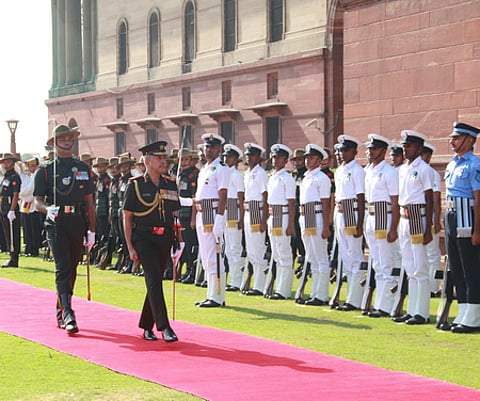
New Delhi: India is moving closer to one of its most ambitious military reforms since Independence, with Chief of Defence Staff (CDS) General N.S. Raja Subramani expected to present the long-awaited theatre commands proposal to Defence Minister Rajnath Singh later this month, according to Indian media reports.
If approved by the defence minister, the proposal will be sent to the Cabinet Committee on Security (CCS), headed by Prime Minister Narendra Modi, for final clearance. The plan, under discussion for nearly two decades, would fundamentally transform how India’s Army, Navy and Air Force prepare for and conduct military operations.
At present, India’s armed forces function through 17 separate operational commands — seven each under the Army and Air Force and three under the Navy — with each service maintaining its own command structure, planning process and operational responsibilities.
Service-specific model
The proposed reform would replace this largely service-specific model with integrated theatre commands, placing Army, Navy and Air Force assets in a particular geographical area under a single operational commander.
According to News18, the current blueprint envisages three integrated theatre commands — a Northern Theatre Command focusing on the China border, a Western Theatre Command responsible for the Pakistan front, and a Maritime Theatre Command overseeing the Indian Ocean region. Alongside these, specialised organisations, including an Air Defence Command and integrated logistics structures, are also expected to improve coordination across the services.
What changes under theatre commands?
Three integrated theatre commands proposed for the China border, Pakistan front and the Indian Ocean.
Single commander to lead Army, Navy and Air Force assets in each theatre.
Service chiefs to focus on raising, training and equipping forces rather than conducting operations.
Joint operations across land, sea, air, cyber and space to improve combat effectiveness.
Proposal to go before the Cabinet Committee on Security after Defence Minister Rajnath Singh’s approval.
Would mark India’s biggest military restructuring since Independence.
NDTV reported that each theatre command would be headed by a four-star officer, placing them on par with the existing service chiefs and creating a new layer of top military leadership.
Under the proposed structure, theatre commanders would be responsible for military operations, while the Army, Navy and Air Force chiefs would focus on raising, training and equipping their respective forces.
Why now?
The reform aims to improve what the military calls “jointness” by allowing the three services to plan and operate together instead of coordinating separately once a crisis erupts. Defence planners believe integrated commands will speed up decision-making, improve intelligence sharing, reduce duplication of resources and enhance India’s ability to fight simultaneous conflicts across multiple fronts.
The urgency for the overhaul has grown following recent conflicts around the world that have highlighted the importance of integrating land, air, sea, cyber and space capabilities into a single operational framework.
According to NDTV, Indian defence planners have also cited last year’s four-day military confrontation with Pakistan, during which the three service chiefs had to coordinate from an improvised joint operations room — an experience that underscored the limitations of the existing command structure.
Despite broad agreement on the need for reform, implementation has proved challenging. News18 reported that one of the biggest sticking points has been the Indian Air Force’s concern that its limited fleet of fighter aircraft should remain centrally controlled rather than permanently divided among multiple theatre commands. Extensive consultations have also been required on issues such as control of strategic assets, logistics, communications and command responsibilities.
According to Hindustan Times, much of the groundwork has already been completed. The proposal has received in-principle backing from the political leadership, while the National Security Adviser, the three service chiefs and the CDS have endorsed the overall framework. General Subramani, who assumed office as India’s third CDS in May, is expected to build on the blueprint prepared by his predecessor, General Anil Chauhan, before presenting the final roadmap to the defence minister. Once approved, the proposal will move to the CCS for the government’s final decision.
If cleared, India would join countries such as the United States and China in operating through integrated theatre commands, marking one of the most significant organisational changes in the history of its armed forces and a decisive shift towards a unified military structure designed for the demands of modern warfare.


