Highly sensitive: Top court refuses to restore Friday namaz at Bhojshala, orders nearby prayer space
Muslims denied prayers in complex; ASI barred from structural changes without approval
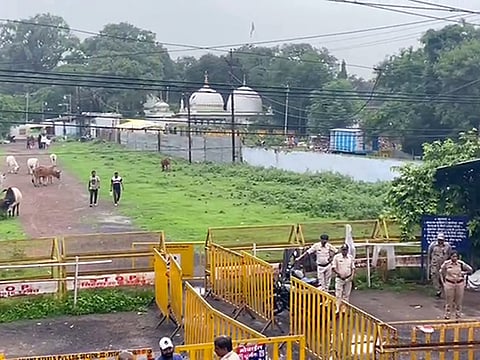
New Delhi: The Supreme Court on Tuesday refused to stay the Madhya Pradesh High Court’s verdict declaring the disputed Bhojshala-Kamal Maula Mosque complex in Dhar a Hindu temple, but directed the state government to provide an open space near the monument where Muslims can offer Friday namaz as an interim arrangement.
Calling for restraint from both communities, the apex court said the dispute was highly sensitive and assured the parties that it would hear the matter on a day-to-day basis to resolve it at the earliest, Indian media reports said.
A Bench headed by Chief Justice of India Surya Kant, along with Justices Joymalya Bagchi and V. Mohana, directed that the arrangement allowing namaz between 1 pm and 3 pm every Friday at a nearby open space would be without prejudice to the rights of either side and subject to the final outcome of the case.
However, the court declined the Muslim parties’ request for interim permission to offer prayers inside the Bhojshala complex, allowing the High Court’s order prohibiting namaz within the protected monument to remain in force.
The Supreme Court also directed the Archaeological Survey of India (ASI) not to undertake any structural alterations at the site without obtaining its prior permission.
What is the Bhojshala dispute?
Location: Bhojshala-Kamal Maula Mosque complex in Dhar, Madhya Pradesh.
Hindu claim: The site is an 11th-century temple dedicated to Goddess Saraswati, built by King Raja Bhoj, and a historic centre of Sanskrit learning.
Muslim claim: The complex has functioned as the Kamal Maula Mosque for centuries and Friday namaz has long been offered there.
2003 ASI arrangement: Hindus worshipped on Tuesdays while Muslims offered Friday prayers.
2024 ASI survey: A 98-day scientific survey concluded that a large temple-like structure predated the mosque and that parts of the present building were constructed using reused temple remains.
High Court ruling (May 2026): Declared Bhojshala a Hindu temple, cancelled the 2003 prayer-sharing arrangement and suggested alternative land for a mosque.
Supreme Court (Tuesday): Refused to stay the High Court verdict, allowed Friday namaz at a nearby open space as an interim measure, and barred structural changes at the monument without its approval.
Court’s approval needed
After senior advocate Huzefa Ahmadi, appearing for the Muslim side, raised concerns about possible changes to the monument, the Bench ordered that any structural modifications proposed by the ASI would require the court’s approval.
The court issued notices to the Centre, the Madhya Pradesh government, the ASI, the district administration and the Hindu respondents on the appeals filed by the Muslim parties. The matter is expected to come up again in two to three weeks.
The Muslim side has challenged the May 15 judgment of the Indore Bench of the Madhya Pradesh High Court, which declared Bhojshala to be a Hindu temple and held that the Hindu community’s right to worship at the site had “never been extinguished.”
The High Court struck down the ASI’s 2003 administrative arrangement that had allowed Muslims to offer Friday namaz inside the complex while Hindus worshipped there on Tuesdays. It held that the arrangement was inconsistent with the monument’s religious character and suggested that the state government consider allotting alternative land for the construction of a mosque.
The High Court relied heavily on the ASI’s scientific survey conducted in 2024. Following a 98-day exercise, the ASI submitted a report exceeding 2,000 pages, concluding that a large structure dating back to the Parmar dynasty existed at the site before the mosque and that the present structure incorporated reused temple remains.
The report cited Sanskrit inscriptions, sculptures, a havan kund and other architectural features associated with a temple and a centre of Sanskrit learning. The Hindu side says these findings, along with coins and inscriptions recovered during the survey, prove the complex was originally a temple dedicated to deity Saraswati, built by the 11th-century ruler Raja Bhoj.
The Muslim parties have rejected the ASI report as biased and argued that it was prepared to support the claims of the Hindu petitioners. They maintain that the site has functioned as the Kamal Maula Mosque for centuries and that Friday prayers had been held there under the long-standing 2003 arrangement.
The High Court had also directed the Union government to make efforts to bring back the ancient idol of deity Saraswati, believed to be housed in the British Museum in London.
The Bhojshala-Kamal Maula complex remains one of central India’s most sensitive religious disputes, with both communities claiming historic rights over the monument.
-- With IANS inputs


