High turnout marks India’s key state elections
Turnout trends in Kerala, Assam and Puducherry point to strong participation
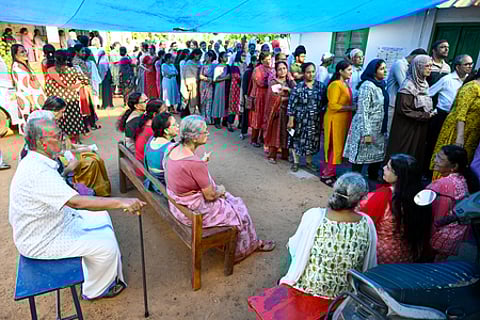
Voters across India’s Assam and Kerala states, along with the Union Territory of Puducherry, turned out in large numbers on Thursday in closely watched Assembly elections seen as a key test of political momentum for both the ruling Bharatiya Janata Party (BJP) and opposition alliances.
With polling underway for 296 seats across the three regions, early turnout trends pointed to strong participation, underlining the high stakes and intense political interest surrounding the elections.
Strong turnout reflects high stakes
Polling began at 7am and continued through the day across thousands of booths, with voters lining up early in several constituencies.
Also Read: Kerala votes in crucial 2026 Assembly polls
The Union Territory of Puducherry recorded the highest turnout at 89.08 per cent, followed by Assam at 85.04 per cent, and Kerala at 77.38 per cent, according to updates available around 7 p.m., though the final figures are yet to be updated by the Election Commission.
Key leaders, including Assam CM Himanta Biswa Sarma and Kerala CM Pinarayi Vijayan, were among the early voters. Puducherry Chief Minister N. Rangaswamy also cast his vote, maintaining his long-standing tradition of riding his motorcycle to the polling booth.
Voting is being held for 126 seats in Assam, 140 in Keralam, and 30 in Puducherry. Votes will be counted on May 4.
In Kerala alone, around 27.1 million voters were eligible to vote across more than 30,000 polling stations, with election officials launching operations before dawn and conducting mock polls to ensure transparency.
The scale and organisation of the exercise also drew international attention, with a 43-member delegation from 23 countries visiting polling stations under the Election Commission’s International Election Visitors’ Programme to observe India’s electoral process.
A test for BJP and opposition
The elections are being closely watched as a measure of Prime Minister Narendra Modi’s political reach, particularly in regions where the BJP has historically struggled to gain a foothold.
Assam and Puducherry are currently governed by BJP-led alliances, while Kerala remains an opposition stronghold. The outcome could indicate whether the BJP can expand into new territories after relying on coalition partners to form the federal government following the 2024 national elections.
For opposition parties, the polls present an opportunity to consolidate gains and build momentum against the BJP’s dominance at the national level.
The results, along with those from West Bengal and Tamil Nadu later this month, are scheduled to be announced on May 4.
Kerala: Fine margins, complex contest
Kerala presents one of the most nuanced electoral battles, where the contest is shaped less by sweeping narratives and more by local dynamics.
The ruling Left Democratic Front (LDF), led by Chief Minister Pinarayi Vijayan, is aiming for a third consecutive term, an unprecedented feat in a state known for alternating governments.
However, after a decade in power, signs of micro-level anti-incumbency have emerged, with dissatisfaction tied to local issues rather than a broad statewide shift.
The opposition United Democratic Front (UDF) is seeking to capitalise on these undercurrents, while the BJP is attempting to expand its limited presence through incremental gains.
Minority voters — Muslims and Christians, who together make up about 42 per cent of the electorate — are expected to play a decisive role.
Assam: Welfare meets identity politics
In Assam, the contest is more direct, with the BJP seeking a third consecutive term under Chief Minister Himanta Biswa Sarma.
The campaign has combined welfare delivery with identity-driven messaging, particularly around immigration — a long-standing and contentious issue in the state bordering Bangladesh.
A key plank of the BJP’s campaign has been the Orunodoi scheme, which provides financial support to around 4 million women, strengthening its grassroots outreach.
The Congress is aiming to regain power after losing the state in 2016, setting up a high-stakes contest with clear leadership implications.
Puducherry: Small assembly, tight contest
In Puducherry, the contest is more compact but remains politically significant.
The BJP-backed National Democratic Alliance, led by Chief Minister N. Rangasamy of the All India N.R. Congress, is seeking to retain control of the 30-member Assembly.
Here, elections are often shaped by candidate-level dynamics and local factors, meaning even small shifts in voter preference can significantly influence outcomes.
As polling concludes, attention will now shift to turnout patterns, regional swings and alliance performance ahead of the May 4 results, which are expected to offer key signals for India’s evolving political landscape.


