A record 4,399 days: Modi enters India’s political history books
Prime Minister overtakes Nehru to become country’s longest-serving elected leader
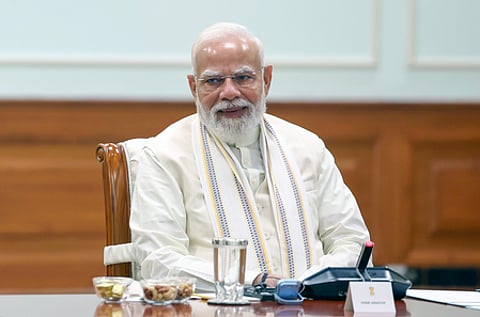
Prime Minister Narendra Modi on Wednesday became India’s longest-serving democratically elected Prime Minister, surpassing a record held by Jawaharlal Nehru for more than six decades and marking another milestone in a political career that has reshaped the country’s electoral landscape.
With 4,399 consecutive days in office, Modi moved past Nehru’s post-election tenure of 4,398 days, becoming the longest continuously serving elected Prime Minister in India’s history. The milestone comes as the National Democratic Alliance (NDA) government completes 12 years in power and enters the third year of its current term.
The achievement was marked by celebrations within the Bharatiya Janata Party (BJP), congratulatory messages from political leaders and world figures, and a special NDA meeting in New Delhi attended by chief ministers, deputy chief ministers and senior leaders from alliance-ruled states.
A record that stood for decades
Nehru, India’s first Prime Minister, led the country from Independence in 1947 until his death in 1964. For the purpose of the elected-tenure comparison, however, only the period following India’s first general election in 1952 is counted.
While former Prime Minister Indira Gandhi spent more than 14 years in office overall, her tenure was interrupted by a period out of power, leaving Nehru’s uninterrupted post-election record intact until now.
Modi first took office on May 26, 2014, after leading the BJP to a landmark victory. He secured a second term in 2019 with an even larger mandate and returned for a third consecutive term in 2024, becoming only the second Indian leader after Nehru to win three successive Lok Sabha elections.
Modi’s journey by the numbers
May 26, 2014: Narendra Modi sworn in as Prime Minister for the first time
May 30, 2019: Returns with a stronger mandate for a second term
June 9, 2024: Begins third consecutive term
June 10, 2026: Completes 4,399 consecutive days in office
Becomes only the second Indian leader after Nehru to win three successive Lok Sabha elections
Has served more than 9,000 days as an elected head of government when his Gujarat chief ministership is included
Surpasses Jawaharlal Nehru’s elected tenure record of 4,398 days
Leads the NDA government into its 13th year in office
Twelve years of political dominance
Since 2014, Modi has remained the central figure in national politics, leading the BJP through multiple electoral contests while expanding the party’s footprint across large parts of the country.
His tenure has coincided with major policy initiatives and reforms, including the rollout of the Goods and Services Tax (GST), expansion of digital payments infrastructure, large-scale welfare programmes, infrastructure projects and campaigns focused on financial inclusion, sanitation and housing.
The government has also highlighted flagship initiatives such as Swachh Bharat, Ujjwala Yojana, PM SVANidhi, the UDAN regional aviation scheme and a series of digital governance reforms aimed at improving service delivery.
Major infrastructure projects undertaken during the period include the new Parliament building, Central Vista redevelopment, Vande Bharat train network, INS Vikrant, the Statue of Unity, the Kashmir rail link, Noida International Airport, Namo Bharat regional rapid transit system and the Ganga Expressway.
Global profile rises
Modi’s tenure has also coincided with a period of increased Indian visibility on the global stage.
Under his leadership, India hosted the G20 Summit, expanded strategic partnerships across regions, strengthened engagement with the Global South and emerged as one of the world’s fastest-growing major economies.
Several international leaders congratulated Modi on the milestone, with messages highlighting India’s growing global role and the Prime Minister’s longevity in office.
Among those extending greetings were leaders from Sri Lanka, Papua New Guinea and Trinidad and Tobago, while US Ambassador to India Sergio Gor described the achievement as a testament to decades of public service.
President Droupadi Murmu congratulated Modi on the landmark, saying his tenure had been marked by advances in governance, economic resilience and social transformation.
Former President Ram Nath Kovind described the past 12 years as a “watershed period” in post-Independence India, arguing that the government had fostered greater confidence in India’s cultural and civilisational identity.
Union ministers hailed the milestone as evidence of sustained public trust, pointing to welfare programmes, economic reforms and infrastructure expansion as defining features of the government’s record.
- with inputs from IANS and ANI


