Trump approval hits new low as Americans fear long Iran war
Energy shock and Iran stalemate threaten Trump’s political fortunes heading into 2026
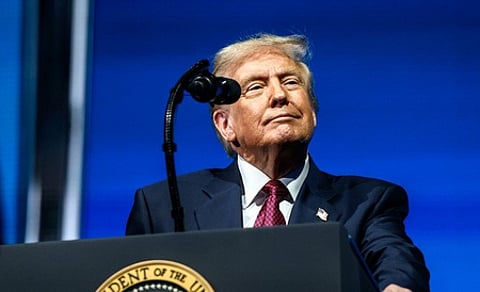
President Donald Trump's approval rating has fallen to 33%, its lowest point of his presidency, as growing numbers of Americans fear his war with Iran could become a prolonged conflict and rising energy costs deepen pressure on the White House.
The Reuters/Ipsos poll, completed Monday (August 17), found that 64% of Americans disapprove of Trump's performance.
His approval rating fell from 35% in an earlier August survey, matching the lowest level recorded during his first term, in December 2017.
The poll comes as Trump's administration faces mounting questions over a war that the president initially suggested could be resolved within weeks.
Get it: Fast, verified news for FREE ... download the Gulf News app — simply click here
80% expect a long Iran war
The strongest warning sign for the White House may be the public's expectations about the conflict.
Eight in 10 Americans — 80% — said they believe US involvement in Iran will continue for an extended period, including 87% of Democrats and 71% of Republicans.
Only 16% expected the conflict to end within a few weeks.
The concern cuts across party lines, suggesting that anxiety over the war is no longer confined to Trump's political opponents.
Only 20% of those polled said the war has been worth it, according to the survey. Even among Republicans, support reached only about half.
Gas prices become a political problem
The war has also collided with one of Trump's central political promises: keeping living costs under control.
The conflict has disrupted oil flows through the Strait of Hormuz, a critical energy corridor through which roughly a fifth of global oil trade normally passes.
The disruption has pushed up energy costs and gasoline prices, adding pressure to American households.
Trump has defended the higher gasoline prices as a necessary cost of preventing Iran from obtaining a nuclear weapon.
At a political rally Friday, he told supporters that paying a little more for gasoline was worthwhile if it prevented Iran from acquiring nuclear weapons.
But the Reuters/Ipsos findings suggest that argument has not persuaded most Americans.
Trump faces a midterm test
The deteriorating numbers come less than three months before the November congressional elections, when Republicans will attempt to retain control of Congress.
The political danger extends beyond the war itself.
An earlier Reuters/Ipsos poll released Aug. 3 found that Americans had, for the first time in nearly a decade, rated Democrats ahead of Republicans on handling the economy. T
rump's approval in that survey stood at 35%.
Another recent Financial Times/Focaldata survey found that more than half of registered voters said they were financially worse off under Trump, with particularly strong dissatisfaction over inflation and the cost of living.
Together, the polling suggests that the White House is confronting a combination of war fatigue, higher energy costs and economic anxiety.
The Iran deal deadline has also expired
The latest poll comes just as a 60-day deadline associated with the U.S.-Iran peace agreement expired without a comprehensive settlement.
The agreement was supposed to help end the conflict and address Iran's nuclear program, but key provisions — including reopening the Strait of Hormuz and lifting the US blockade — were not implemented. Washington and Tehran have blamed each other for the breakdown.
Mediators are still pushing for negotiations, but the political environment has become more difficult.
For Trump, that creates a particularly awkward contradiction: the longer the war lasts, the more it threatens the political promises on which he campaigned.
He returned to office promising to contain inflation and avoid drawn-out foreign wars.
Instead, the Iran conflict has become increasingly entangled with the price of gasoline, global oil supplies and his standing with voters.
Republicans are feeling the pressure
The erosion of support is beginning to raise concerns among Republicans about the midterms.
The Reuters/Ipsos polling shows Trump's advantage on immigration — traditionally one of his strongest issues — has narrowed dramatically. Meanwhile, Democrats have gained ground on the economy and cost of living.
That does not necessarily mean Republican voters are abandoning Trump. His approval among Republicans remains far stronger than among Democrats.
But the latest numbers suggest that even Republican voters are increasingly worried about how long the Iran war will last.
With the conflict continuing and the Strait of Hormuz still constraining global energy flows, the political question for Trump is becoming increasingly difficult to avoid: Can he end the war before the war's economic and political costs become the dominant issue of the 2026 elections?


