Maduro gone, the regime remains: What comes next for Venezuela
From US intervention to internal power struggles, nation enters dangerous uncertainty
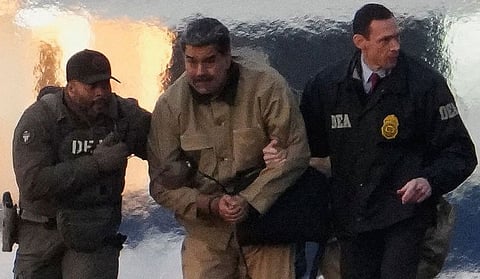
Dubai: The United States has captured Venezuelan President Nicolás Maduro and his wife Cilia Flores in a night-time raid in Caracas, flown them out of the country and transferred Maduro to New York to face criminal charges. In court, Maduro pleaded not guilty, saying: “I am a decent man, the president of my country.”
Venezuela’s envoy to the UN, Samuel Moncada, condemned the operation as an “illegitimate armed attack” and a “flagrant violation of the UN Charter”.
The dramatic move has removed Venezuela’s most powerful political figure — but not the system he led.
Who is running Venezuela now?
Maduro’s long-time deputy Delcy Rodríguez has been sworn in as interim president. Venezuela’s top court declared Maduro’s absence “temporary”, a legal interpretation that allows Rodríguez to govern for up to six months without calling elections.
CSIS analyst Christopher Hernandez-Roy said the structure of power remains largely intact. “This is the same regime; it’s just not headed by Nicolás Maduro,” he said during a CSIS event on Monday.
Is the regime stable — or on the brink?
For now, analysts say the government is holding.
Latrobe University’s Raul Sanchez-Urribarri told ABC that the state continues to function “as normal as it can in those circumstances”, noting Rodríguez’s strong ties to business elites who see her as an “efficient operator”.
But CSIS experts warned that removing a leader often triggers internal competition. Emily Harding, vice-president of CSIS’s Defence and Security Department, said that after shocks like this, regimes often experience “sharp elbows within the system” as figures jockey for position.
Possible scenarios for Venezuela
Regime continuity, managed compliance: Rodríguez remains in power, security chiefs hold the line, and Caracas selectively complies with US demands while delaying elections.
Internal power struggle: Factions within Chavismo compete for influence, raising the risk of instability or policy paralysis.
Delayed transition to elections: Economic pressure and legitimacy concerns eventually force talks on elections, but only after months of manoeuvring.
Escalation with Washington: CSIS defence expert Mark Cancian warned a second US strike is possible if Caracas resists. “I think it’s highly likely there will be follow-on US strikes,” he said.
Domestic violence risk rises: Armed groups, militias and criminal networks exploit uncertainty, pushing Venezuela closer to unrest.
Will Venezuela hold elections soon?
Under Venezuela’s constitution, elections are required within 30 days if a president becomes “permanently unavailable”. But by framing Maduro’s absence as temporary, the court has delayed that trigger.
UNSW expert Anthea McCarthy-Jones told ABC: “There’s a lot of trepidation and uncertainty… I don’t think that Delcy Rodríguez is keen to hold an election. I don’t think that’s her priority at this time.”
Hernandez-Roy said the US appeared to be prioritising calm over democratic legitimacy. “The United States has chosen stability over legitimacy. But there’s a risk with that,” he said at CSIS.
What did Washington mean by saying it would “run” Venezuela?
US President Donald Trump initially said the US would temporarily “run” Venezuela, a remark later softened by his administration.
Hernandez-Roy said the phrase should be read as policy direction rather than formal control. “They’re going to direct policy, and they’re going to expect Caracas to follow the US lead,” he said, pointing to likely demands on drugs, migration, oil sales and foreign influence.
ABC reported those demands include curbing drug flows, expelling operatives linked to Iran, Cuba and hostile networks, and altering oil exports.
Does Rodríguez actually control the security forces?
That remains a central question.
Hernandez-Roy warned that Rodríguez lacks direct command over the armed power centres. “Delcy doesn’t have the men with the guns,” he said, referring to figures such as Defence Minister Vladimir Padrino López and Interior Minister Diosdado Cabello.
While the military has publicly backed Rodríguez (ABC), analysts say that support could be conditional — especially if she is seen as too closely aligned with Washington.
Could Venezuela descend into violence?
Several analysts believe the risk is real.
McCarthy-Jones described Venezuela as a potential “powder keg”, citing the number of heavily armed actors — from the military and national guard to militias and criminal gangs. “It really seems like a situation that could easily spin out of control if things aren’t managed correctly,” she told ABC.
At CSIS, Harding highlighted the danger of informal power brokers and criminal networks exploiting uncertainty to secure their interests.
What happens to the opposition and María Corina Machado?
Opposition leader María Corina Machado, a Nobel Peace Prize laureate, remains widely respected. But ABC reports hesitation among business elites to abandon the current power structure.
Sanchez-Urribarri told ABC that some elites may calculate it is safer to deal with the regime they know, especially if it appears capable of cooperating with the US.
CSIS Americas Program director Ryan C. Berg framed the moment as transitional rather than decisive. “We’re not at the beginning of the end, but the end of the beginning,” he said.
Will oil rescue Venezuela’s economy?
Oil remains central to Venezuela’s future, but recovery will take time.
CSIS energy expert Clay Seigle said international companies’ key “litmus test” is political stability. “The preeminent requirement is political stability,” he said.
He estimated Venezuela could boost production by about 500,000 barrels a day in the near term through repairs and maintenance, but warned that deeper recovery would require tens of billions of dollars and years of work.
Will Venezuelans abroad return home?
Not yet, according to AFP. Venezuelan sociologist Ligia Bolivar, now living in Colombia, said: “There has been no change of regime in Venezuela… In these circumstances nobody is going to run home.”
Edwin Reyes, a 46-year-old window installer living in Colombia for the past eight years, said that once Venezuela was “completely free” he would consider a move back.
“We’ve waited so long, another four or five months won’t hurt.”


