Venezuela’s ousted leader Maduro pleads not guilty, says ‘I was captured’ in US Court
Maduro’s wife, Cilia Flores, accompanies him facing US narcotrafficking and crime charges
New York: A defiant Nicolás Maduro called himself the “president of my country” as he protested his capture and pleaded not guilty on Monday to federal drug trafficking charges.
The charges, brought by the Trump administration, were cited as justification for the extraordinary US operation that removed him from power.
“I was captured,” Maduro said in Spanish, translated in court before the judge interrupted. Later, when asked to enter a plea, he added: “I’m innocent. I am not guilty. I am a decent man, the president of my country.”
Maduro made his first appearance in an American courtroom Monday on the narco-terrorism charges the Trump administration used to justify capturing him and bringing him to New York.
Maduro, wearing a blue jail uniform, and his wife were led into court around noon for a brief, but required, legal proceeding that will likely kick off a prolonged legal fight over whether he can be put on trial in the U.S.
His next court date is set for March 17.
Maduro, 63, arrived at a Manhattan courthouse under heavy guard just over 48 hours after being seized in a U.S. military operation in Caracas. His wife, Cilia Flores, accompanied him as the couple faced narcotrafficking and violent crime charges.
First US Court appearance
Monday marked Maduro’s first appearance in a US courtroom since the dramatic pre-dawn military operation in Caracas. The case, heard in Manhattan, is being closely watched as one of the most high-profile prosecutions of a foreign head of state in decades.
Both Maduro and his wife wore headsets to follow the proceedings in Spanish and were escorted from a Brooklyn jail under heavy armed guard.
The journey to Manhattan
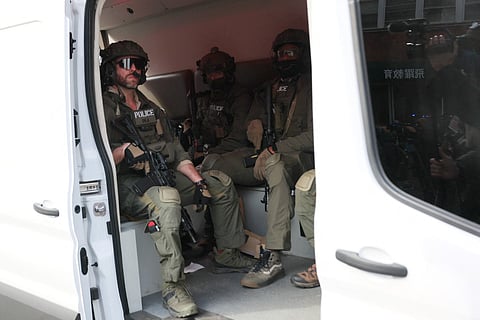
The transfer began at 7:15 a.m. with a motorcade leaving the jail. Maduro was flown by helicopter across New York Harbor to a Manhattan heliport. Limping in handcuffs, he was then placed in an armored vehicle and driven into the courthouse garage—just around the corner from where former President Donald Trump was convicted in 2024 of falsifying business records.
Outside, police separated a small group of anti-US intervention protesters from pro-intervention demonstrators waving Venezuelan flags.
Court appearance marks start of complex legal battle
Monday’s hearing is expected to be brief but is a required procedural step. Legal experts note that Maduro’s case is unusual given his former role as Venezuela’s head of state.
Defence challenge: Maduro’s lawyers are likely to argue he has sovereign immunity, similar to past cases like Panamanian leader Manuel Noriega.
US stance: The US government does not recognise Maduro as Venezuela’s legitimate leader following his disputed 2024 re-election.
If convicted, Maduro and his wife could face life sentences, with charges extending beyond drug trafficking to include kidnappings, beatings, and murders associated with cartel operations.
US military operation and political fallout
Maduro and Flores were seized early Saturday from a military base in Caracas in a highly coordinated operation, backed by warplanes and a naval deployment.
Trump’s declaration: President Donald Trump announced the US would temporarily run Venezuela, citing the country’s oil resources as a priority.
Interim government: Former vice president Delcy Rodriguez now serves as interim president. Maduro’s son, Nicolas Maduro Guerra, expressed support for Rodriguez, assuring Venezuelans that the country remains in good hands.
Protests and international reaction
Around 2,000 Maduro supporters rallied in Caracas over the weekend, some armed, waving Venezuelan flags.
US demonstrations: Approximately 40 people protested outside the New York courthouse, while a smaller group expressed support for Maduro.
Global response: UN Secretary-General Antonio Guterres urged respect for sovereignty and territorial integrity, while Mexico and Colombia criticised US actions, with Colombia’s President Gustavo Petro warning of possible resistance.
Economic stakes and regional strategy
Venezuela’s oil industry is central to US interests:
Trump demanded “total access” to oil and other resources to rebuild the country.
US oil majors Chevron, ExxonMobil, and ConocoPhillips saw shares surge following news of the operation.
The Trump administration has deployed a large naval presence in the Caribbean and imposed an oil blockade, signalling continued economic and strategic leverage in the region.
Legal and diplomatic complexities
Maduro’s legal team will argue for diplomatic immunity, citing past international cases.
US Treasury sanctions against Maduro and his family complicate representation, as American lawyers must secure special permission to act on their behalf.
Interim president Rodriguez has indicated willingness to cooperate with the US, reflecting a cautious approach amid the country’s political transition.
Charges against Maduro and associates
Collaborating with cartels to smuggle cocaine into the US.
Ordering kidnappings, beatings, and murders to protect trafficking operations.
Wife Cilia Flores accused of accepting bribes for arranging meetings between traffickers and Venezuelan authorities.
Several associates and Maduro’s son are also charged, while alleged gang leader Hector Rusthenford Guerrero Flores remains at large.
Public reactions
Supporters of Maduro in Venezuela rallied to celebrate his legacy and protest against what they view as US intervention, while Venezuelans in the US welcomed his removal as a “gift,” applauding Trump’s decisive actions. Monday’s court appearance marks the likely start of a prolonged legal and diplomatic saga, carrying significant implications for US-Venezuela relations, regional stability, and the global oil market.
This court appearance is likely the beginning of a prolonged legal and diplomatic saga, with implications for US-Venezuela relations, regional stability, and the global oil market.
With inputs from AFP, AP


