Canada says it will not join Trump’s Board of Peace after Davos spat
Ottawa gives no reason as invitation is withdrawn amid diplomatic row
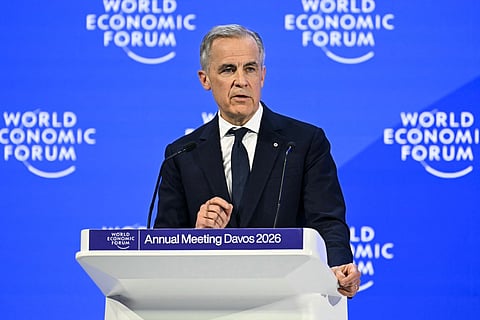
Canada has said it will not join US President Donald Trump’s newly launched Board of Peace, a high-profile initiative aimed at mediating global conflicts, following a sharp diplomatic exchange between Trump and Canadian Prime Minister Mark Carney at the World Economic Forum in Davos.
No official reason has been given by Ottawa for its decision. However, it comes days after Trump publicly criticised Carney’s remarks on the global order and subsequently withdrew an invitation for Canada to join the body in a post on his Truth Social platform.
In his message, Trump addressed Carney directly, saying the Board of Peace was withdrawing its invitation to Canada’s participation in what he described as “the most prestigious Board of Leaders ever assembled.”
The move followed Trump’s comments at Davos, where he accused Canada of being insufficiently “grateful” to the United States and claimed that the country “lives because of the United States,” remarks that prompted a swift response from Carney.
“Canada doesn’t live because of the United States. Canada thrives because we are Canadian,” Carney said in a national address, while acknowledging the close partnership between the two countries.
Wider platform
The Board of Peace was formally launched by Trump on Thursday at the World Economic Forum, where he signed its charter and hailed the initiative as a major step toward resolving global conflicts. Initially conceived as part of a broader plan to oversee post-conflict reconstruction in Gaza, the board has since been presented by the Trump administration as a wider platform for international peace efforts.
Trump has said the board could eventually rival or complement some functions currently performed by the United Nations. Administration officials have claimed that dozens of countries were invited to join, with Trump suggesting that more than 50 nations could ultimately sign on.
However, participation from traditional US allies appears uneven. Several countries, including France, Norway and Sweden, have either declined or expressed reservations, citing concerns over the board’s mandate and its potential overlap with existing multilateral institutions. Canada had been non-committal before Trump’s invitation was withdrawn.
‘Rupture in global order’
The diplomatic friction between Washington and Ottawa intensified after Carney’s speech at Davos, where he warned of a “rupture” in the US-led rules-based global order and cautioned against the weaponisation of trade, finance and supply chains. Though Trump was not mentioned by name, the remarks were widely interpreted as a critique of recent US policies.
Trump responded a day later, saying he had watched Carney’s speech and accusing the Canadian leader of lacking appreciation for US support, while also asserting that American missile defence initiatives would protect Canada.
The exchange underscores broader strains in the bilateral relationship, even as the two countries remain deeply economically intertwined. The United States accounts for more than three-quarters of Canadian exports, and trade negotiations under the existing North American framework are expected to resume later this year.
While Trump has portrayed his Board of Peace as a landmark diplomatic initiative, questions remain over its structure, membership and long-term role in global conflict resolution. The board’s charter has not yet been made public, and several governments have said they are still reviewing the proposal.
Canada has not indicated whether it would reconsider participation in the future, but for now, Ottawa has made clear it will stay out of Trump’s flagship peace initiative.


