Explained: Why Trump’s ‘Board of Peace’ is drawing global attention
From Gaza oversight to global role, supporters see a peace mechanism, critics see risks
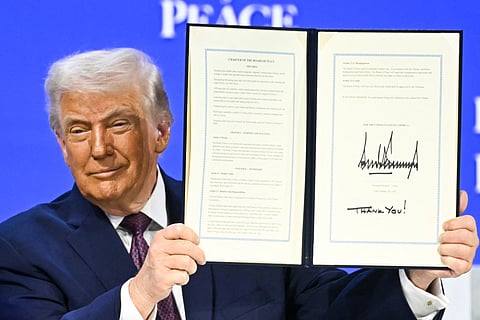
US President Donald Trump has formally launched a new international body called the Board of Peace, unveiling it at the World Economic Forum in Davos amid sharp global attention and mixed reactions from US allies.
Initially conceived as a mechanism to oversee the Israel–Hamas ceasefire in Gaza, the initiative has rapidly expanded in scope, raising questions about its mandate, membership, funding model and relationship with existing global institutions.
The launch has drawn scrutiny not only because of who has signed on — and who has stayed away — but also because of concerns that the board could evolve into a parallel forum to the United Nations, particularly its Security Council. Supporters describe it as a pragmatic peace mechanism, while critics see risks of politicisation and “pay-to-play” diplomacy.
Below is a detailed look at what the Board of Peace is, how it works, and why it has proved controversial.
What is the Board of Peace?
The Board of Peace is a new international body announced by President Trump to oversee ceasefires and help resolve global conflicts. Trump serves as its chairman. While its first focus is Gaza, the board’s founding charter allows it to take on a broader role in mediating international disputes.
Why was it launched now?
The idea originated in Trump’s 20-point Gaza ceasefire proposal, parts of which were earlier endorsed by the UN Security Council. With the Israel–Hamas ceasefire still fragile, the administration says the board is meant to provide sustained political oversight to prevent a return to large-scale conflict.
Trump has also long expressed frustration with existing multilateral institutions, arguing they are slow and ineffective in stopping wars.
What is the board’s role in Gaza?
US officials say the board’s immediate priority is ensuring that the Gaza ceasefire becomes durable. This includes monitoring compliance, supporting humanitarian access and facilitating discussions on post-war governance.
A central issue remains the future of Hamas. Trump has stated that under the next phase of the ceasefire, Hamas must disarm or face severe consequences — a position Israel has consistently maintained and which Hamas has rejected.
Does the board replace the United Nations?
Trump has floated the idea that the Board of Peace could eventually take on some functions currently handled by the UN. However, he has also said it will operate “in conjunction” with the UN, not formally replace it.
Several countries have expressed concern that the board’s mandate is too broad and could undermine the UN-centred international order established after World War II.
Who's on the executive board?
The executive board will be chaired by Trump and include seven members:
US Secretary of State Marco Rubio
Steve Witkoff, Trump's special negotiator
Jared Kushner, Trump's son-in-law
Tony Blair, former UK prime minister
Marc Rowan, billionaire US financier
Ajay Banga, World Bank president
Robert Gabriel, Trump aide on the National Security Council
Who are the members?
Leaders or senior representatives from 19 countries signed the founding charter at Davos. These include the United Arab Emirates, Argentina, Hungary, Saudi Arabia, Qatar, Turkey, Jordan, Morocco, Pakistan, Indonesia, Kazakhstan, Azerbaijan, Armenia, Kosovo, Bulgaria, Paraguay, Uzbekistan, Mongolia and Bahrain.
Who has declined to join?
Several key US allies, including the United Kingdom, France, Norway and Sweden, chose not to participate in the launch. Britain said the board raises complex legal and political questions, particularly given the inclusion of leaders involved in ongoing conflicts.
The European Union, Canada, China and Ukraine have not yet publicly committed to joining.
Why is Russia’s invitation controversial?
Trump confirmed that Russian President Vladimir Putin has been invited to join, despite Russia’s ongoing war in Ukraine. Putin has said he is still reviewing the proposal.
The invitation has alarmed European allies and Ukraine, which argue that Russia’s participation in a peace body while the war continues sends mixed signals.
How does Ukraine fit into this?
Trump is expected to meet Ukrainian President Volodymyr Zelenskyy in Davos to discuss a possible ceasefire. US officials say talks to end the war have narrowed to one unresolved issue, though details have not been disclosed.
Ukraine has expressed concern that other geopolitical priorities — including Trump’s recent comments on Greenland — could distract from efforts to end the conflict with Russia.
What is the $1 billion membership fee?
Permanent members of the Board of Peace are required to contribute $1 billion. The Trump administration says the funds will be used for humanitarian relief, peace monitoring and post-conflict reconstruction.
Critics argue the fee risks turning the board into a “pay-to-play” institution, where financial capacity determines influence — a comparison often made with the UN Security Council’s permanent membership structure.
What has Israel’s position been?
Israeli Prime Minister Benjamin Netanyahu has said Israel will join the board, though he did not attend the Davos signing ceremony. His government has previously raised concerns about international oversight mechanisms but supports efforts that maintain pressure on Hamas.
How does Iran factor into the picture?
The launch comes amid tensions with Iran, which the US has long accused of being Hamas’ principal backer. Trump has linked his administration’s hardline stance toward Tehran — including military strikes last year — to the conditions that enabled the Gaza ceasefire.
While Trump has recently indicated he will avoid new military action against Iran for now, the issue remains a significant backdrop to the board’s peace ambitions.
What happens next?
The Board of Peace is expected to begin regular consultations on Gaza while assessing whether to take on additional conflicts. Several countries have indicated they may still join, pending parliamentary or internal approvals.
- with inputs from AFP, AP


