Why is the UAE passport the world’s most powerful?
Emiratis can travel to 182 destinations through visa-free, visa-on-arrival
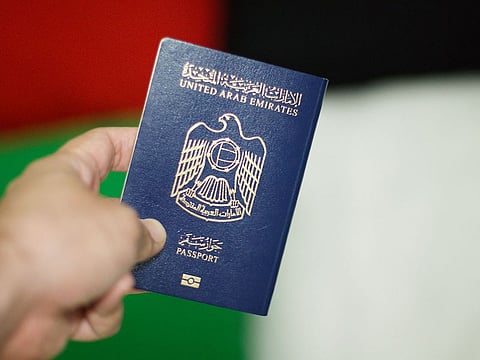
Dubai: The UAE passport has retained its position as the world’s most powerful passport in 2026, giving its holders facilitated access to 182 destinations worldwide, according to the latest September report by Passport Reports.
The UAE recorded a Mobility Score of 182, equivalent to 91.9 per cent worldwide access. The score covers destinations that UAE passport holders can enter visa-free, obtain a visa on arrival or through other simplified arrangements, or access using an electronic travel authorisation (eTA).
The ranking places the UAE ahead of other passports in terms of the breadth of international travel access available to its citizens.
Visa-free destinations
Of the 182 destinations covered by the UAE’s Mobility Score, 128 offer visa-free entry, while 44 are accessible through visa on arrival or other simplified entry arrangements. A further 10 destinations require an electronic travel authorisation.
Only 16 destinations are classified as requiring a visa for UAE passport holders: Afghanistan, the United States, Australia, Belize, Bhutan, Algeria, Eritrea, Cameroon, North Korea, Lesotho, Libya, Myanmar, Nicaragua, Somalia, Turkmenistan and Venezuela.
Some of these destinations offer electronic visa facilities despite remaining classified under the report’s visa-required category.
Full access to Europe
The UAE passport records 100 per cent overall access across Europe, with 46 destinations offering visa-free entry and the remainder covered through the eTA category.
Access is also 100 per cent across the Gulf, with UAE passport holders able to travel visa-free to Bahrain, Qatar, Kuwait, Saudi Arabia and Oman.
The wider Middle East also records 100 per cent overall access, comprising 75 per cent visa-free access, 18.8 per cent visa-on-arrival or simplified access and 6.3 per cent through eTA arrangements.
Outside these regions, overall access stands at 93.8 per cent in the Caribbean, 92.9 per cent in Oceania, 91.7 per cent in South America, 89.8 per cent in Asia, 88.9 per cent in Africa, 87 per cent in North America and 80 per cent in Central Asia.
UAE leads rankings
The UAE passport also ranks first in several regional and international comparisons.
It is ranked No. 1 among 50 Asian countries, 17 Middle Eastern countries and six Gulf countries, as well as among 24 countries where Arabic is an official language.
The passport also tops comparisons covering 159 World Trade Organisation members, 57 Organisation of Islamic Cooperation countries, 22 Arab League members, 11 BRICS countries and 132 G77 countries.
While the overall ranking highlights the breadth of access available to UAE passport holders, entry conditions and permitted stays vary between destinations.
Visa-free stays
The report lists visa-free stays of up to 180 days in destinations including Dominica, El Salvador and Armenia. The United Kingdom and Canada are listed under the eTA category, also with stays of up to 180 days.
Other destinations have additional requirements. These include an e-ticket for the Dominican Republic, an arrival card for Malaysia, a tourist card for Suriname, tourist registration for Seychelles and pre-registration for Côte d’Ivoire.
Welcoming country
The report separately ranks countries according to how easily they allow foreign passport holders to enter. In this welcoming-country ranking, the UAE stands 91st among 199 countries.
This measure is separate from the UAE passport ranking, which assesses how easily UAE citizens can travel abroad.
The report also highlights differences in reciprocal access. The United States and Australia are among destinations where their citizens have facilitated access to the UAE while UAE passport holders face visa requirements.
Conversely, citizens of countries including India, Pakistan, Kenya, Thailand, Türkiye and South Africa face visa requirements for the UAE while UAE passport holders receive facilitated access to those countries.
Passport Reports determines its rankings primarily by Mobility Score – the number of destinations offering visa-free, visa-on-arrival or simplified access, and eTA access. Where passports have the same score, the ranking is decided first by the number of visa-free destinations, followed by eTA and visa-on-arrival or simplified-access destinations.


