UAE: Here’s how Emirati artisan preserves Talli art
Atiga Al Mansouri promotes Emirati Talli worldwide, aims to inspire future generations
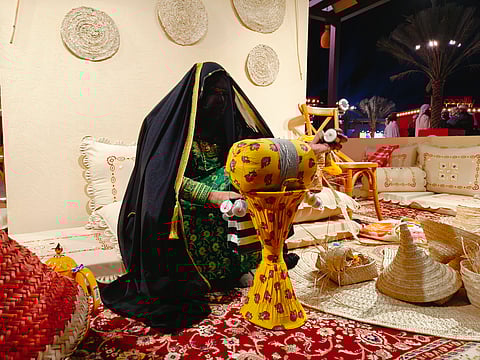
Abu Dhabi: Atiga Abdullah Al Mansouri, a veteran Emirati artisan from Liwa, gets lost in time as she works on Talli – a traditional handicraft that creates bright and beautiful designs for women’s clothing.
Atiga underlined that the Emirati embroidery, which has earned a spot on UNESCO’s Intangible Cultural Heritage list, has been passed down through generations, but it needs to be preserved.
“Some of my daughters know the basics, but they aren’t as deeply passionate about it as I am. However, I continue to work on it with dedication,” Atiga, wearing a traditional dress, told Gulf News during the Liwa International Festival in Abu Dhabi’s Al Dhafra region.
Learn Talli
Sitting in an old-style village setting, showcasing an authentic glimpse of the past, Atiga twists and braids various strands of thread to create strips of fabric with intricate patterns. She uses a pillow, called a ‘mousadah’, as a support base for her braiding.
In today’s digital age, where youngsters are often glued to their smartphones and other electronic gadgets, Atiga hopes they will take an interest in learning Talli.
“It’s crucial to preserve this heritage and teach it to the younger generation to ensure the craft doesn’t fade away,” she said as a group of visitors stopped by to watch her work.
Reflecting on her early days, Atiga noted that she was drawn to the craft by her own enthusiasm and learned it by observing older women.
“I started this craft when I was young, around 11 years old. I learned by observing the older women in my community as they worked. I would watch their techniques closely and replicate what they were doing. I asked them to teach me the basics. Over time, I practiced and improved on my own.”
Tradition to modernity
Traditionally, Talli braids featured real silver or gold threads to form the central part of intricate patterns, which were then paired with pure cotton threads in various colours along the borders. These combinations produced unique designs for weddings and other ceremonial events.
“Traditionally, the craft involved using cotton threads and silver palm fronds. These materials were often repurposed from older garments and applied to new ones.”
Atiga pointed out that the Emirati handicraft has “significantly” modernised. Today, real silver and gold have been substituted with synthetic alternatives. Along with silver, the most common colours for Emirati Talli are black, green, red, and white.
“While earlier generations focused on simpler designs with limited rows of embroidery, today we create more intricate and elaborate decorations. Entire garments are now adorned with detailed embellishments, making them more beautiful and sophisticated.”
Promoting beyond UAE
Atiga, who resides in Liwa, has been actively promoting the craft both in the UAE and abroad for years.
“While I primarily work in Liwa, I’ve also travelled internationally to teach and showcase our heritage. We’ve been invited to places like Morocco, Pakistan, and Jordan to participate in festivals and share our craft,” she said and noted: “These trips are usually organised by government entities or UAE embassies abroad. They invite us to represent our culture and participate in events and festivals. I’ve even taught non-natives, like Indian women, who have embraced and mastered the techniques.”
She stressed the importance of participating in festivals like the ongoing one in Liwa, and others across Al Dhafra and the rest of the country, to showcase the Talli craft.
“These festivals are vital for preserving and promoting our culture. They attract people from all over the world, and every year, the events become more advanced and meaningful, thanks to the continuous support of our leadership,” she said as the Liwa Festival concludes on Saturday.


