UAE: AI tools to boost productivity, reduce time spent on tasks at work
Industry leaders highlight AI’s role in enhancing efficiency and creativity
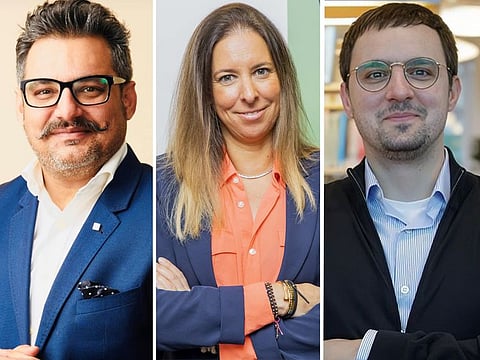
Dubai: Artificial intelligence (AI) is rapidly transforming industries by automating routine tasks, enhancing decision-making and improving efficiency. AI tools can significantly boost productivity and potentially shorten workweeks, experts said.
Recently, JPMorgan CEO Jamie Dimon predicted that AI will reshape work-life balance as the next generation of employees will work for only three and a half days a week.
Echoing these sentiments, local industry experts highlighted AI solutions will increase efficiency and reduce the time required to complete tasks in the workplace.
“On average, a person loses about three hours per week on administrative tasks, such as documenting, finding documents, reading them, and filling in forms. By utilising AI, automation, and hyper-automation, we have reclaimed these hours, allowing teams to focus on more valuable work,” said Jessica Constantinidis, innovation officer for EMEA at ServiceNow, a company providing AI solutions to businesses.
Constantinidis pointed out that AI-driven systems enable employees to focus on more creative and strategic tasks.
“One of the main advantages of AI is its ability to quickly document, summarise, and find data. For example, instead of spending 1 to 2 hours manually building a dashboard of ongoing projects and their current status – by searching for data, figuring out how to structure the dashboard, and laying it out – AI can streamline the process,” Constantinidis said.
Transforming workplace
Sid Bhatia, area vice-president and general manager for the Middle East, Turkey, and Africa at Dataiku, an AI company, noted that AI is transforming how employees work, particularly in regions like the UAE, where innovation is advancing rapidly.
“By automating repetitive tasks like data entry, report generation, or scheduling, AI frees up employees to focus on bigger, more strategic projects. It’s not just about working faster; it’s about working smarter and creating space for creativity and innovation.”
Bhatia underlined that for real and measurable impact, AI tools must be accessible for everyone and not just tech experts.
“When these tools are in the hands of diverse teams, amazing things can happen. You get better problem-solving, fresh ideas, and more progress on the big stuff that really matters.”
Upskilling its workforce, the UAE recently announced plans to train one million people in AI technologies. Microsoft, in partnership with government entities, launched the AI National Skills Initiative to upskill 100,000 employees across local government institutions in Abu Dhabi, Dubai, and Sharjah.
Impacting sectors
Dr Radu-Casian Mihailescu, associate professor in computer science at the School of Mathematical and Computer Sciences, Heriot-Watt University, Dubai, said that AI allows employees to focus on roles that require emotional intelligence, creative thinking, and complex problem-solving.
“AI systems have the potential to take on responsibilities that are repetitive, dangerous, or demand a degree of accuracy and reliability that humans find challenging to maintain. Hence, humans can dedicate more time on jobs that require deep thinking, creativity, or a personal touch.”
Dr Mihailescu highlighted the vast potential of AI to revolutionise various industries.
“Large Language Models (LLMs) and other deep neural nets have the potential to play a big role in society, especially in areas such as information technology, healthcare, finance, customer service, and education through the emergence of the human-AI collaboration paradigm that leverages the unique strengths of both humans and AI to achieve superior results across various industries.”

