Ready to move in
Expatriates buy properties as first projects available for non-national ownership near completion
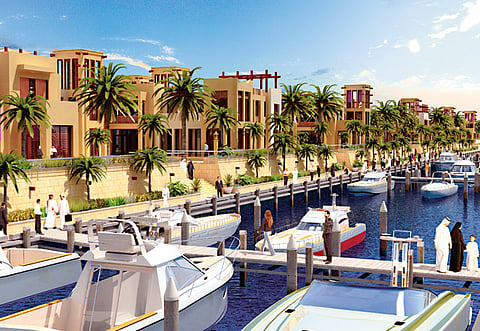
The past few months have seen significant changes taking place on Abu Dhabi's real estate landscape. At the end of December last year, the first units of Manazel Real Estate's Al Reef Villas were handed over to their new owners, closely followed this year by the handover of Tamouh's Marina Square on Al Reem Island.
So why are these handovers so noteworthy? Along with the Al Raha Beach development by Aldar (which is due to make its first handovers later this year), they are the first developments in Abu Dhabi that are available for ownership by non-GCC residents. They offer a 99-year usufruct (which is similar to a leasehold) to expatriate buyers, and there is the possibility that this will be converted to freehold status, should the 2005 Law Concerning Real Estate Property be amended in years to come.
In a city where demand for property still far outstrips supply, these new units have become an attractive proposition, particularly because they are squarely aimed at the mid-income range of the market. Designed as fully integrated developments, they offer an all-encompassing lifestyle experience, with a range of community-focused amenities such as mosques, schools, health care and leisure facilities, not to mention easy access to the capital and Abu Dhabi International Airport. >
Matthew Green, Head of Research and Consultancy at CB Richard Ellis, says, "New and upcoming developments, such as Marina Square, which are now completing, offer expatriates a prime location with product quality generally superior to current offerings on the island. Newer developments are also typically offering larger unit sizes, better facilities and (importantly for Abu Dhabi) adequate parking allocation."
According to a spokesperson from real estate agents Hamptons International, whose portfolio includes properties at Al Reef, Al Raha Beach and Al Reem Island, "There has been a noticeable increase in enquiries for properties that are close to completion. Off-plan requests are minimal now", while Aldar's figures show that the ratio of non-national buyers to nationals in its Al Raha Beach development is approximately three-to-one.
Jesse Downs, Director of Research and Advisory Services at independent property consultants Landmark Advisory, says, "We are seeing increased demand from owner-occupiers. In fact, most of the existing demand is from owner-occupiers purchasing units close to completion, indicating that current demand is driven primarily by expatriates."
Aldar — which is due to hand over leasehold properties in the Al Bandar precinct of Al Raha Beach in the second quarter of this year — has noticed a surge in buyer interest as units near completion. "Taking into account the fact that new units are coming to the market soon and with the support of the financial institutions in terms of mortgage products, more non-nationals are considering paying the same amount they are already paying for their rent, if not less, towards a property they will own," says Rami Nasser, Aldar's Director of Sales.
Conservative lending policy
Today, lending policies in the capital are much more conservative than those offered in neighbouring Dubai during the property boom, but nevertheless developers are helping potential buyers with flexible payment structures and close relationships with leading financial institutions.
"However, at the same time borrowers are required to present strong proof of financial capability and commitment to the property," says Green.
Abu Dhabi Finance offers loans for a number of approved developers, including Surouh and Aldar, with residential mortgages of up to 85 per cent for individuals earning a minimum salary of Dh10,000 per month. According to the experts at Hamptons International, "Some banks have reduced their exposure to 70 per cent and in the case of Lloyds TSB even 50 per cent loan to value. With interest rates still at the 7-8 per cent mark, monthly repayments are about Dh8,000 per million borrowed over 25 years."
Rental markets
For Abu Dhabi residents the positive news is that the existing high rental prices look set to fall as the year progresses. According to the latest report published by Landmark Advisory, following on from market-wide rent declines in the last quarter of last year (with some high-end units even seeing prices fall by up to 15 per cent), the trend will continue into the first quarter of this year, as more supply filters onto the market.
The experts at Hamptons International confirm the trend, "Abu Dhabi is growing in prominence locally and globally. This year is likely to be one of further consolidation and we could even witness slight declines in rents."
However, the impact will be most noticeable in lower-grade assets rather than newer units on the market, and less likely to affect prices and occupancy rates in prime residential areas and the Central Business District.
"The downward rate is likely to be slow and steady as opposed to witnessing any sudden drop in rents," says Green. "The level of undersupply in the capital is such that although a small impact has been felt, it has not yet been sufficient to lead a major slump in rental values."
According to Landmark, one of the effects of the continuing high prices and shortage of supply in Abu Dhabi is the emergence of a substitute market in Dubai. Falling rents and the stagnation of property prices in the city have seen residents using it as a base from which to commute into capital, from outlying areas such as Dubai Marina and the Greens Community.
It's a phenomenon that's only going to be short-lived, however, predicts Green. "The ongoing handover of new supply and declining rental values will slowly start to draw residents back to the capital."


