'Make it in the Emirates 2026' offers 1,000 new jobs for UAE nationals
Jobs fair surpasses 5,000-role target early as demand shifts to tech skills
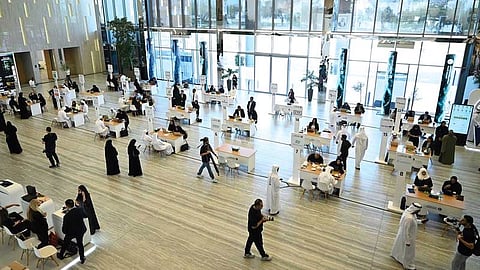
Abu Dhabi: Osama Amir Fadhel, Assistant Undersecretary for the Industrial Accelerators Sector at the Ministry of Industry and Advanced Technology (MoIAT), stated that participants in the "Make it in the Emirates 2026" Jobs Fair for Industry and Advanced Technology, which opened yesterday (Monday) in Abu Dhabi, highlighted a significant shift in the types of jobs demanded by the private industrial sector compared to a decade ago. Today, the focus is increasingly on roles such as programming, automation, data analytics, and other technology-driven professions.
Get updated faster and for FREE: Download the Gulf News app now - simply click here.
He noted that since the launch of the exhibition in 2023, it has facilitated more than 4,200 employment opportunities, while the 2026 edition alone is offering 1,000 new jobs.
Fadhel added that the "Make it in the Emirates" Jobs Fair is one of the key initiatives supporting the National Strategy for Industry and Advanced Technology, aimed at creating employment opportunities for Emirati talent and equipping them with the skills required to keep pace with the ongoing transformation of the industrial sector and its evolving workforce demands.
5,200 Jobs for Emiratis in the industrial sector over three years
Speaking on the sidelines of the two-day event, which features the participation of more than 70 companies, Fadhel said that more than 5,200 job opportunities have been created for Emiratis in the industrial sector over the past three years, surpassing the original target of 5,000 jobs set for 2027.
He explained that since its launch in 2023, the exhibition has generated over 4,200 employment opportunities, while the current edition has added another 1,000 positions.
Fadhel emphasized the growing demand for new skill sets, including programming, automation, data analysis, and robotics—roles that were not widely sought after a decade ago. He noted that the UAE's industrial sector continues to evolve in line with the objectives of the National Strategy for Industry and Advanced Technology.
He further explained that when the exhibition was launched three years ago, the Ministry had set a target of creating more than 5,000 jobs by 2027. With the announcement of over 1,000 new vacancies during the 2026 edition, the total number of opportunities generated by the initiative has exceeded 5,200, effectively achieving the target a full year ahead of schedule.
Encouraging private industrial companies
For her part, Salama Al Awadhi, Senior Vice President, Commercial Affairs, In-Country Value (ICV), and Industrial Development at ADNOC Group, said that the third edition of the "Make it in the Emirates" Jobs Fair, organized in partnership between ADNOC and MoIAT, aims to recruit, develop, and empower Emirati talent for careers within the private industrial sector.
She noted that the previous two editions generated more than 4,200 jobs, while the current edition has created an additional 1,000 positions, bringing the total to 5,200 jobs over three years.
Al Awadhi explained that ADNOC leverages the exhibition to encourage its suppliers and partner companies to recruit and train Emirati talent, particularly as the company advances strategic projects worth more than AED 200 billion. Many of the companies involved in these projects are seeking qualified Emirati professionals in engineering, programming, data analytics, robotics, and other specialized technical fields.
Continued participation
Meanwhile, Saeed Al Zarooni, Head of Procurement at e& Group, said that e& is one of the key partners of the "Make it in the Emirates" initiative in attracting Emirati talent across various fields, including sales and customer service.
He noted that since the launch of the National In-Country Value Program, e& has remained committed to participating in the initiative.
In a related development, Marwan Al Bastaki, Director of Strategic HR Partnerships at Emirates Global Aluminium (EGA), said that the company regularly participates in the exhibition to attract Emiratis to the aluminium industry, one of the UAE's largest industrial sectors.
He explained that the company's participation focuses on recruiting both university graduates and high school graduates, particularly in engineering disciplines. Through specialized national training programs, EGA develops their skills and expertise, enabling them to build successful careers and become industry specialists in aluminium manufacturing.
Nafis allows Emiratis to move between private sector companies
Issam Al Ali, Director of Communications and Partnerships at the Emirati Talent Competitiveness Council (Nafis),stressed that there is no issue with Emiratis moving between private sector companies, noting that the private sector offers a diverse range of opportunities and operates in a competitive environment driven by skills and merit.
Speaking on the sidelines of the "Make it in the Emirates 2026" Jobs Fair, Al Ali said that Emiratis working in the private sector are not required to remain with a single employer for a specific period, as the labor market is dynamic and offers numerous opportunities. Employees are free to pursue better prospects and enhanced benefits whenever available.
His comments came in response to concerns raised by some employers regarding competition among companies to recruit trained and qualified Emirati employees after investing in their development and professional training.
Al Ali emphasized that workforce mobility among Emiratis is a healthy phenomenon and that competition for skilled national talent ultimately strengthens the labor market. He added that companies facing such challenges should adapt to evolving market conditions and ensure that their compensation packages and incentives remain attractive enough to retain employees.
Growth in Emirati salaries in the private sector
Al Ali explained that when the Nafis program was first launched, there was no legislation requiring private-sector companies to provide a minimum wage for Emirati employees. In 2024, however, a ministerial decision established a minimum salary of AED 4,000, which was subsequently increased to AED 5,000 last year, regardless of educational qualifications.
At the beginning of this year, the minimum salary was raised to AED 6,000, while the continuation of the Nafis program was extended through 2040.
He highlighted the competitive nature of the private sector and its important role in attracting Emirati talent, noting that numerous success stories have emerged among Emiratis who have progressed into senior management positions thanks to education, training, and career development opportunities.
177,000 Emiratis employed in the private sector
Al Ali described the Emiratisation file as a major success story, noting that the initiative began with approximately 29,000 Emiratis working in the private sector, while the current figure has reached 177,000.
He added that when the program was launched, only 15% of Emiratis were attracted to private-sector employment, whereas that figure rose to 60% by the end of 2025.
The Ministry of Industry and Advanced Technology recently announced the latest edition of the "Make it in the Emirates" Jobs Fair, held on June 8–9 at the Abu Dhabi Energy Center. The event aims to connect Emirati talent with employment and training opportunities in fast-growing industrial and technology sectors.

