Raising the bar
SWA Group aims to create a 'wow factor' to match that of the world's tallest building
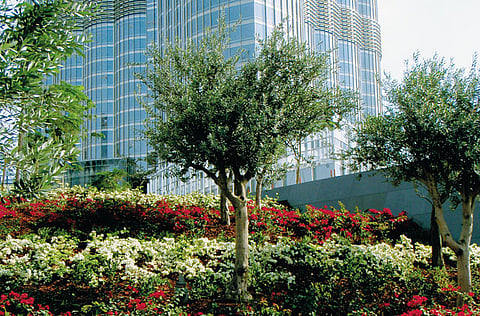
Creating an appropriate landscape for the world's tallest building, the 800-metre-plus Burj Khalifa, is certainly no small feat. The challenge was met by US-based SWA Group, one of the world's leading landscape architecture, planning and urban design firms, which has worked on award-winning projects across the globe. We went onsite with SWA Group's David Gal to find out more about the project.
"Our primary goal was to raise the bar for quality here in Dubai," he says. "SWA has been around for more than 50 years, and we're internationally recognised for the landscapes we produce. We want people on future projects to look at the Burj Khalifa and say, ‘That's the kind of landscape we want too'."
Covering 11 hectares around the base of the tower, the design was devised in close collaboration between SWA and architects Skidmore, Owings and Merrill — the result is a verdant oasis with palm-lined walkways, dancing fountains and a colourful abundance of flowers and shrubbery.
"The architect's inspiration for the design of the Burj Khalifa was the hymenocallis, or spider lily, so of course we used that in the design of the landscape too," says Gal. "Each one of the major plazas has rings of hymenocallis planted around them, sowhen they bloom in springtime, the flowerswill mimic the shape of the tower itself. There are also Arabic motifs that run through the design of the tower, which we have repeated through the landscaping."
With three distinct areas — the Armani Hotel, residential area and offices — SWA needed to create a landscape that complemented each of the tower's facets. "We've tried to design areas that are unique to each side of the tower," says Gal. "There are themes which run through the entire project, but each separate location has a theme too. For example, as well as specific types of trees and water features for each section, we've used an absolute black granite throughout, but each side has been interjected with a signature granite colour — the hotel side is green and the residential is brown."
To truly appreciate the intricacies of the landscape's design, it is best seen from above. "The tower is basically in a triad shape," says Gal. "Everything is on a radial: there is a circle that connects the three points of the tower together, and as you proceed closer to the tower, the Arabic patterns become even more complex and the use of materials even richer."
Rich palette
As one would expect from such a prestigious development, the choice of materials was key. "With the tallest building in the world, you need something special, so we've used a very rich palette," says Gal. The finest granites were sourced from quarries in China and India — with no exposed concrete in the 11-hectare project, everything from the monolithic blocks used in the fountains to the cobblestones underfoothad to be of the highest quality and consistency. As well as native plants and trees, exotic species have been sourced from across the world. "We've used a lot of indigenous species that you normally find in Dubai, but have mixed them with more exotic species too — we have olive trees from Italy, and there are species that flourish in the Californian desert that grow very well here, as well as varieties of cactus and succulents. We have tried to take into account flowering times, so as one plant is declining in its blooming cycle, the one next to itis starting to flower."
Planting in a climate such as Dubai is not without its challenges, but the key to making it work is the soil, explains Gal. "You need to get a soil that is well aerated. The soil here is sandy and alkaline — some plants thrive well in this environment, but most want a normal pH, so we add fertilisers and composts to make a really good blend. When the plants and water are added, just stand back and watch! A lot of the plants have doubled in size in the four months since they were planted."
Ecologically balanced
A 50-millimetre layer of mulch on top of the soil serves to hold the temperature down, provides nutrients and also prevents evaporation, which, in turn, helps to conserve water. An innovative and highly efficient irrigation system also boosts the landscape's eco-credentials.
"The water condensate from the tower is part of the irrigation system," says Gal. Recycling an estimated 15 million gallons of water each year, "this makes for a significant saving, as it's just a by-product of the building itself. The use of drip irrigation is highly efficient, plus there is a pumping station underneath the tower that features a fertiliser injection system. So as the plants get water, they also get a minimal dosage of liquid fertiliser, which constantly feeds them."
As the finishing touches of this ambitious project are put in place, the true test of the Burj Khalifa's landscaping will come from the public's reaction as it is unveiled. And David Gal is optimistic, "I've watched people just stopping their cars in the middle of the road to get out and take pictures. Their first reaction seems to be ‘wow' as they see the tower and its sheer size. Hopefully the landscape that it is sitting in will create that ‘wow factor' too."


