New generation of Emiratis forge a new career path
Young Emiratis confidently seeking opportunities in the workplace, and are ready to compete
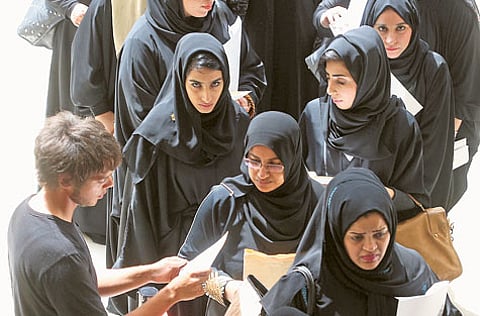
Dubai As the spring leg of the Gulf Education and Training Exhibition (Getex) kicks off in Dubai Thursday, the spurt in training and recruitment fairs primarily aimed at facilitating employment for UAE nationals is beginning to reflect changing trends among Emiratis in their hunt for job opportunities, officials and experts say.
Confirming a rising employment trend in Emiratis joining the retail sector, Ahmad Al Ahmadi, Branch Manager at Tanmia — the UAE's national development and employment authority — said: "This year retail was very high for Emirati employment. We trained many people for the trade and they got jobs directly."
According to Al Ahmadi, such trends indicate a successful mindset change among young Emirati jobseekers who are now willing to accept more diverse but potentially low-paying jobs according to their level of education.
"The problem may be this generation is a bit different; because my father and grandfather worked as anything — they were taxi drivers, construction workers, and the women would be vending in the marketplace," says Al Ahmadi. "There was no shame in work, any kind of work, and we have been focused on bringing this culture back and people are now changing."
The UAE Cabinet passed a decree in 2005 that stipulates companies operating in trade and commercial activities with over 50 employees should maintain an annual 2 per cent Emiratisation quota.
Some private sector companies boast Emiratis well over that official requirement. "Majid Al Futtaim Properties' employees are made up of 17 per cent Emiratis," says Younis Al Mulla, Senior Vice-President of Development at Majid Al Futtaim Retail. "In Majid Al Futtaim retail, which owns Carrefour, we have almost 150 jobs available for Emiratis from now until the end of the year." The positions available at the hypermarket chain vary from cashiers to heads of departments, he says.
According to Eisa Al Mulla, Executive Director of the Emirates National Development Programme (ENDP), a lot of Emiratis are often misled by relatives and peers and therefore misinformed about the positive career growth prospects available to them in the private sector.
Right attitude
However, Ammar Shams, HSBC's Regional Head of Corporate Sustainability, Middle East and North Africa, believes that most young Emirati graduates now have the right attitude towards career development. Yet, demographics and improved education have seen the growth of a competitive market for Emirati jobseekers.
"The way our demographics are structured means the supply of skilled workers is increasing; because when I joined the workforce many years ago there were hardly any Emiratis anywhere in the private sector," he says.
Emirati jobseekers, therefore, have to be more competitive while employers are able to be more selective due to a better educated and skilled Emirati workforce, Shams says.
"A new graduate looking for a job today will find there are already Emirati managers who have a track record because they are no longer the exception but the norm," he says. "More UAE nationals are developing the skills necessary before they join the workforce so it's becoming a more competitive environment."
Measuring success
However experts believe despite such consistent efforts, there is still no adequate system in place to track the job fairs' actual contribution to the Emiratisation of the UAE's workforce. They say there are no tangible measures of success to trace the employment of Emiratis after events like the recent Careers UAE 2012, organised by the Dubai World Trade Centre.
"There is no follow up with the organisers or companies after the career fairs are over," Al Mulla says.
"Generally there is no follow up system in the UAE overall… and as per my knowledge there is no entity looking into that matter."
"We don't have the figures of how many people are recruited after the event," says Hayete Jemai, exhibition director for Tawdheef, one of the UAE's largest annual education and training fairs, organised by Informa Exhibitions and held every January.
"We collect job vacancies from exhibitors before the event and this year there were more than 2,000 jobs available," she says. "Normally if everything goes well a minimum of 2,000 jobseekers should be recruited after Tawdheef."
Sector imbalance
Al Mulla adds that an initial solution to track applicant progress could be the creation of a portal to register candidates who apply for jobs at a fair in order to measure its success.
However, Khurram Saeed, exhibition director of Najah and Al Ain Education and Career Fair, says the only way to monitor an exhibition's success is by overall growth.
According to Al Ahmadi, there are approximately 40,000 unemployed Emiratis across the country. "There are 13,000 jobseekers registered on the Tanmia database," he says. "However, we are now working on a database to cover the entire country by merging jobseeker information at local authorities like ENDP and Tawteen under one umbrella."
Federal and local entities such as Tanmia and ENDP's main mandates are to tackle Emirati unemployment and also increase the number of Emiratis in the private sector. Al Mulla says that approximately only 4 per cent of Dubai's current private sector workforce is Emirati. This is compared to a 35 per cent Emirati workforce in Dubai's 58,945 strong public sector, according to the Dubai Statistics Centre's 2011 figures.
"Our main challenge is to increase those numbers [in the private sector] as we now need to focus on adequate career guidance in private and government schools," Al Mulla says. "At job fairs we have nice booths and lots of companies participating but career guidance is missing big time."


