Historian reflects on Abu Dhabi history
Dr Al Mutwalli looks back to 1793 when the Fort Palace was built
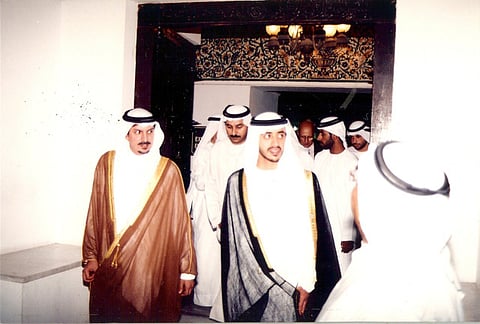
Abu Dhabi: A prominent historical feature in Abu Dhabi, the Al Hosn Fort, was built roughly 220 years ago by Shaikh Shakhbout Bin Zayed Al Nahyan. It was also the palace where the late Shaikh Zayed Bin Sultan Al Nahyan held his court on his accession in 1966.
Gulf News spoke to historian Dr Reem Tarek Al Mutwalli — author of the book Qasr Al Hosn — who has carefully chronicled the storied history of the architectural centrepiece in the nation’s capital.
Al Mutwalli said that the construction of the castle in 1793 is an important historical date. It was the time when the seat of the government was moved from Liwa Oasis to the Abu Dhabi Island.
After centuries of hosting royalty, the fort came under the stewardship of Al Mutwalli who became one of the privileged few to hold the fort’s keys after starting her work in 1984 at the Culture Foundation in Abu Dhabi. She held the keys in her position for two decades.
Looking back at her historical adventures inside the fort, Al Mutwalli said: “It was like holding a segment of a time when glory and greatness went hand in hand to pave the way to the present. I worked there from 1984-2000 and was very fortunate to be able to have access to the fort and its keys,” she said.
She conducted a full survey on all of Abu Dhabi’s forts as part of her master’s degree in Islamic art, architecture and archaeology at the School of Oriental and African Studies at the University of London, publishing the first architectural survey on the fort, Qasr Al Hosn, in 1995.
Shaikh Nahyan Bin Mubarak Al Nahyan, Minister of Culture, Youth and Community Development, and Shaikh Abdullah Bin Zayed Al Nahyan, Foreign Minister, supported her book as did Ahmad Al Suwaidi, the former chairman of the Cultural Foundation in Abu Dhabi.
Al Suwaidi encouraged everyone around him to preserve everything of historical importance, said Al Mutwalli. "He would also motivate people to write and produce books. He was very modest in his great achievements. He wanted the fort to be sustainable and, in turn, he wanted this for the whole country."
History
When Shaikh Zayed ruled Abu Dhabi, Al Hosn’s importance transferred from the home of the ruling family to a governing institution.
Ahmad Al Suwaidi, Ahmad Al Habroush, Hamouda Bin Ali and Abdullah Al Masoud were all some of Shaikh Zayed’s first men who worked in Al Hosn.
The offices of ministries were moved to different locations and, at the time, the court of President His Highness Shaikh Khalifa Bin Zayed Al Nahyan, was in Al Hosn.
Today, the white plaster walls are the only modern part of Qasr Al Hosn fort, which has stood in the middle of the capital for 250 years.
Contractors in the 1980s painted it white and layered the walls with materials, to protect the fort’s walls and conceal the delicate layers of history lying beneath.
The fort is the symbolic birthplace of Abu Dhabi and has played a fundamental role in the capital’s past.
The story goes that in the mid-1700s, Shaikh Dhiyab Bin Eisa, leader of the Bani Yas tribes, discovered fresh water on Abu Dhabi island and built a watchtower in 1761 to protect the spring from intruders.
When these supplies of drinkable water were found, Shaikh Dhiyab, who was then chief of the Bani Yas tribal confederation deep in the Liwa desert, gave instructions for founding a small village.
Samuel Hennell, a British officer in 1831, wrote that the island “was sometimes visited by the Bani Yas fishermen as a place well-adapted for the prosecution of their employment; but on these occasions they were under the necessity of taking their supplies of water with them”.
Drinking water
The new village grew rapidly and the first establishment consisted of 20 houses.
The news of the water discovery quickly spread through the tribe, and before two years had passed, the community had grown to 400 houses.
The oldest tower of the fort probably wasn’t built until about 1795, when Shaikh Dhiyab’s son and successor, Shaikh Shakhbout, moved his headquarters to Abu Dhabi. The fort’s rapid growth, however, is testimony to the wisdom of Shaikh Dhiyab in deciding to take possession of the island.
Other factors contributed to this growth.
The inhabitants of Abu Dhabi’s deserts, coast and islands had been harvesting fish and pearls from the Gulf for more than 7,000 years. Yet there was not a single town along the lengthy stretch of coast that extended from Sila’a in the west, to Dubai in the north. There was only the small fishing village of Mirfa.
As time passed, the town on the island grew, to become the capital of the largest emirate in the southern Gulf, a political power within the region. Oil and gas replaced pearling wealth and Abu Dhabi’s influence continued to grow.
Qasr Al Hosn, and the small settlement that it dominated more than two centuries ago, represents the beginning of that process.
The Gulf was an ancient centre of commerce and Qasr Al Hosn conveyed an image of power, instilling confidence in the hearts of residents.
Given the substantial security the island now offered, the official residence of the ruling family was transferred from Liwa to the fort, the name of which is Arabic for “palace fort”.
In the early 1800s it was enlarged and Abu Dhabi turned from palm dwellings into a town of more than 5,000 residents. By now, Qasr Al Hosn was the seat of power in Abu Dhabi.
It was used as a mosque during Eid and other religious festivities, offered shelter to those in need and even acted as a majlis for resolving disputes within the community.
A beautiful monument of a beautiful and ambitious past, which still lives and thrives today.


