Nestlé infant formula recall in UAE, MENA: A week on, all updates you must know now
Toxin concerns, safety measures, refund options: How the recall unfolded across region
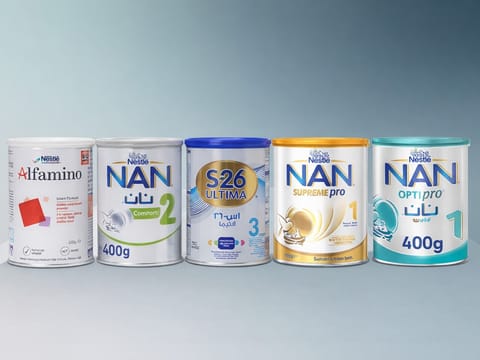
Dubai: It has been a week after certain Nestlé infant formula products were recalled in the UAE and seven other countries in the Middle East and North Africa (MENA) region as part of a global recall announced by the company.
The precautionary recall, which affects specific batches of NAN, S-26 and Alfamino products distributed across eight MENA countries, was triggered after a contamination scare involving a rare bacterial toxin. Gulf News has compiled all the essential information parents and caregivers need to know.
What triggered the recall
The Emirates Drug Establishment (EDE), in coordination with Nestlé, announced the voluntary recall, emphasising that product safety and quality remain the authority's highest priority.
The recall was initiated here on Wednesday, January 7, after one of the raw materials used in production was found to contain traces of the Bacillus cereus bacteria, which can produce the toxin cereulide. Nestlé detected a quality issue with arachidonic acid (ARA) oil, an ingredient supplied by an external provider.
“The safety of our products and the wellbeing of infants is our highest priority,” Nestlé later told Gulf News in a statement.
“Following the detection of a quality issue with an ingredient provided by a leading supplier, Nestlé has undertaken testing of all arachidonic acid (ARA) oil and corresponding oil mixes used in the production of potentially impacted infant nutrition products,” the company said.
Which products are affected
The recall includes NAN Comfort 1, NAN Optipro 1, NAN Supreme Pro 1, 2 and 3, S-26 Ultima 1, 2 and 3, and Alfamino products. However, only specific batch codes are affected, and these vary by country.
Parents can identify affected products by checking the batch codes on the base of the tin. Nestlé has released country-specific lists showing which batches are included in the recall across the UAE, Saudi Arabia, Qatar, Oman, Kuwait, Bahrain, Iran and Egypt.
Countries not affected by the recall in the MENA region include Algeria, Iraq, Jordan, Lebanon, Libya, Morocco, Palestine, Sudan, Syria, Tunisia and Yemen.
Understanding the health risks
Cereulide is a substance of bacterial origin created by certain strains of the microorganism Bacillus cereus, which causes foodborne illness. The company said that the presence of cereulide in oils is very uncommon.
Parents and caregivers should monitor their children for symptoms, which typically appear between 30 minutes to six hours after exposure. These include severe or persistent vomiting, diarrhoea and unusual lethargy.
"If no symptoms are displayed, there is no cause for concern of any health impact. If you have any concerns about your child's health or nutrition, we advise you to talk to your paediatrician or healthcare provider," Nestlé stated in its guidance.
The company has highlighted that regardless of whether symptoms are present, parents and caregivers should immediately discontinue the use of any product included in the recall notice.
No reported illnesses
Following the recall, Gulf News has received queries from worried parents seeking guidance on their children's health and safety, with some questioning whether recent illnesses in their newborns could be linked to the affected batches.
Both Nestlé and the Emirates Drug Establishment had confirmed that no illness or adverse events linked to the affected batches had been reported or confirmed.
In the UAE, parents can report any related cases to the Emirates Drug Establishment via pv@ede.gov.ae. The EDE had posted images of some of the affected products' tins on social media to help with identification.
How to check your formula
Parents can verify if their product batch is affected through Nestlé's online batch checker tool available on the Nestlé MENA website. The tool offers a sample image of a batch code to help caregivers locate the code on their tins, along with a search function to check if it's among the affected ones.
Batch codes can be found on the base of the tin. Parents can also check country-specific links on Nestlé's website to verify if their batch is included in the recall.
Refund, replacement options
Following the announcement of affected batch codes, Nestlé has rolled out two options for refunds and replacements, including a dedicated online claims system and regional consumer support.
Option 1: Return the affected batch to the original point of sale for a refund or replacement. Bring your original purchase invoice.
Option 2: Submit an online claim through Nestlé's dedicated portal. You will need a clear photo of your product batch number, which can be found at the base of the tin.
For further assistance, parents can contact Nestlé's Consumer Engagement Centre through WhatsApp at +97148100000 or call the local support centre. The toll free number in the UAE is +9718001161001.
Current safety measures
The Emirates Drug Establishment clarified that, in coordination with Nestlé, the affected batches have been quarantined in the company's and distributors' warehouses. Efforts have been underway to complete the recall of any remaining quantities in accordance with approved regulatory procedures.
"The recall process is being conducted in coordination with the relevant regulatory authorities in the UAE to ensure the complete removal of the affected batches from all points of sale, including online retail platforms," said EDE.
The Establishment has emphasised that these measures were undertaken as part of its commitment to reinforcing the national pharmaceutical security system and ensuring the sustainable availability of medical products at the highest standards of quality and safety.
The UAE's Ministry of Climate Change and Environment (MOCCAE) has also announced that it has begun testing all Nestlé milk products in the country as a precautionary measure. In conjunction with local authorities, the ministry has collected samples of various Nestlé-branded milk products currently available in UAE markets for analysis.
Limited scope of recall
Nestlé told Gulf News that only a limited volume of affected batches was distributed in the UAE. “All identified batches have been blocked at country level in line with Nestlé's quality and food safety protocols, and the recall is being carried out in close coordination with the relevant authorities,” the company said.
“All other Nestlé products and other batches of the same products that are not in the scope of this recall are safe to consume,” it reiterated.
The batches included in the recall represent significantly less than 0.5 per cent of the company's annual group sales, and the financial impact is not expected to be significant, according to Nestlé.
What parents should do
The company and authorities have outlined clear steps for concerned parents. If you have purchased any of the affected products, verify the batch numbers found on the base of the packaging and compare them against the official list. Should the batch numbers match, do not consume the product and dispose of it safely.
"We understand that this news may cause concern, and we are committed to providing clear, transparent information and support for parents and caregivers throughout this process," Nestlé stated.
On the online portal, Nestlé has highlighted an important message: "We believe breastfeeding is the ideal nutritional start for babies and we fully support the World Health Organisation's recommendation of exclusive breastfeeding for the first six months of life. A healthy maternal nutrition is key to start and sustain breastfeeding."


