From the skies
The UAE is not simply a constellation of colossal structures. A trip 1,500 feet above reveals an ecosphere that facilitates the lives of millions who live here
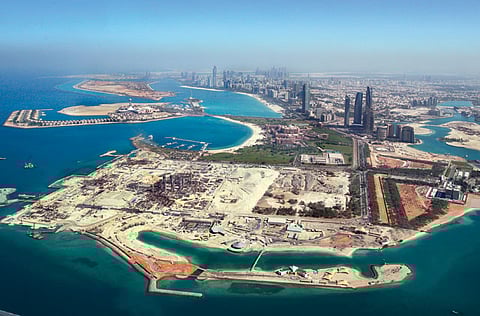
There are a few things about the UAE that people hear but may not get to see to the full extent. For one it is said that the Palm and World islands are visible from space; the water on the east coast of the country apparently blends from blue to a cool teal, and the Burj Khalifa is in fact 200 metres taller than any other man-made structure on earth. Testing these claims thoroughly requires a unique perspective — perhaps one from 1,500 feet above ground.
A short trip to the Jebel Ali Golf Resort will get you to one of several Seawings take-off points dotted around the Emirates. “No liquids, flammables or sharp objects” reads the sign at the entrance of the short pier, and a man with some kind of a detector scans your body thoroughly. Good to see that what seems like the world’s smallest airport still carries the same security protocol. As the raucous buzz of the propeller begins, so does a similar stirring in the gut. The plane, no larger than a van with wings and buoyant clown feet, buzzes along the water quite comfortably. A thumb’s up from the pilot and it picks up speed, leaving a white spray in its trail. The ears pop and immediately you are aware that this isn’t flying as you know it.
The ride is choppy at times — moments of turbulence are amplified in this tiny aircraft. Hitting iffy patches of weather can be nauseating or loads of fun depending on your predisposition. Quick, sharp plunges can be expected, but air sickness bags are provided (though parachutes are not). Ask the pilot to circle around again at your own risk — turning in this flying pod is absolutely exhilarating, and can open up a direct view of the ground below from your window. Onto the sightseeing: Even someone who lives in Dubai would be well taken aback to see it from the sky. It is as if all the hype surrounding Dubai that existed for the last decade or so — its modern history if you will — is mapped out in plain view.
Man-made wonders
Granted, it’s a long way from outer space, but seeing the Palm Jumeirah from even a few hundred feet up, it becomes pretty plausible that it would be visible from beyond the atmosphere. It’s truly a feat of engineering — a man-made wonder, and upon seeing the beachfront villas you really wish you lived there. The first sky — reaching cluster then appears. Jumeirah Lakes Towers and Marina, juxtaposed parallel to each other. Fronted by the imposing JBR residences, this strip of land is a metropolis in itself. Thoughts can’t help but turn to the fact that just over a decade ago this entire expanse was flat and barren. The iconic sail and wave, the Burj Al Arab and Jumeirah Beach Hotel cap off the edge of the area. A stretch of low-lying structures ensue before the ground springs up once again, this time higher.
Further up, the Burj Khalifa needs to be seen from a height. From ground level, its true stature cannot be appreciated as line of sight does not permit an absolute perspective of something so huge. The plane flies 1000 feet lower than the tip of the tower, but it is clear to see that it is at least two and a half times the size of its closest competitor on the Shaikh Zayed Road strip. Then the landscape changes dramatically — the modern spires turn into a city of old world charm and history. Satwa and later, Deira, contrast deeply to anything south of the Dubai World Trade Centre. The city from here appears as classically Middle Eastern, but with better infrastructure.
Winding through the mazy souqs and dilapidated buildings are perfect roads. This is one thing consistently witnessed throughout the country — no matter how rural the terrain might get, the roads are well-organised and up to scratch.
A telling experience
At first glance, Sharjah is of the same ilk as the older areas of Dubai — seemingly well organised but the city is symbolic of Arab authenticity — the city centre is indistinguishable from those in Damascus and Amman. The buzz seems to emanate from the corniche in Sharjah — a beautiful stretch of hustle and bustle by the sea. Similarly, Ajman’s corniche, while less busy, seems to act as the nucleus of the small Emirate. Gliding into Umm Al Quwain, one of the eye catchers of the area is undoubtedly Dreamland Aquapark. The jungle gym-looking mess of blue pools is immediately striking.
This continues into the Hajjar Mountains, the topography of which from the skies looks like that of another planet. An initial vivid red desert turns into this rocky texture. Greys and browns — every hue and shade of them paint this rough abstraction of relatively low-lying mountains. Occasionally a village, or a glowing wadi will be visible in one of the several valleys created by this landscape. The highlands lead to yet another coastline — this time on the east of the country. Fujairah offers the most beautiful beaches in the UAE. The colour of the water is more vivid and more varied as you fly along the beachside. A flurry of resorts are visible — the blue of their chlorinated pools challenged by the adjacent sea. One of the oldest forts in the country — about 360 years old — sits above the beachy city, almost peering down at it.
A short distance from there is another emirate — Ras Al Khaimah, which is also one of the landing areas for Seawings. On the way to landing in Al Hamra Village — a resort reservoir of sorts drawn from the sea, RAK’s recent industrial developments are there to see. Namely, the RAK Free Trade Zone and Industrial Area are a visual treat from above. Seeing stacks upon stacks of cargo and containers lined up is not something your mild mannered citizen would come across every day from down below. Seeing the true extent and breadth of operations is a telling experience.
Regal structures
Getting to the capital, Abu Dhabi involves a short trip south along the coast from Jebel Ali. Leaving the Palm Jebel Ali in your wake, the first thing that catches the eye are aquamarine clusters of water jutting to and from newly dredged strips of land around the islands of As Sammaliyyah and Umm Al Nar. The symmetrical suburban blueprint of Khalifa City is then visible — winding rows of homes streaming along the landscape.
From the sky, Ferrari World looks like a giant scarlet space station from a future millennium — the stallion badge almost regal in its grandeur. It could be a candidate for most impressive structures from the air anywhere in the world. Next door, the Yas Marina
Circuit is also impressive, and carved into the foliage in between the track are the words ‘Abu Dhabi’ smiling up at only those who can see it from above. Shortly after, the skeletons of a new skyline appear on Reem Island, and slowly it courses into central Abu Dhabi. Dense city blocks and busy streets expand into high rises on the Corniche. Although there are taller high-rises immediately surrounding, the ADIA building oozes a fashionable elegance — its façade flowing from curve to curve like a silk sheet. The Emirates Palace is in the lushest area in the city. The grand hotel is surrounded by greenery, almost as if they were royal gardens. A swoop back north, and further up Shaikh Zayed Grand Mosque becomes visible — a thing of real beauty — although it is richly Arab in design, it holds South Asian and Mughal architectural elements.
Landing is a breeze, surprisingly. Post flight, surveying those same structures from the ground makes you think about their physical entirety; how they fit into the story of the UAE. What has been built in this country is not simply a constellation of individual structures — each capable of wowing in their own right — but an ecosystem, a living, breathing organism that facilitates the lives of millions who have come here to live and those who have come to simply gaze at the magnificence visible everywhere.


