UAE-based Varkey Foundation awards $500,000 Global Schools Prize to Lebanon's refugee-led project
Alsama Project kept displaced teens learn through war, helped students earn scholarships
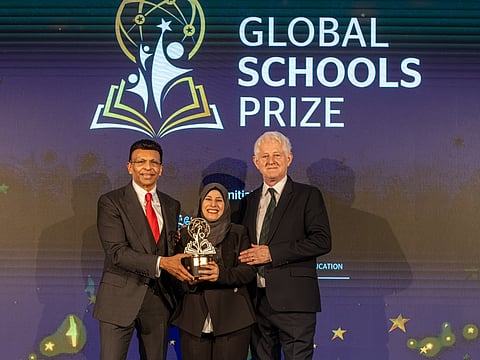
London: Lebanon's Alsama Project, a refugee-led organisation that kept more than 1,100 displaced teenagers in classrooms through two rounds of conflict, has won the inaugural Global Schools Prize worth $500,000 awarded by the UAE-based Varkey Foundation.
The winner was announced at the Education World Forum in London by celebrated filmmaker, charity fundraiser and campaigner Richard Curtis, who named Alsama the standout school from nearly 3,000 applications and nominations across 113 countries.
He was joined by Sunny Varkey, founder of the Varkey Foundation, the Global Schools Prize, and GEMS Education, in honouring Alsama, represented by its co-founder Kadria Hussein.
Sky-high ambition
Founded in 2020 with just 40 teenagers in Beirut's Shatila refugee camp, Alsama (Arabic for 'sky') has grown into a pioneering education organisation serving displaced Syrian and Palestinian youth who are largely shut out of traditional schooling.
In Lebanon, 85% of Syrian refugees cannot attend school, and fewer than 2% of displaced Syrian youth complete secondary education.
Rather than focusing on younger children, as most refugee education programmes do, Alsama targets adolescents, an age group often overlooked and trapped in systems that were never designed for them. Around 90% of students arrive unable to read, write, or perform basic maths. Within six months, most can do all three.
Six years to university
Alsama's accelerated curriculum is built around students' real-life contexts. Beginners learn Arabic by reading road signs; numeracy is taught through planning a weekly grocery budget. From that starting point, students can progress to university in just six years, which is considered half the length of a traditional education pathway.
The results are striking. Alsama's first cohort is due to graduate in July, with students already securing scholarships to the University of Cambridge, the University of Leicester, and Arizona State University.
Teaching through bombs
When bombs fell across Beirut in 2024, and again earlier this year, many Alsama students were forced to flee to Syria. The organisation was one of Lebanon's only education providers to continue teaching without interruption. They shifted immediately to online learning, distributing SIM cards through emergency fundraising, and setting up temporary classrooms in displacement shelters.
It operates four education centres in the Shatila and Bourj al-Barajneh refugee camps in Beirut, each home to around 40,000 refugees, and one centre in Homs, Syria.
Community at its core
The organisation is run largely by the communities it serves: 72% of staff are refugees, 96% come from refugee or local communities, and most senior leaders have refugee backgrounds themselves.
Each centre includes trauma-informed psychosocial support, full-time psychologists, and weekly sessions covering students' rights, healthy relationships, gender equality, and personal safety.
Alsama also works directly with families to intervene when children are at risk of early marriage, child labour, or abuse. So far, it has helped prevent 256 girls from early marriage and kept 278 boys out of child labour, while supporting 66 students experiencing domestic or sexual abuse.
Ninety-eight percent of students report feeling safe at school, a remarkable figure in communities where violence and instability are everyday realities.
Cricket as a classroom
One of Alsama's more unexpected tools is cricket. Across more than 20 hubs, boys and girls train together, building teamwork, discipline, and confidence. Half of all cricket coaches are girls, directly challenging gender norms. Older students are also employed as junior coaches, librarians, and teachers, giving them safe income that reduces the economic pressures that can push children into labour or early marriage.
Transformative power
Sunny Varkey, Founder of the Varkey Foundation, the Global Schools Prize, and GEMS Education, said: “Huge congratulations to Alsama Project. Your extraordinary achievement demonstrates the transformative power of schools – innovation against the odds, courage under crisis, and an unshakeable belief in every child’s potential. Your work has created life-changing opportunities for teenagers excluded from education, while strengthening entire communities. By recognising your achievement, we hope to inspire a global movement to scale the best ideas in education, so we can reimagine learning for a world in constant change.”
Meike Ziervogel, co-Founder and CEO of Alsama Project, said: “Winning the inaugural Global Schools Prize means an enormous amount to all of us at Alsama. It will give an international voice to our students. I am incredibly grateful to the Varkey Foundation and the Global Schools Prize team for believing in our work. Too often, refugee teenagers are overlooked. This recognition sends a clear message that their education, ambitions, and futures matter, and can help shape a more peaceful world."
What comes next
“What started with 40 teenagers in the Shatila refugee camp in Beirut, Lebanon, in 2020 has now grown into supporting more than 1,100 displaced young people across Lebanon and Syria. This was only possible because our students and staff refused to let war and displacement end their education. The prize will allow us to open additional education centres in Lebanon and Syria. Hundreds of more illiterate teenagers will have the chance to get ready to apply to university or skilled employment within six years," Ziervogel added.
Earlier this month, Alsama also won the Global Schools Prize category award for Overcoming Adversity, receiving $50,000.
The $500,000 grand prize will now fund a second accelerated learning centre in Homs, Syria, offering Arabic, English, maths, science, IT, financial literacy, and rights-based awareness sessions, alongside yoga and cricket.
The Global Schools Prize with a total prize pool of $1million joins the Global Teacher Prize and Global Student Prize, both Varkey Foundation initiatives, forming what the foundation describes as a trilogy celebrating educators, learners, and schools as institutions of innovation and change.
The other category winners that won $50,000 each were: IIS Ettore Majorana, Italy (AI Transformation); Freedom International Schools, Kenya (Arts, Culture, and Creativity); Escuela de Talentos Guanajuato Azteca, Mexico (Character and Values); LEAD 359, US (Global Citizenship and Peacebuilding); IES Carmen de Burgos Seguí, Spain (Health and Wellbeing); Suubi Community Primary School & Secondary Schools, Uganda (SEND and Inclusive Education); Neeson Cripps Academy, Cambodia (STEM Education); Institución Educativa Comercial de Envigado, Colombia (Sustainability); Reach Academy Feltham, UK (Teacher Development).


