Scientific excellence
Pioneering R&D along with quality education mean Switzerland is at the cutting edge of technological developments
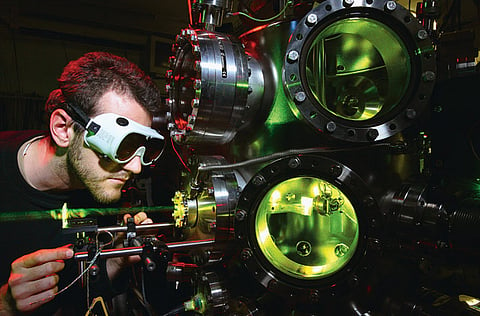
While Switzerland has long been known for its finishing schools and envied tradition of educating some of the world's finest hoteliers, its contribution to engineering, technology and computer science education is less well-known. The École Polytechnique Fédérale de Lausanne (EPFL) is leading the way with vital and innovative research and development, though, adding to Switzerland's well-deserved reputation for quality education.
EPFL is currently ranked number one in Europe alongside the UK's Cambridge for engineering, technology and computer sciences, says president Patrick Aebischer. "The Academic Ranking of World Universities (ARWU) ranking especially reflects the fact we are a university with numerous high-quality researchers who frequently publish excellent articles in scientific journals," he says.
"The fact these articles receive media attention is a great opportunity to let people outside Switzerland know it is a country of scientific and technical innovation and not only a land of mountains, cheese and chocolate," says Aebischer.
But, he says, the university is even more excited about receiving another formof unofficial ranking. "EPFL was allotted the highest number of European research grants out of any other university the past two years in a row [and] this is a true sign of scientific excellence."
Evolution of EPFL
EPFL has been born twice, explains Aebischer; first in 1853 when it opened as a private school before being integrated into the University of Lausanne as an engineering department, and again in 1969 when it became a federal institute directly under the control of the Swiss government. It quickly gained a reputation comparable to its sister institution — the only other federal technical institution in Switzerland, the Swiss Federal Institute of Technology Zurich (ETHZ) — for consistently producing graduates who contribute to the Swiss economy as engineers, businessmen and women and often an entrepreneurial combination of both, says Aebischer.
According to Aebischer, EPFL's strong points are sustainable development, biomedical research and what the university likes to call ‘scientific adventures'. "EPFL is home to the dye-sensitised solar cells of Professor Michael Gratzle; their functioning is inspired by natural photosynthesis, and they are cheaper to produce than traditional solar cells and are efficient even under cloudy skies," he says. "[And] Professor Jose Millan has recently developed a wheelchair that can be controlled using non-invasive brain-machine interfaces."
Although EPFL has traditionally been considered an engineering school, the addition of a life science faculty in 2002, enabling work on such innovations as the wheelchair, is >a prime example of the inter-disciplinary work ongoing. "EPFL is leading several projects in neuro-prosthetics — [such as] brain-machine interfaces, ocular and cochlear implants — and will open a centre in the near future," says Aebischer. "Researchers in this domain constantly collaborate with the other faculties to find solutions to mobility and sensory disabilities."
Research and development in bio-technology around the Lake Geneva region benefits immensely from EPFL, says Aebischer, asa recent study conducted by the EPFL Career Centre shows the majority of students who have gained their Masters at the university remainin the area. A significant percentage also use their skills and knowledge elsewhere in Europe, whilst the rest go on to work in the US and elsewhere. Impressively, alumni have gone on to found and co-found such renowned companies as Logitech and Synopsys Inc among others.
Crucially for industries involved, Aebischer is adamant any advances in technology are made available as soon as possible. "We make sure that technology does not get stuck in the labs," he says. "In many ways EPFL is a traditional European technical school but it has adopted many practices of the American system; it isthe best of both worlds. Cutting-edge technology is developed under some of the best working conditions worldwide and we have an assertive policy for the transfer of technology."
Fully integrated learning environment
The university plays an important role in making learning and resources available to all thanksto the Rolex Learning Centre, a recent addition to the Lausanne campus designed to offera fully integrated learning environment forboth students and the general public. Openedin February 2010, the learning centre provides libraries, dedicated study areas and services along with facilities for socialising, restaurants and cafés and plenty of outdoor space.
Aebischer says the centre is a public building where anyone can come to work, read or borrow books. "It is very important that our flagship building be open to everyone, for our university is committed to maintaining a dialogue between the sciences and the public at large," he says.
Looking to the future, EPFL's Scientific Park is expanding into what will be known as Innovation Square, with several new buildings and international companies such as Cisco and Logitech moving in.
"Most importantly, these last couple of years have been a time for investment in grey matter," says Aebischer. "Our tenure track systemfor assistant professors has attracted someof the best and brightest from around the world, [and] many of their research projects arejust getting started. We are very excitedabout their imminent results." n
EPFL in RAK
In an exciting development for research and education in the UAE, the EPFL has announced a sister campus to the original university in Lausanne. EPFL Middle East, based in Ras Al Khaimah, will begin enrolling Masters students from 2011. Some postgraduate research is already under way in temporary facilities — with projects including energy, electrical grids and wind engineering, all of which are set to be focal areas when the full facility is up and running — while a brand new campus is currently at the design stages and set to be completed by 2012.
"From a scientific perspective, RAK is an ideal location for hands-on research on some of the most important challenges of this century; energy, water and sustainable development," says Franco Vigliotti, dean of the new facility. "Equally importantly, RAK enjoys a sustained, dynamic and diversified development in its industry and economy; this is a prerequisite for scientific research."
Vigliotti also sees the potential of the region for scientific research and engineering at graduate and post-graduate levels. "This is a major factor of long-term development, with first-hand collaboration opportunities for our own students, faculty and researchers."
The focus at the new facility will be on graduate research, research-based graduate education and post-graduate education, according to Vigliotti. "The programmes will address areas underpinning sustainable development, with the same standards of quality we have on our Swiss campus," he says. "Our students will pursue EPFL degrees and will meet the corresponding admission requirement."
A state-of-the-art atmospheric boundary layer wind tunnel for studies in wind energy and structural wind engineering is just one of the many facilities set to be available at the new campus, along with enviable teaching facilities, laboratories and other specialised research infrastructures.
EPFL in Ras Al Khaimah
In an exciting development for research and education in the UAE, the EPFL has announced a sister campus to the original university in Lausanne. EPFL Middle East, based in Ras Al Khaimah, will begin enrolling Masters students from 2011. Some postgraduate research is already under way in temporary facilities — with projects including energy, electrical grids and wind engineering, all of which are set to be focal areas when the full facility is up and running — while a brand new campus is currently at the design stages and set to be completed by 2012.
"From a scientific perspective, RAK is an ideal location for hands-on research on some of the most important challenges of this century; energy, water and sustainable development," says Franco Vigliotti, dean of the new facility. "Equally importantly, RAK enjoys a sustained, dynamic and diversified development in its industry and economy; this is a prerequisite for scientific research."
Vigliotti also sees the potential of the region for scientific research and engineering at graduate and post-graduate levels. "This is a major factor of long-term development, with first-hand collaboration opportunities for our own students, faculty and researchers."
The focus at the new facility will be on graduate research, research-based graduate education and post-graduate education, according to Vigliotti. "The programmes will address areas underpinning sustainable development, with the same standards of quality we have on our Swiss campus," he says. "Our students will pursue EPFL degrees and will meet the corresponding admission requirement."
A state-of-the-art atmospheric boundary layer wind tunnel for studies in wind energy and structural wind engineering is just one of the facilities set to be available at the new campus, along with enviable teaching facilities, laboratories and other specialised research infrastructures.


