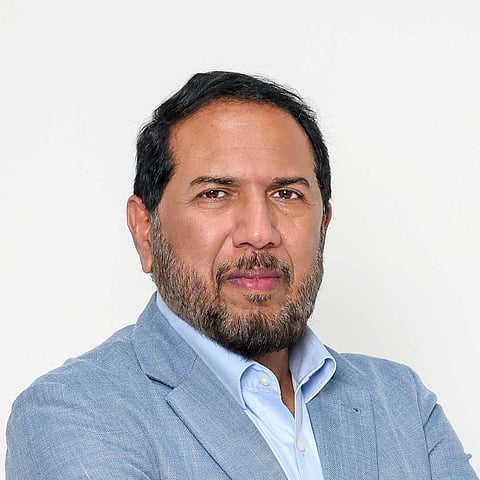
Khalaf Al Habtoor calls for renewed push to protect Arabic
Emirati business leader says preserving Arabic is vital to identity, knowledge
Dubai: Strengthening the Arabic language as a pillar of identity, knowledge and national progress took centre stage as the Al Habtoor Research Centre (AHRC) celebrated its third anniversary, with Emirati businessman Khalaf Ahmad Al Habtoor urging renewed efforts to protect and promote Arabic amid rapid global change.
Speaking during a special dialogue session at the anniversary event, Al Habtoor, Founder and Chairman of the Al Habtoor Group, stressed that safeguarding the Arabic language is not merely a cultural choice but a responsibility linked to the region’s future, intellectual independence and values.
“Arabic is the language of the Holy Quran and an essential part of our identity,” Al Habtoor said, calling for stronger Arabic education for younger generations and greater use of the language in scientific research, academia and public discourse.
The annual event held on Wednesday brought together diplomats, business leaders, researchers, academics and policymakers, highlighting the growing regional and international role of the Al Habtoor Research Centre in shaping evidence-based policy and strategic thinking.
Research and responsibility
During the dialogue session, Al Habtoor also reflected on the UAE’s development journey, crediting the country’s founding leaders for their clear vision, long-term planning and deep sense of responsibility. He underlined that unity, cooperation and teamwork remain the true foundations of nation-building and essential tools for navigating today’s political, economic and technological transformations.
He emphasised that supporting research centres is a national duty rather than an intellectual luxury, urging business leaders and decision-makers to invest in knowledge as a pathway to sustainable development and social resilience.
Growth and impact
AHRC used the occasion to showcase its achievements over more than 1,000 days since its establishment, reaffirming its position as a leading think tank specialising in strategic foresight, policy analysis, early warning systems and risk assessment.
Dr Azza Hashem, Director of the Al Habtoor Research Centre, outlined the Centre’s institutional journey from its launch in 2022 to its regional expansion with the opening of its Dubai branch in 2025. She described the Dubai expansion as a strategic shift that integrates technology-driven research with political and economic analysis to produce practical, policy-focused solutions.
The Dubai branch, she added, will focus on innovation, scientific research and medical studies, complementing the Centre’s Cairo operations and expanding its global engagement.
Arabic and beyond
The Centre highlighted its research output, including more than 600 analytical reports and over 110 research publications in both Arabic and English. It also showcased flagship initiatives such as the “What If” analytical series and the region’s first dedicated risk-foresight periodical, which explores unconventional future scenarios involving technology, artificial intelligence and global security.
AHRC’s research covers a wide range of issues, including the future of warfare, AI governance, data conflicts, economic transformation, space studies and digital economies, with growing attention to Latin America.
Champions of the Arabic language
A key moment of the event was the honouring of winners of the Khalaf Al Habtoor Initiative to Preserve the Arabic Language, recognising individuals and projects that strengthen Arabic as a language of research, knowledge and scientific production.
He honoured Dr Qayati Ashour Mohamed Abdel Latif from Egypt and Rifaat Al-Kinyari from Morocco in the Research Category while Hussein Ali Al-Nahas from Egypt got award in the Initiatives Category.
The initiative reflects the Centre’s commitment to reinforcing Arab intellectual identity and ensuring Arabic remains relevant and vibrant in the digital age.
Concluding the event, AHRC announced that 2026 will be designated as a Year of Peace and Construction, with research priorities focusing on nuclear security, biosecurity and food security. The agenda aims to turn challenges into opportunities, promote peacebuilding, and strengthen the Arab role in global knowledge production.