Child falls and home injuries: Sharjah issues urgent safety warning
Families urged to identify hidden hazards before preventable accidents occur
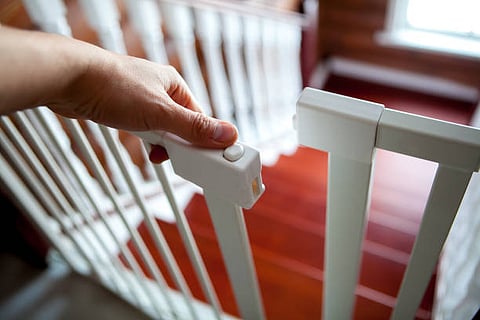
Sharjah: Many of the dangers threatening children's safety are hidden in the places families consider safest — their homes, residential buildings and play areas, according to the Child Safety Organisation (CSO), an affiliate of the Sharjah Family and Community Council.
In a fresh awareness campaign focusing on falls and unintentional injuries, the organisation urged parents and caregivers to conduct regular safety checks of the environments where children live, play and move, stressing that child safety should be a daily priority rather than a concern addressed only after an accident occurs.
Get updated faster and for FREE: Download the Gulf News app now - simply click here.
The warning comes as international figures continue to highlight the scale of the issue. The organisation noted that unintentional injuries — including falls, drowning, burns, poisoning and road traffic accidents — remain among the leading causes of death and injury among children worldwide. Global estimates indicate that more than 1,600 children and adolescents under the age of 19 die every day from injuries, many of which are preventable. The World Health Organisation also classifies falls among the leading causes of serious injury and injury-related deaths among children.
According to the organisation, many childhood accidents stem not from unusual dangers but from ordinary features that families encounter every day. A window, balcony, staircase, chair or piece of furniture may appear harmless to adults, but for a child it can become an invitation to climb, explore or reach beyond safe limits before they are able to recognise danger or understand the consequences of their actions.
The CSO explained that the early years of childhood are characterised by rapid physical development and an increasing desire to explore the world. However, children's ability to assess risks remains limited. Driven by curiosity, trust and a natural urge to learn through experience, young children frequently test their surroundings, making some homes and shared residential spaces far more hazardous than adults may realise.
The organisation stressed that the risk of falls extends beyond windows and balconies. Potential hazards can include furniture positioned near windows or edges, unsecured staircases, elevated surfaces, common areas within residential buildings, sharp corners, protruding edges and objects that allow children to access unsafe locations or increase the risk of injury if they trip or fall.
Seeing the world through a child's eyes
Hanadi Saleh Al Yafei, Director General of the Child Safety Organisation, said genuine safety begins when adults learn to view spaces from a child's perspective.
"Real safety begins when we look at a space through a child's eyes. A place that seems ordinary to adults may feel like an invitation to explore for a child whose awareness of danger is still developing," she said.
"What we see as a window, corridor or chair may be seen by a child as a chance to move closer, climb higher or follow someone nearby."
Al Yafei noted that children in their early years act out of trust rather than recklessness.
"They trust the place around them, the people close to them and their new ability to move. This trust is a beautiful part of childhood, but it requires conscious care and continuous responsibility," she said.
"Our role is not to make children afraid of the world, but to make the world around them more suitable for their age, needs and level of awareness."
She added that preventing accidents should not be viewed as assigning blame after incidents occur.
"We are not speaking about safety as a judgement made after accidents happen, nor are we placing responsibility on one party alone. We are calling for stronger awareness within families and the wider community that children do not see danger the way adults do," Al Yafei said.
"When we understand this, prevention becomes more humane and more effective, because we cannot expect a child to protect themselves from a world they do not yet fully understand."
Regular checks can prevent accidents
The organisation urged families to regularly review the environments where children spend their time and to assess homes and residential buildings from a child's eye level.
Parents and caregivers should consider what children can reach, climb, open or use in unexpected ways. The CSO also recommended keeping furniture away from windows and balconies, ensuring barriers and protective measures are secure, closely supervising young children in shared and transitional spaces within residential buildings, and never leaving them unattended in areas that could provide access to elevated or unsafe locations.
The organisation further emphasised the importance of educating older children about safe behaviour when playing with younger siblings and relatives, while encouraging families to foster a culture of shared responsibility to create safer environments for everyone.
Concluding its message, the Child Safety Organisation stressed that effective prevention is not about overprotecting children, limiting their movement or instilling fear. Instead, it is about creating safe spaces where children can explore, learn and grow with confidence while minimising risks that could threaten their wellbeing.


