“I want to be like Sanjay Leela Bhansali,” Emirati filmmaker tells stories from home
Abu Dhabi resident taking Emirati stories to the world through films, cultural connections
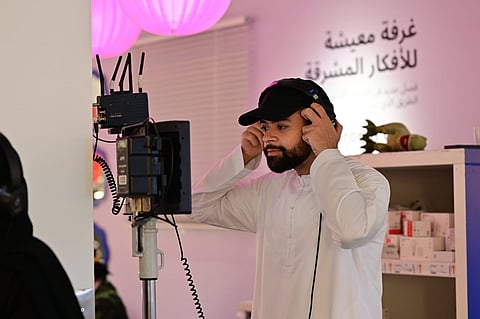
Abu Dhabi: The Emirati filmmaker, Abdulrahman Al Madani was always passionate about making movies. Hollywood and Bollywood fed his imagination, and one film above all: Devdas. He saw it in the cinema, and it was, in his words, a magical experience.
"Then and there, I was like, I want to be like Sanjay Leela Bhansali when I grow up." In his head, he says, he was going to make Bollywood films, songs and all. It took a little time to realise he could tell stories from home instead.
Walking the carpets of Emirates Palace, Abu Dhabi, he is reminded of the first time he was here, a very vivid memory and a turning point in his life. Abu Dhabi Film Festival 2012, where the 19-year-old Al Madani with a camera, a few friends and no budget first heard his name called out as the winner.
“I stood up, then sat back again. People were like, why did you sit back down? And I was like, I'm just registering it,” he said. Fourteen years later, he now stands at the same hallway, up for another award, presenting another story to his audience.
The audience's reaction, however, stayed with him. The documentary was not intended to be a comedy, but viewers found humour in the conversations and situations unfolding on screen. For Al Madani, that response became an early lesson in storytelling: a film does not need to force an emotion when the reality of a situation can speak for itself.
A childhood shaped by cinema
Madani was only a child, when he decided to become a filmmaker. He grew up in a time when watching movie was an expedition in itself, a trip to the video store, a rental, family gathering around a screen, very different from the culture of OTTs we have now.
His first audience was his own family. As a child he made movies with his cousins, shooting with their not-so-professional equipment but a great deal of imagination.
“I think that was a great push from my family, to keep doing it,” he added. “But I think that's what makes it exciting. Like constantly having to think about what you will do next.”
Later, in class, his professor encouraged him to submit his first, very basic film to festivals, insisting that every student in his class had submitted and he should do it, “Just apply. Don’t argue, “he remembered his professor’s words.
Al Madani said he was the only student in his class accepted to the Gulf Film Festival and went on to win an award, which helped motivate him to keep making films.
His filmmaking education extended beyond the classroom too. After studying media at the Higher Colleges of Technology, he went on to complete a year of filmmaking studies at the New York Film Academy. He also spent time volunteering on film sets, assisting directors and taking on different production roles.
Those experiences helped him understand the practical demands of making films, particularly in a country where independent filmmakers often have to build their own opportunities.
The journey was not always simple. “It's not a very usual field for especially an Emirati to go into filmmaking because it's not like a full-time job where you know you're like sorted financially,” he added. Being a filmmaker here, especially when there is no established film industry, hits differently.
"You constantly have to think about what you will do next,” he added.
Still, the uncertainty has never been enough to make him put down the camera he first picked up as a child. The Gamboo’a Revolution (2012) was his first documentary, which won awards at the Gulf Film Festival and the Abu Dhabi Film Festival.
That reality has not discouraged him. Instead, it has shaped the kind of filmmaker he wants to become. His short films are largely inspired by real people, encounters and stories from his surroundings.
He gravitates towards social dramas that explore subjects not often discussed, drawing inspiration from Bollywood, European and Iranian cinema. He also has a particular interest in blending drama with dark comedy, allowing humour to emerge naturally from uncomfortable or familiar situations rather than relying on conventional jokes.
Taking local stories to a global audience
One of his films has taken that approach beyond the UAE. Premiering last year at an international film festival in Denmark, the film received three awards, offering an opportunity to see how audiences outside the region would respond to a story rooted in local culture.
He had wondered whether European viewers would understand the cultural references. Instead, he found them responding to the film with laughter.
"If you tell a human story, everyone can relate to it," he says.
Today, he presents 'Oug', a film that follows an Emirati couple navigating the societal pressures of married life.
The film earned him an award in 2025, bringing him to the Abu Dhabi Festival, a flagship initiative of ADMAF reflecting the Foundation’s broader commitment to advancing arts, culture and education.
He has now started his new project, Meylas Aflam, a UAE film screening initiative that aims to showcase Emirati short films beyond festival runs. With five screenings already held, the project aims to give homegrown productions a space to be seen and appreciated.
His way of extending his dream for others like him.


