FIFA World Cup 2026 final: How Argentina's Spanish colonial past and now Messi connect the nations
Argentina was once part of the Spanish Empire
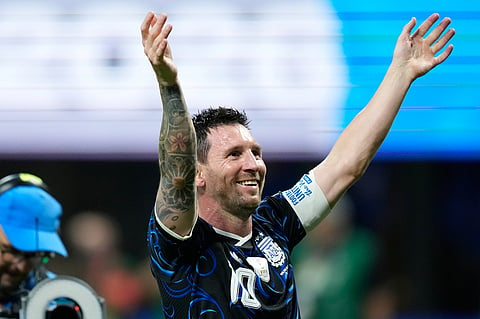
A Spain vs Argentina World Cup final is bursting at the seams with football history.
There is Lionel Messi, leading Argentina into another final against the country where he spent 21 years of his life. And, there is Spain, the footballing superpower that once tried to claim him for its own national team. And then there is the history between the two countries, a relationship that goes back centuries, long before football, World Cups or Messi's famous left foot entered the picture.
Argentina was once part of the Spanish Empire. But the story of how Spain arrived in what is now Argentina was not exactly a straightforward conquest story involving gold, silver and a neatly mapped-out empire.
In fact, the early Europeans who sailed into the region were initially looking for something else entirely.
The search for a route to Asia
When European powers began exploring the Americas, much of the continent remained a mystery to them. Spain and Portugal divided their claims through the Treaty of Tordesillas, but the geography of South America was still largely unknown.
For European navigators, the Río de la Plata, the enormous river system that flows through present-day Argentina and Uruguay, was particularly intriguing. Some believed it could offer a passage towards Asia.
Then came the rumours. Stories began circulating about vast sources of silver and mythical riches somewhere in the region. The rumours were so powerful that they would eventually help give Argentina its name, derived from argentum, the Latin word for silver.
The catch: The silver was never actually found.
Spain arrives
Juan Díaz de Solís became the first European known to land in the region in 1516. He reached the Río de la Plata, but the expedition ended disastrously. Solís and several of his men were killed by Indigenous people, and the surviving members of the expedition returned to Spain.
The region was not exactly offering European explorers a warm welcome.
Later, the Venetian explorer Sebastian Cabot heard stories of the supposed silver wealth from Francisco del Puerto, a young survivor of Solís' expedition who had remained in the region. Cabot went looking for the legendary riches and established a settlement near the Paraná River.
Once again, the expedition ended in failure. There was no silver and the settlement was destroyed, and the Europeans eventually left.
The Spanish Empire eventually takes hold
Spain continued its efforts to establish control over the region, with expeditions arriving from different directions. But Argentina was not Mexico or Peru. Unlike the Aztec and Inca territories, the region did not contain a centralised empire with enormous stores of precious metals waiting to be seized. The Spanish colonisation became slower and more complicated.
Over time, however, Spain established settlements and administrative control over the territory. Buenos Aires was founded, abandoned and later re-established. The region became part of the Spanish colonial system, eventually forming part of the Viceroyalty of the Río de la Plata, created in 1776.
For centuries, the territory that would become Argentina remained under Spanish rule.
Then came the ideas of the Enlightenment, political upheaval in Europe and Spain's own crisis during the Napoleonic era. The pressure for independence grew, leading to the Argentine Wars of Independence in the early 19th century.
Argentina eventually broke away from Spanish rule.
The Messi connection makes the history even more complicated
The historical connection between Spain and Argentina would already give this World Cup final an intriguing backdrop, but football has bent the twist through Lionel Messi. Born in Argentina, Messi moved to Barcelona at the age of 13 and spent the next 21 years in Spain, joining La Masia before becoming one of the greatest footballers in history.
As he spent so much of his formative footballing years in Spain, Messi was eligible to represent the country internationally. In another version of football history, he could have worn Spain's famous red shirt and been part of the golden generation that won Euro 2008, the 2010 World Cup and Euro 2012.
Instead, Messi chose Argentina, although the country did not always move as quickly as it might have to ensure that its future captain remained part of its international plans.
The possibility became particularly urgent in the early 2000s, when Messi was still relatively unknown in Argentina but had already begun attracting attention in Barcelona.
The VHS tape that almost changed Argentina's football history
In the early 2000s, Lionel Messi was still largely unknown in Argentina, although word was beginning to spread within the country's football circles about a remarkably small teenager in Barcelona who could glide past opponents with extraordinary speed and control.
During a 2002 trip to Europe, Argentina coach Marcelo Bielsa and his assistant Claudio Vivas were in Barcelona visiting senior internationals when Messi's early representative, Horacio Gaggioli, arranged for Vivas to see footage of the young player, as he told ESPN. That was [Messi's dad] Jorge's idea. He told me: "Horacio, the Argentine national team is coming to Barcelona, can you get them some footage of Leo?" Leo wasn't well known in Argentina. We had a video that I was given by Barça with some plays, and I went to the Hotel Princesa Sofia in Barcelona where they were staying. I asked for Vivas, who was Bielsa's assistant."
The footage came through a VHS tape containing highlights of a long-haired, diminutive Messi wearing a Barcelona shirt and weaving through opponents with the kind of close control that made him look almost impossible to catch.
Vivas was so impressed that he told Bielsa about the teenager, prompting the coach to ask to see the footage himself. According to Vivas, Bielsa initially asked him to play the tape at normal speed because the movement on screen seemed too fast to be real, only to discover that it was, in fact, playing at normal speed.
Messi's international future, however, was not secured immediately. Argentina did not select him for the 2003 Under-17 World Cup, where the team went on to face Spain in the semi-final and lose 3-2. After the match, Argentina youth coach Hugo Tocalli was approached by the Spanish team's chef, who reportedly told him that Argentina might have won had it brought “the kid from Barcelona” to the tournament.
Tocalli knew exactly who he meant, and the comment reportedly stayed with him. Once back in Argentina, he began working to ensure that the country did not lose Messi to Spain, which was also interested in the young player and could potentially have called upon him because of his years living and developing as a footballer there.
The hastily arranged match that secured Messi for Argentina
The solution was a hastily arranged friendly against Paraguay, organised specifically to give Messi an opportunity to make his international debut for Argentina.
The circumstances were unusual enough to raise questions even among those involved, with referee Gabriel Brazenas later recalling that he received a Monday call informing him that he had to officiate a match at Argentinos Juniors' stadium and complete the necessary FIFA paperwork, despite the fact that such fixtures would normally involve a foreign referee.
He was also told to expect a young player to come on in the second half.
The player was Messi, and his arrival immediately made an impression. Former player Federico Almerares, who was involved in the match, recalled the teenager's ability to take on opponents, while Brazenas later described Messi moving past him with a quick “ta-ta-ta” as he dribbled around the pitch.
The match may have been arranged in a hurry, but its significance was enormous. Argentina had moved quickly enough to ensure that the player who would eventually become its captain, World Cup winner and greatest modern footballing icon would represent the country of his birth rather than the country where he had spent most of his footballing life.
Messi always wanted to play for Argentina. Gaggioli revealed, "I received many calls: "Hey Horacio, do you think he can play for the Spanish national team?" I would say: "We'd have to talk to him, and the family, of course he can play, he's more than capable, but he has to decide." But Leo was always clear: He wanted to play for Argentina and Barcelona."
And so, the history gives the Spain-Argentina final a connection that stretches well beyond the football itself. The two countries are linked by centuries of history, beginning with Spain's exploration and colonisation of the territory that would eventually become Argentina, followed by Argentina's struggle for independence and emergence as a nation in its own right.
More than two centuries after Argentina broke away from Spanish rule, the two countries now meet on the biggest stage in world football, with an added connection that could hardly be more fitting: Spain once governed the territory that became Argentina, and centuries later the country also came close to claiming Argentina's greatest footballer for its own national team.
Messi, who spent 21 years in Spain and became a Barcelona legend, chose Argentina, leading the country to the 2022 World Cup and now into another final against the nation that had been such a major part of his life.


