How much did Lionel Messi’s trip cost India. Was it worth it?
Reports suggest a closed-door “meet and greet” had a price tag of nearly Rs10 million
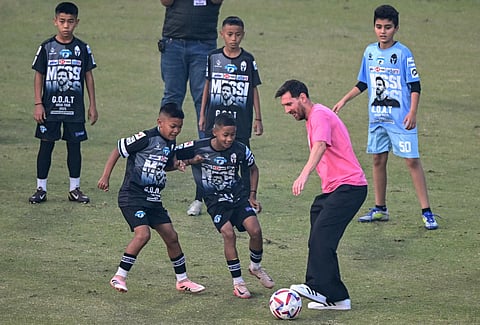
Dubai: For a country starved of footballing icons, the arrival of Lionel Messi was always going to feel seismic. As the GOAT India Tour rolled into view, ticket prices quickly spiralled into the realm of the surreal. Hardcore fans were willing to shell out anywhere between Rs5,000 ($55) and an eye-watering Rs50,000 for the chance to merely glimpse the Argentine maestro. Indian media even reported a closed-door “meet and greet” for select VIPs and corporate clients, with the price of that exclusive handshake allegedly touching Rs10 million.
The frenzy paid off on paper. Stadiums in Kolkata, Hyderabad, Mumbai and Delhi were all sold out well in advance. Brand Messi, as expected, proved irresistible. A recent report put the total cost of his trip to around Rs1.2 to 1.5 billion.
But the tour’s opening act in Kolkata descended into chaos. At the Salt Lake Stadium, angry fans ripped out seats and hurled objects towards the pitch as frustration boiled over. Thousands of supporters in the football-mad capital of West Bengal — many of whom had reportedly paid more than Rs12,000 — were left seething, victims of shambolic event management. Most didn’t even get a proper look at Messi. Surrounded by officials and celebrities during a brief walk around the stadium, he was swiftly whisked away as the mood turned hostile.
The remaining stops on the tour passed without incident, thanks largely to tighter organisation. Yet the damage had already been done, raising an uncomfortable question: was any of this drama really worth it?
The timing could hardly have been more ironic. Indian football is in visible decline. The national team recently slipped six places to 142nd in the Fifa rankings, its lowest position since October 2016. Against that backdrop, a three-day spectacle featuring no actual football felt less like inspiration and more like distraction. For corporate sponsors, being in the vicinity of Brand Messi was enough to justify the expense. For the domestic game, it offered little beyond fleeting glamour.
India’s slide is no mystery. Years of systemic neglect have hollowed out the sport: chronic underinvestment at the grassroots, underwhelming domestic competitions, coaching deficiencies, mismanagement, and a broken talent pipeline. The desperation is palpable. Sunil Chhetri, the face of Indian football for over a decade, was coaxed out of retirement, only to step away again soon after. The decision to naturalise an Australian player to fill the void spoke volumes about the state of player development in the country.
Football, after all, cannot survive in a vacuum — and India has spent much of the past year trapped inside one. The Indian Super League (ISL), the nation’s top-tier professional competition, has been suspended in what can only be described as a bureaucratic coma. What began as a contractual dispute between the All India Football Federation (AIFF) and its long-time commercial partner spiralled into a full-blown structural collapse.
A verbal restraint by the Supreme Court prevented the federation from renewing its commercial agreement, effectively freezing the league. The subsequent tender to find a new partner attracted not a single bidder. For a league once sold as the engine of Indian football’s revival, it was more than a setback — it was a damning vote of no confidence.
Even the I-League, meant to serve as the stable backbone of the system, has not escaped farce. Last season’s championship was decided only after weeks of disputes, appeals and counter-appeals, reducing the crowning of a champion to a legal footnote rather than a sporting celebration. When a league cannot conclude its season without committee intervention, it signals a system struggling to perform the most basic function of competition.
Messi’s visit, for all its spectacle, ultimately served as a mirror. It reflected India’s obsession with imported stardust while exposing the crumbling foundations beneath. The country can sell out stadiums for a global icon, but until it fixes the structures that sustain its own game, such moments will remain exactly what they were — expensive, fleeting, and fundamentally hollow.


