Philippines: The Bulacan airport debate — between environmental caution and infrastructure urgency
As Manila chokes on air traffic, a climate‑vulnerable bay braces for reclamation
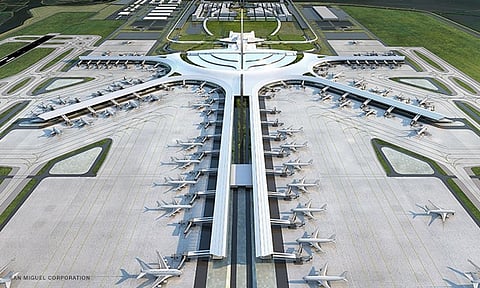
The construction of the proposed New Manila International Airport (NMIA) in Bulacan — formally linked to the “San Miguel Aerocity” project — has become a focal point of protest.
Groups such as Pamalakaya warn of environmental degradation, displacement risks, and long-term ecological damage.
NMIA, also known as Bulacan International Airport, is a major airport project being developed on a 2,500-hectare coastal site in Barangays Taliptip and Bambang, Bulakan, Bulacan, about 35 km north of Manila.
The debate is no longer simply about an airport.


Rather, it is about how the Philippines balances development with environmental protection in an increasingly crowded and climate-vulnerable landscape.
Largescale development
Protesters argue that the project, which involves large-scale land development and flood-prone coastal and river-adjacent zones, could worsen flooding patterns in surrounding communities, disrupt marine ecosystems, and damage fisheries that sustain local livelihoods.
They point to concerns over dredging, land reclamation impacts, and the alteration of natural waterways feeding into Manila Bay.
For groups like Pamalakaya, which represents small fisherfolk communities, the issue is existential: once ecosystems are altered, they say, recovery is uncertain and often irreversible.
On the engineering side, the project is ambitious by any standard.
The NMIA is envisioned as a multi-runway, multi-terminal facility spanning several thousand hectares, with capacity targets reportedly double Manila’s Ninoy Aquino International Airport (NAIA) at full build-out.
Ninoy Aquino International Airport (NAIA) is the only aviation gateway serving Metro Manila, composed of 16 cities and 1 municipality, and home to 15.5 million inhabitants (as per UN data). NAIA is notoriouly congested, stemming from serving over 52 million passengers annually in a facility designed for 32 to 35 million.
Relief for passengers
Currently, NAIA faces bottlenecks, due to severe runway limitations, overcrowded terminals, and congested landside traffic.
This has earned the gateway poor global rankings.
The new airport project is being developed by San Miguel Aerocity Inc, a subsidiary of SMC Infrastructure, under a long-term public-private partnership (PPP) "concession" with the Philippine government.
When fully completed, NMIA is expected to include four parallel runways, a massive passenger terminal complex, cargo and logistics facilities, airport support infrastructure and an "Airport City".
It will also include road/rail links to Metro Manila and surrounding regions.
It will have a capacity expandable from 35 million passengers annually in Phase 1 to as many as 100 million passengers per year upon full build-out.
$15 billion project
Cost estimates have been widely reported: the airport (privately financed), with total project costs estimated at around $12 billion (₱740 billion) to $15 billion (₱906 billion) depending on phased development, with construction timelines stretching into the late 2020s and beyond, subject to financing, permitting, and reclamation progress.
NMIA is projected to generate over 1 million direct and indirect jobs from construction, to operations, and the surrounding Bulacan Aerotropolis development.
Supporters of the project argue that large-scale aviation infrastructure often requires equally large-scale land transformation.
They point to international precedents: Hong Kong’s Chek Lap Kok Airport, built on reclaimed land in the 1990s, Singapore’s continuous Changi expansion involving reclamation and Japan’s Kansai International Airport, also constructed offshore.
Additionally, they point to India's offshore airport (near the Vadhavan Port in Maharashtra) and the recently-opened Navi Mumbai International Airport, which was built over former marshland, mud flats, and mangroves, utilizing rock blasted from nearby hills.
These projects were controversial in their early stages; now, they're central to their countries’ global connectivity and economic competitiveness.
Policy, communication gap
Critics, however, maintain that the Philippine context is different.
They stress that Manila Bay and adjacent coastal systems are already under environmental stress from pollution, subsidence, and storm surge risks.
For them, the issue is not simply whether reclamation can be engineered, but whether it should be pursued at such scale given long-term climate uncertainty.
Yet one persistent criticism of opposition groups is the perceived absence of a fully-articulated alternative of comparable scale.
While calls are often made to improve existing airports (NAIA, Clark), redistribute air traffic to regional hubs, improve roads, RORO and invest in rail-based connectivity, these proposals are rarely presented with the same level of financial detail or implementation timeline as the Bulacan project.
This creates a policy gap: principled opposition vs executable national infrastructure planning.
At the heart of the debate is a deeper tension: whether large infrastructure projects should be judged primarily by their risks or by their necessity.
Critics see a pattern of environmental trade-offs being repeatedly accepted without sufficient safeguards.
Proponents see an economy, jobs and development constrained by underinvestment in infrastructure, where hesitation itself carries economic costs.
The challenge for policymakers is not to dismiss either concern, but to ensure that environmental safeguards, engineering resilience, and long-term transport strategy are addressed together — not as competing absolutes, but as interdependent requirements for national development.


