Dubai’s band of friends: From childhood living rooms full of music to sold-out gigs and big dreams
The budding band That's Julian, share their journey with us and what keeps them going
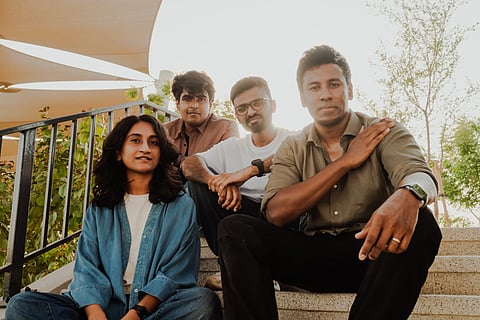
It has been a while since we last met the Julians. The band's name, That's Julian, is a droll reference that gets people asking the question: What's Julian?
Julian, as it turns out, is a humble plant, and the band's silent member and mascot.
A lot has happened in the two years since, including the release of their song 'Stations' on streaming platforms. Today, in a restaurant, the four Julians — Moses Thomas, Rohan Verghis, Aarti Venkat and Croydon D’Souza — settle onto one sofa and share their stories: How each of them found music, how they piece their schedules together, and what it takes to pursue music alongside the demands of everyday life. For bassist Croydon, that also means making room for music around a full-time job.
They don't romanticise the challenges of making music in an industry that rarely gives you time to catch your breath. And yet, as each of them talks about music, a little, almost imperceptible joy slips through. The road may be jagged, with a pothole or two along the way, but they're determined to see it through.
And they have each other.
The Beatles and songwriting
Before the conversation, we're told that Rohan Verghis is the rather reserved and quiet one of the group. Perhaps so, but when it comes to loving music, who really is?
The roots stretch back into childhood, and a lot came from his mother who knew about The Beatles. Then a book about the Beatles crossed his path. One photograph stayed with him: four young men, three of them holding guitars. "I was like, that looks so cool," he says. "I want that."
As he says, he fell in love with the idea of it all. They were young. They wrote songs, and changed the world. “I just wanted to do whatever they were doing.”
He tried his first songs in seventh grade. About ten or eleven years ago he set out to write properly structured ones, and he has been writing ever since. Covers never really interested him. Songs did. Then, near the end of university, he put the dream on hold. "I was like, I need to get my act together," he says. "Maybe I need to do the right thing. So I got a job."
It was a trade-off, he says, that didn't make much sense, especially with his wife supporting his music. "I don't know why I'm giving up music to do this," he remembers thinking.
That question is what led to the phone call.
The phone call
That's Julian started with a phone call and a favour that wasn't asked until the very end.
Two years ago, Rohan had songs piling up and no idea what to do with them. He wasn't even sure he wanted to make music anymore. "I was kind of tired of everything," he says. "But there was some kind of itch in me to do it, to do something with it."
He called the one person he thought could help. Moses was in the scene and seemed to be helping everyone make music. The two of them talked about songs and songwriting for nearly an hour. At the end, Moses asked the obvious question.
"He was like, hey, why did you call me?" And the band begins to laugh at their own beginnings. "I said, well, I have a show coming up in a few weeks. I wanted to see if you'd be willing to help. And he said, yes, let's do it."
From there it snowballed. Maybe Aarti could sing on one song. Maybe Croydon could play on another. In the end, nine musicians came together for that one show. Four of them seemed to be at every rehearsal, helping everyone else: The singer, the instrumentalists, anyone who needed help with their parts. Croydon, Rohan recalls, was always working out the feel of each song and what it needed from the bass and the rhythm.
The show finished on a high Rohan had never felt before. "It was something I wanted my whole life."
‘Okay, sing’
Aarti can't say when music began for her, because she can't remember a time without it.
She grew up in Dubai, with family back home in Bombay, and both her parents are singers. Childhood was learning songs together. One of them would hold up the camcorder and say: okay, sing. Formal training in Indian classical music began when she was about ten, and Western music crept in along the way. "There was no entry point in music," she says.
Even so, as a teenager she had another plan. "I was really hell-bent on taking up accounting in high school," she says. "I was like, man, I'm really good at this." Her teachers agreed with her.
Her parents had another suggestion. Her brother, a year ahead of her at school, had already chosen audio engineering. Just give it a shot, they told her. She signed up for a short course at SAE, and by the end of it she had changed her mind. A bachelor's in audio followed, and then years of engineering, production and performing.
"Audio and music, it's never really gone away," she says. "It's just found its way back."
She calls herself multi-passionate, moving between voice, guitar and keys, still working out what music means to her. For now her answer is simple, and she admits it's a cliché. Music is about expressing what you feel, whether through someone else's song or your own. "Just doing the part," she says. "And with your full heart."
Lemons and lemonade
For Moses Thomas, music is practically a family heirloom, handed down before he was old enough to hold it.
There are photos, he says quite plainly, where he is sitting beside his father at 4am with a lemon in his mouth, listening to him play. Read it as a metaphor if you like: handed a lemon early, he has spent his life working out every possible recipe for lemonade.
His father sings, and his grandfather used to take his father along to shows. So music was always around, Carnatic music included. Even the car became a drumset.
Moses remembers drumming on whatever he could reach in his father's Mercedes-Benz, until his father sought a respite. "That's enough of that," Moses remembers him saying. "Let's get you a proper drum set. Before you start damaging things." The Mercedes, one assumes, breathed a sigh of relief.
He started drumming properly at ten. At church, he was lucky enough to play next to Croydon, who he says "taught me so much about music." It was the start of a musical bond that, years later, would land the two of them in the same band. In between came bands in school and at university, often several at once.
Still, he never planned to make it his career. "I was always such a stressed child," he says. "I'm very academic." Now he plays keys for That's Julian and makes music full-time.
"I'm happy I am doing it. No regrets," he says. "I never expected any of this to happen the way it did. But that's the beauty of life. You can't expect these things."
Guitars and brotherhood
Music has a way of keeping people with you, even when they’re not.
For Croydon, music is intertwined with his father’s memories. As he shares, his father came to Dubai in the early 1980’s and played in a band. He had even told his own father he didn't want to go to college, or even finish school. So, his father bought him a bass guitar. A generation later, Croydon was the boy brought along to gigs and rehearsals, with music always playing in the background.
At home, it was the Beatles, constantly. "It was like 24-7. Blaring at home. All of the albums," he says. His father played the records and took them apart, talking at length about how the songs were written.
At 12 or 13, Croydon began learning the guitar. His father showed him some barre chords, and with the first three, he wrote a song about a girl he had a crush on, which he now describes as "very cheesy". From then on, every chord he learned was for a song he wanted to write. And every song was a way of spending time with his dad: a Beatles track, the chords explained, then shown on the guitar.
"It's very vivid in my head, the memories with my dad," he says. "He's passed now. It's been 11 years. But my best moments with the guitar is with him. Listening to a Beatles song."
His first real band experience was in church, next to Moses. "This little guy. Barely getting over the drum set," he says about Moses. Croydon was filling in for a much better bass player, and the young drummer let him know it. "I thought, ‘I need to make sure this drummer's happy’. This 10-year-old drummer. But at that time, I knew this guy was great. Eventually, I think he liked me too."
Today, Croydon is the only member of the band with a full-time job. His day starts early with the school run, dropping the kids off and then rushing to work. Music fits in around everything else: A few hours a week, more when a gig is coming up, enough to stay on top of the songs and his parts. He doesn't hide how he feels watching the others. "When I look at them, I'm so jealous," he says. "Because you can clearly see the joy in their faces." They work late, sometimes finishing at 5 or 6 in the morning. "I just want to contribute where I can."
‘We're not this. We are this.’
So, how do four very different personalities stay together in a band? Well, for a start, it takes honest conversations.
Aarti describes two halves of band life. One is the music: rehearsing, telling each other what you feel, and being honest and vulnerable. A few months ago, the four of them went through their 13 songs one by one. Why did you write this line? What is this chord doing here? "It was so insightful," she says, "because we get to know each other's world and play that together."
The other half is administrative work, and it matters just as much. "We ask, ‘Can you reply to me on time? Show up at the gig’," and the band chuckles again. "It's tough to handle four people's brains and schedules."
Moses says the answer is to sit down and agree on a shared direction. That's Julian started as Rohan's songs played by friends, and turning it into a band meant asking hard questions. What do we like about this? What don't we like? How much time can each of us give? The four even made a list of what the band is and what it isn't. Alignment, Moses says, is a relief. "We don't want to play rock music? Amazing! None of us want to do that."
Time is still the hardest aspect of it all. They tried rehearsing for an hour every day, but it didn't survive the hustle of earning a living here. "You have to be open and try to have your fingers in lots of places," Moses says. So, they cover for each other instead. In the weeks before the sold-out Fridge show, Moses couldn't give much. Rohan and Aarti worked late into the night.
"Some days, one person is able to give more," Aarti says. "It's really just four people."
"It's a team," Moses says. "You have to depend. You have to check in. Honestly, you try your best."
A Friday night
And so what comes next? The squad keeps it practical, with a balance of breeziness. They will look ahead with more original music, properly released and properly promoted. More shows they put on themselves. Perhaps brands that want to back original music.
Moses also has a hope for the city itself. Here, he says, people rarely weigh a night at the movies against a night watching a band. He'd like that to change. "I would love for Dubai to get there, where people go, 'Oh, it's a Friday night, let me go and listen to a band,'" he says. "Hopefully we're one of those where they choose a night with us, and that's it."
Until then, there are school runs and a day job, rehearsals squeezed into whatever time is left, and late nights that end at dawn. To deal with the stress, Croydon does go for a little run in the morning.
But the thing that really helps, he says, is the three people on the sofa next to him.
"Music aside, they're great people to hang out with," he says. "Great people to bond with and tell jokes with."
And as he says, “Even if there was no music, I think we'd still be friends."
Four musicians on one sofa, and a silent fifth member who is, after all, a plant.
That's Julian.


