Meet Emirati metal band Metarust: Two brothers, a childhood friend and how Metallica fuelled their UAE rise
The band share their journey from childhood days to heading for overseas performances
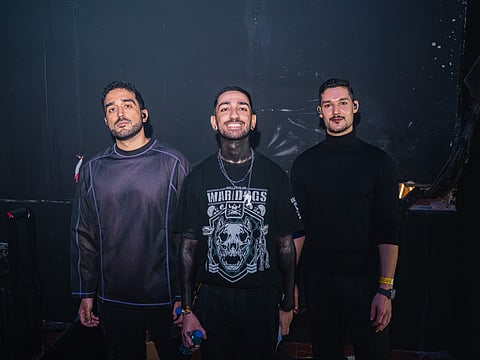
“If somebody says they're not into Metallica, they're lying to you.”
We laugh.
But the brothers are serious.
Saif and Samir Sami, dressed in Odyssea t-shirts and chains, sit in the middle of their studio, surrounded by guitars, love for Metallica, drum set, along with X-Men pop figurines and One Piece cushion. The room is a music and pop-culture haven, bursting with the story of the brothers and their UAE-based metal band, Metarust.
They’re missing their third member and bassist, Marwan El Messeery, who is abroad at the moment. Nevertheless, the unconscious motto is leave no member behind and Marwan is conspicuous by his absence.
The band have just returned from Romania, where they performed for the first time as part of the Odyssea Rock Fusion Festival. But their story began much closer to home: with childhood music lessons, garage gigs, a Metallica concert and a chemistry quiz about rust.
The soundtrack started at home
Saif and Samir don’t expound on cliches about ‘breathing’ music, or need to say that music is in their blood.They talk about music and metal with a warm affection, like one does about a close friend made in childhood, the friend who doesn't need to be reassured that they're loved.
The friend just knows it.
As Saif explains, “It’s always been a part of our life. Our parents were always into 80s, 90s pop, and different types of music. So, we took inspiration from them playing music all around the house.”
What was the kind of music that would echo in the Sami household? Samir recalls, “I got into Scorpions through my dad. He introduced me to them, and that were the first songs I learned on the drums. Michael Jackson, Wham, and a lot of Bollywood playing in the house, so a lot of dancing."
When Saif was nine and Samir was around four, their parents had noticed their love for music. As the brothers agree: They saw that their children had the courage and the ability to be on stage without stage fright. “They’re like, oh at a young age there’s no such thing as stage fright. So, they pushed for it,” added Samir. They decided to take them for guitar and drum classes. As the brothers explain, their parents noticed the love for music and playing instruments.
"We got to choose our instruments. And we kind of have been playing since then,” adds Saif, admitting that he wasn’t attached to the guitar initially. Samir remained with the drums. “And he stuck to it. I fell off, for a while for a few years, until I met Marwan.”
Marwan introduced him to Metallica, and it motivated him to return to guitar, and learn the electric guitar. “He picked up the bass as well. And since then it's kind of been the three of us jamming since we were kids.”
The jamming began. They would just practise a song and jam together, learning Seven Nation Army by White Stripes, at the ages of 9 and 13.
In school, both Marwan and Saif would be writing: They wanted to be in a band. There was no other dream.
Performing as children
Performing at Global Village could have been just another Tuesday for the trio. They regularly played shows as the three of them, moving from talent shows and malls to venues such as Ibn Battuta Mall.
At times, they didn’t even need an event to perform. They would just set up mini-gigs, and their friends, family would arrive with full support and cheer. It could even be in the garage, where their neighbours would come around to attend, realising that a serious gig was in town. "We did the full grind also, as children. We were hauling amplifiers and the drum kits with my parents. We would drive across Sharjah for a wedding and things like that,” adds Saif.
Metallica, chemistry and the birth of Metarust
So when did they become Metarust? Well, for the few years, the band didn’t have a name. They experimented with many ideas, and their friends pitched names, but nothing quite stuck and really felt like something that belonged to them.
And for a while, life almost interfered with their love for music in the form studies. Nevertheless, the brotherhood was persistent, but the band was slowly taking a backseat, and it was Metallica that made them realise that nothing else mattered. “Metallica came to Abu Dhabi, and for all three of us, it is our number one,” says Saif. “There’s no bigger band to us than Metallica. There’s no bigger influence.”
The determination was iron-clad: Metallica was coming, and they just had to see them.
Metallica arrived on a Wednesday, in the middle of a school week, with a looming pop quiz on the next day. The dilemma was pulsing: How do they do both? Would they even go to school? But, the teacher was firm. Metallica or no Metallica, the call of chemistry had to be answered.
But, they went for the concert anyway, and after seeing Metallica, the seriousness for the band returned in full force. “I told Marwan, that we had to take this band seriously,” recalls Saif.
With dreams about how it would look if their names were right under Metallica on Apple Music, Saif had to contend himself to a rather dulling reality: The chemistry quiz on rust. And as he kept circling around the effects of rust, the idea of Metarust was born.
“Since then, the doubt of the name never came back,” says Samir.
And quickly, logos were designed. The YouTube, Facebook pages were followed. Metarust was kickstarted by 15-year-olds, a 12-year-old, who were just armed with passion and a desire to play. Sometimes, just sometimes, that’s all you need.
Finding a way to make music work
Growing up in the UAE, the trio knew that building a career in music, particularly in punk, metal or rock, came with its own questions about stability. “You do wonder, it would be great to make this your future, but how stable will it be if we start from here?” Samir says.
“So I think the grind here in the industry is about maintaining a job that can help fund you and provide some stability, while also giving you the opportunity to invest in music and help it grow on the side.”
Saif had briefly gone to business school, thinking that if music was going to be his career, he also needed to understand stability, how to manage his finances and build a secure future. He stayed for three and a half years. However, his mother looked at him and told him something he perhaps already knew. “You don't want to do this. This is not you.”
He was demotivated and withdrawn, but the music was never gone. Marwan was still around and the the three of them were still spending time together and talking about music. Metarust remained in the background. They still had their old Facebook pages and YouTube channel from high school, and they had some demos. They played covers and had the occasional jam.
But the band had not yet become what they imagined it could be. Then Saif's mother, knowing that what her son needed, took him out of school and enrolled him in sound and music production at SAE Institute.
“I was thinking, I don't know, it's a different language. I was very intimidated by media production,” he says. But after enrolling at SAE, something clicked. He found his calling, as he says. Samir joined soon after graduating from high school.
“And immediately, it was like, this was what we wanted to do all along.” The three had studied music theory in high school and completed GCSEs in the subject, but theory had not offered them the outlet they were looking for.
“It was more annotation, it was more literature. It was less performance.”
The first single
They began recording between 2016 and 2018, creating the demos that would eventually lead to their first single.
That single was Killing Me Psycho, released in the summer of 2019. It was, somewhat surprisingly, one of the simplest songs they had made.
“There were some songs that I focused more on,” Saif says. “I was showing more musical, artistic abilities and everything like that.”
However, Killing Me Psycho was different. “I think we made it in maybe under an hour. It was just like, okay, just do this, just do that. Didn't think too much about it.”
And then people heard it and the song was becoming a earworm. Their teachers were impressed, as well. However, Saif was initially unconvinced. He thought there were better songs — songs he had spent more time and effort on. Yet, Killing Me Psycho kept returning, and eventually, they decided it would be their first single.
Writing songs together
There is no one person who decides the course of the song and its lyrics. Its all three of them.
They wait to see what clicks, what sounds catchy, what works with the riffs and the hook. What would connect with others, is the question they keep returning to.
Then comes the voice. “We make sure that the voice is an instrument rather than just trying to force meaning and force words into a song,” Saif explains.
They listen for the words that sound right with the music. Then, from there, they bring meaning into the lyrics.
Much of that meaning, they say, comes from their own thoughts.
Their music is often about the thoughts inside their heads, as they say. But around the time they released their fourth song, Keep in Touch, they began to recognise a recurring theme. “This is the theme that we feel is resonating with people,” Saif says. “This is the theme that we want to represent us as well.”
And as he emphasises, the writing is not restricted to one member of the band. They work together in the studio, contributing to one another's parts and lyrics.
They may have all started from the same musical foundation, but each has branched into different genres and influences, from hip-hop to electronic music and beyond, adds Samer. Sometimes one of them will hear something and think: I need to make something like this. And that's what makes music.
Why metal?
But why metal?
But why not, metal?
It was always an outlet, the brothers agree. It’s a passionate genre. "You know, when you're into metal music, it becomes a part of your identity,” says Samir. “It becomes a part of how you talk, how you preach, and what you talk about, it’s a part of what you wear, how you preach and what you talk about. It controls all of you.”
And while the UAE's metal scene may not always be immediately visible, it is there. “The metal industry here, once you find it, you’ll realise it’s actually quite big,” says Samir.
You have to keep digging for it. As the brothers say, there are so many bands, here. You’ll always find events, find the venues. And once you know someone, they’ll connect you to another. “That’s why we champion many of the bands. We always had the mission to make UAE a metal hub and show that representation,” notes Saif.


