Mumbai on edge: Bomb threat targets Amitabh Bachchan's home Jalsa, Mayor's office, and airport
Bomb threats at Bachchan's home revive Bollywood's underworld memories
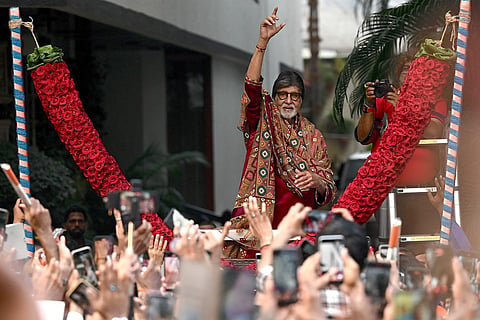
Dubai: Mumbai police were put on high alert after a fresh bomb threat targeted Bollywood superstar Amitabh Bachchan's Juhu bungalow, Jalsa, along with the Mayor's Office and Chhatrapati Shivaji Maharaj International Airport.
According to a report on NDTV, bomb disposal squads and security teams searched the locations named in the threatening email, but found nothing suspicious.
The latest scare is part of a string of threatening messages that have kept security agencies on their toes. On November 6, Bachchan's residence was named in another bomb threat, prompting police to inspect the property. An earlier email on October 23 had threatened explosions at the Mayor's Office, Bachchan's bungalow and the venue of singer Diljit Dosanjh's November 27 Mumbai concert at Mahalaxmi Racecourse.
That message also threatened a grenade attack on a school and referred to possible violence at Bachchan's residence between October 31 and November 27. Subsequent emails reportedly named the Bombay High Court and Bombay Stock Exchange.
The repeated threats have also cast a shadow over Bachchan's famous Sunday ritual of greeting fans outside Jalsa. During a recent appearance, the veteran actor waved to admirers from behind a transparent bulletproof shield, with his son Abhishek Bachchan and security personnel nearby. He later resumed the interaction without the barrier.
Police are investigating the origin of the emails, and no explosives have been recovered during the reported searches.
For Bollywood, however, threats against its biggest names evoke memories of a far more violent chapter in Mumbai's history, when the city's underworld was deeply entrenched in the Hindi film industry.
When Mumbai's underworld called the shots in Bollywood
There was a time when Bollywood's most dangerous villains weren't found on screen. They operated from the shadows, financing films, demanding money and allegedly deciding which stars and producers would face the consequences of defying them.
During the 1980s and 1990s, Mumbai's criminal syndicates developed an increasingly disturbing relationship with the film industry. Alleged gangsters such as Dawood Ibrahim, Chhota Shakeel, Chhota Rajan and Abu Salem became synonymous with an era of extortion, intimidation and violence.
Bollywood was particularly vulnerable because film financing was largely informal. Before the industry gained greater access to institutional funding, producers frequently relied on private financiers and cash transactions. Criminal networks exploited these arrangements to invest money, cultivate influence and allegedly interfere in casting and distribution.
The industry's growing international market also made it attractive to organised crime. Overseas distribution rights were lucrative, and disputes over money could quickly escalate into threats.
For some producers, refusing an extortion demand meant risking more than a film's commercial prospects. It could put their lives in danger.
Gulshan Kumar's murder: The day Bollywood was shaken
One of the darkest moments came on August 12, 1997, when T-Series founder Gulshan Kumar was gunned down outside a temple in Mumbai's Andheri neighbourhood.
Kumar was a music industry powerhouse who had revolutionised India's cassette business and built T-Series into one of Bollywood's most influential music labels.
His murder sent shockwaves through the entertainment industry. It demonstrated that even immensely successful businessmen with enormous influence were not immune to gangland violence.
The killing became one of the defining crimes of the decade, exposing the extent to which organised crime had infiltrated the entertainment business.
Rakesh Roshan shot after Hrithik's blockbuster debut
In January 2000, filmmaker Rakesh Roshan, father of Bollywood actor Hrithik Roshan, survived an assassination attempt outside his Mumbai office.
The shooting came shortly after the phenomenal success of Kaho Naa... Pyaar Hai, the romantic blockbuster that transformed Hrithik into an overnight sensation.
Roshan survived the attack, but the incident underscored the dangers facing successful film personalities at the time. The shooting was investigated in connection with organised crime and alleged extortion-related motives.
The attack also exposed an uncomfortable reality: a film's commercial triumph could attract unwanted attention from criminal networks seeking a share of the profits.
Rajiv Rai and the filmmakers who lived in fear
Filmmaker Rajiv Rai, known for popular Hindi films including Tridev, Vishwatma and Gupt, survived an armed attack in Mumbai in July 1997.
Rai subsequently spent years living abroad, with security concerns profoundly affecting his personal and professional life.
Film producer Mukesh Duggal was murdered in Mumbai earlier that year, another killing that contributed to the climate of fear surrounding the industry.
The violence was not limited to individual rivalries. Extortion rackets allegedly targeted producers, actors, music executives and distributors, with criminal groups using threats to extract payments or influence business decisions.
For an industry built on glamour, fantasy and larger-than-life heroes, the contrast with its off-screen reality could hardly have been more disturbing.
Dawood Ibrahim and Bollywood's murky connections
The name Dawood Ibrahim became inextricably linked with Mumbai's organised-crime history, particularly after the 1993 serial bomb blasts that devastated the city.
The fugitive underworld figure and his associates were accused of running criminal operations that extended into several businesses, including film financing and distribution.
Photographs and reports of Bollywood personalities attending events associated with underworld figures fuelled public scrutiny of the industry's relationship with organised crime.
But the nature of those associations varied considerably, and social contact alone was not proof of criminal involvement.
The more serious allegations concerned the use of illicit money to finance productions, pressure on filmmakers and extortion demands backed by threats of violence.
The underworld's influence became so deeply embedded in the public imagination that it eventually inspired an entire genre of Hindi crime films.
Ram Gopal Varma's Satya and Company, along with Anurag Kashyap's Black Friday, explored different dimensions of Mumbai's criminal world, transforming the city's violent history into compelling cinema.
Yet for those who had lived through that period, the stories were far more than cinematic entertainment.
How Bollywood began breaking free
The industry's relationship with organised crime gradually changed as film production became more corporatised and access to formal financing improved.
The Indian government's decision to grant the film industry formal industry status in 1998 helped pave the way for greater institutional investment and bank financing.
Stronger policing, criminal investigations and changes in the financing and distribution of films also reduced some of the vulnerabilities that had allowed criminal syndicates to flourish.
That did not mean threats against celebrities disappeared. But the era when gangsters could openly exert influence over sections of the film business became increasingly difficult to sustain.
Why the latest threats cannot be dismissed
The latest emails targeting Bachchan's residence have understandably attracted attention, particularly given Mumbai's history of violence against film personalities.
However, there is an important distinction between the gangland attacks of the 1990s and the present investigation.
Police have not established any connection between the recent bomb threats and the organised-crime syndicates that once operated in Bollywood. Nor have the searches uncovered explosives at the locations named in the messages.
The immediate challenge for investigators is to identify the sender or senders, determine whether the emails are connected and establish whether they represent credible threats or deliberate attempts to spread panic.
Meanwhile, Bachchan's Sunday gatherings at Jalsa remain a powerful symbol of his relationship with fans.
The sight of the actor greeting admirers behind bulletproof glass was unusual, but it also reflected the practical security considerations that can accompany extraordinary fame.
For Mumbai, a city where the worlds of cinema, money and organised crime once collided with deadly consequences, the latest threats are an uncomfortable reminder of the industry's turbulent past.
The difference is that the danger in the present case remains unproven. What happens next depends not on Bollywood's history, but on what the police investigation uncovers.


