Halloween Watch | Paranormal Activity: The only horror is a man who won't put his camera down
If you ever buy a good camera, maybe put it down and go to sleep
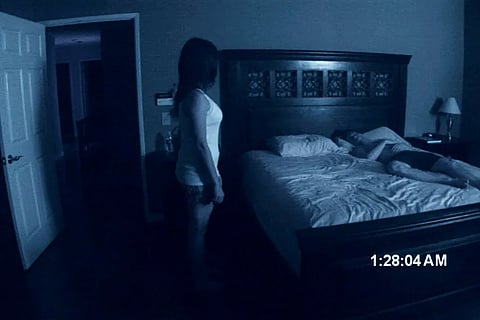
I would like to propose a reading of Paranormal Activity that its marketing department would not endorse: it is, at heart, the story of an exasperated demon teaching an obsessive content creator a lesson about boundaries. That’s how I see it, anyway, and once you see it, you can’t unsee it.
In 2009, a film made for roughly $15,000 crept into cinemas and terrified half the planet, or so it seems. Director Oren Peli had shot it in his own San Diego house in about a week, with two unknown actors who kept their real names, Katie Featherston and Micah Sloat, the better to blur the line between fiction and footage.
Paramount rolled it out with a campaign that was half genius, half dare: Audiences were invited to 'demand' it in their town, while trailers showed night-vision footage of real cinemagoers clutching each other and shrieking. The limited social media of the era did the rest, confirming that this, folks, was the scariest film you would ever see. It went on to gross nearly $200 million, which makes it one of the most profitable films ever made, and almost certainly the most profitable blanket.
See, I am always ready to be scared by horror films. I love being scared, and I adore a good old-fashioned jump scare. The demon perched on top of the wardrobe in The Conjuring trained me to shut my eyes firmly if I ever think I’ve glimpsed a shape in the dark. Sinister taught me something I already suspected: never move into a house where a family was murdered, because you’ll find a box of Super 8 snuff films in the attic and Bughuul, a grim entity who sweet-talks children into dispatching their own families. These are useful life lessons.
Paranormal Activity taught me just one: if I ever buy a good camera, I should put it down and go to sleep.
The setup is simple. Katie and Micah, a young couple, have recently moved into a tidy suburban house. Katie has been dogged by an unseen presence since childhood, and it has followed her. Micah’s solution is to buy an expensive camera and film everything, especially the two of them sleeping, which he does nightly from a tripod at the foot of the bed. A psychic visits and advises calling a demonologist. Micah, a man who has never met a bad idea he didn’t want to film, declines and brings home a Ouija board instead. That's...what you should do yes, yes, of course.
For the first 45 minutes, very little happens. A door creaks. A blanket shifts. Somebody hears a thud. You spend a remarkable amount of time squinting at grainy darkness, waiting for something to move. Eventually it does: footprints appear in talcum powder, Katie stands motionless by the bed for hours, and she is at one point dragged down the hallway by her ankle. Through it all, Micah follows her around with the camera, as one does when one’s girlfriend is being taken over by a demon.
Read it my way, and the demon’s behaviour suddenly looks very reasonable. Here is an entity, minding its own business, which finds itself filmed every single night by a man who also taunts it, challenges it and refuses all professional help. By the finale, it has had enough of both of them and demands some privacy in a fairly bloodless manner. Honestly, who could blame it? We’ve all had a flatmate like Micah.
Of course, a hit this size was never going to stay a one-off. Paranormal Activity 2 arrived in 2010 as a prequel, introducing Katie’s sister, Kristi, her husband Dan, a new baby and a family dog named Abby. After a supposed break-in, Dan installs a network of security cameras, so this time the CCTV footage does the squinting for us. Kristi duly gets possessed, the cameras duly capture very little in great detail, and once again the household is undone by a refusal to simply move out.
The only one you truly feel sorry for is the dog, who senses trouble long before anyone else, suffers most for it, and never asked to be in a found-footage franchise. Abby deserved better. Frankly, so did the demon.
Paranormal Activity 3 (2011) rewinds to 1988, when Katie and Kristi were little girls with an imaginary friend called Toby, who is neither imaginary nor friendly. Their mum’s boyfriend, Dennis, is a wedding videographer, so naturally the family’s response to a haunting is better production values. His great innovation is strapping a camcorder to an oscillating fan, giving us the slowest, most nerve-shredding panning shot in cinema history. It’s genuinely the best of the lot, and that isn't saying much.
Paranormal Activity 4 (2012) finally admits the demon has gone tech. Teenager Alex lives across the street from a now very possessed Katie and her suspiciously quiet young son. The family’s Xbox Kinect projects infrared dots across the living room, revealing the ghost as a sort of spooky disco. It’s the first horror film in which the scariest thing is a games console’s motion sensor, and the demon, frankly, looks tired.
Four films in, the lesson is consistent. Nobody calls a priest, nobody moves house, and everybody buys more cameras. The demon isn’t the villain here; it’s the long-suffering subject of the world’s least-wanted reality show.


