Halloween watch: The Woman in Black — Daniel Radcliffe’s ghost story is thick with fog, grief and shrieks
Loss and rage fuel the ghostly terror in this atmospheric thriller
jA dark shadow glides through the audience. A child screams.
Before Daniel Radcliffe walked the causeway to Eel Marsh House, there was the play. Before the play, there was the book: Susan Hill’s 1983 novella, a deliberately old-fashioned ghost story in the tradition of M.R. James. The premise is cutting: Jennet Humfrye, unmarried and pregnant in a world that won’t forgive her, is forced to give up her son to her married sister. She watches him grow up as someone else’s child, and then, by a crueller twist of fate, watches him die, swallowed with a pony and trap by the marsh and the fog.
Grief consumes her, and when illness finally takes her, death doesn’t end her rage. She haunts the house and the town of Crythin Gifford. Whenever she is seen, a child dies.
Stephen Mallatratt’s stage adaptation opened in Scarborough in 1987 and moved to the West End in 1989. It ran at the Fortune Theatre for more than three decades, until 2023, second only to The Mousetrap among London’s long-running plays. It is a marvel of thrift.
There are two actors: an elderly solicitor, Arthur Kipps, who hires a young actor to help him tell the story that has haunted him for most of his life. A wicker hamper becomes a pony and trap, and a dog exists only in mime and sound. The first half is wry, almost comic: Two men rehearsing, bickering about technique. Then the lights drop and the play turns.
The Woman in Black herself is a shadow. She stands at the back of the stalls, at the edge of a doorway, in the corner of your eye, and her presence feels like a change in air pressure. She is a wound, a figure whose face has been worn away by grief and grievance. The play is atmospheric, as the audience is left to imagine the haunting.
Every empty chair on that bare stage seems occupied.
James Watkins’ film, released in 2012 as the comeback flagship of the revived Hammer Films and written by Jane Goldman, has to show us something, and it does.
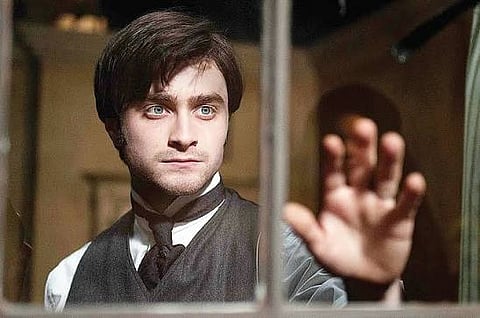
Radcliffe, in his first major role after Harry Potter, plays a younger Arthur Kipps, a widowed London solicitor whose wife died giving birth to their son. He is sent north to settle the papers of the late Alice Drablow, and the villagers of Crythin Gifford are colder than the weather. Only Sam Daily, a wealthy local played with weary decency by Ciarán Hinds, offers him friendship, and Daily is a grieving father himself.
Goldman’s most important change is to the ghost’s motive. Here, the Woman in Black doesn’t just bring death to children; she drives them to kill themselves, and the opening scene of three little girls stepping out of an attic window is chilling for its calm. She is vindictive and seething, and the plot gains a ticking clock, since Kipps’ four-year-old son, Joseph, is due to join him by train. The change also gives the film its emotional spine. Kipps arrives already haunted by loss, which makes him a mirror for Jennet: two parents defined by grief, one sunk in sorrow, the other turned to rage.
And then, there's the house itself.
Eel Marsh House stands on a tidal island, joined to the mainland by a causeway that the sea swallows twice a day, a constant reminder of how trapped and isolated a person can be.
This is where the film drives its horror home, when it trusts its setting. The landscape is its first ghost: fog over flat grey marsh, a house rotting from the inside, a village whose doors close as Kipps walks past.
The most frightening room contains nothing threatening at all. The nursery is full of clockwork monkeys and porcelain dolls, and when they begin to move on their own, the horror lies in the absence they point to, a child who once played there and never grew up.
Watkins is at his best with the patient fright. The Woman appears in the background of a shot, or in the reflection of a window just behind Kipps’ shoulder, and the camera holds steady and lets you find her.
Often she is visible to us and not to him, which turns the audience into helpless witnesses and trains us to search every corner of the frame. In those moments, the film comes closest to the play.
The trouble is that it does not trust its own atmosphere for long. Carefully built dread is broken again and again by a sudden noise, a bird against the glass, a crow taking flight, a gush of filthy water from a tap, each one punched home by a shriek of strings. These make you jump, but there is a difference between being startled and being frightened, and every sting spends tension the film has worked hard to earn.
The same failure of nerve shows whenever the Woman is fully revealed. Each time that ruined face lunges at the camera, she becomes smaller. A face can be studied and dismissed; a shape at the edge of vision cannot. The play built its terror on absence, while the film keeps feeling obliged to cash that absence in.
As the deaths mount, Kipps sets out to lay her to rest. He wades into the marsh to recover her drowned son and reunites mother and child, believing this will bring her peace.
It is classic ghost-story logic, and it fails, because her rage cannot be bargained with. At the station, she claims Joseph, luring him onto the tracks as the train pulls in, and Kipps leaps after him. Then, on the misty platform, we're greeted with a family reunion: It is an ending that is grim and oddly consoling at once: the father cannot save his child, but he will not let him go alone.
Hill’s novella is far less merciful. Its Kipps survives Eel Marsh House, marries and has a son. Years later he sees the Woman in Black again, and the pony and trap carrying his wife and baby crashes into a tree. There is no resolution and no meaning, only ruin, and he is left to go on living with what he has seen.
The film sacrifices the lifelong sentence for a family reunion. It is the more commercial choice, but also a coherent one for a story about parents and children who are never allowed to keep each other. What it softens is the book’s cruellest insight. In Hill’s telling, the real horror is surviving. Death would have been a relief.
The film’s other weaknesses sit close to its strengths. Radcliffe carries the long, nearly wordless stretches of a man alone in a dark house with real conviction, but he was in his early twenties during filming, and as a widower with a four-year-old son he is hard to believe.
Kipps needs the weight of a lived life, a marriage, a loss, years of grief, and since the film runs on that grief, it is exactly where the performance is thinnest. Jennet, too, is shortchanged.
She was punished for having a child outside marriage, her son taken from her not by fate but by respectability, and buried in that is a ghost created by cruelty, returning to demand what was stolen. The film brushes against the idea and then compels her to become the monster.
And the play’s boldest trick, the ghost slipping out of the story into the room where it is told, cannot survive the move to the screen. The film’s Woman menaces Kipps, but she never threatens us, which is why she is easier to shake off when the lights come up.
If you’re a seasoned horror fan who has survived Sinister, The Woman in Black may feel tame. On its own terms, though, it earns its chills: handsomely made, sincerely sad, and full of images that outlast its jump scares. Its failures are failures of confidence. The film interrupts its own dread, shows its ghost when it should hide her, and offers its hero a reunion where Hill offered none.
The play understood what the film half-forgot.
The Woman in Black's real horror is her grief. It's profound loss that has corrupted her soul and left her for dead, and there's no peace even after death.
And so, she haunts everyone around.
She is everywhere; she might be standing just behind you, in the dark, and you will not know until you turn around.
-(Read-Only)_resources1_16a4a163826_large.jpg?w=320&auto=format%2Ccompress&fit=max)


