Why buying gold in UAE will now be cheaper for Indian expats
India’s gold duty hike widens UAE price gap as GCC jewellers brace for demand surge
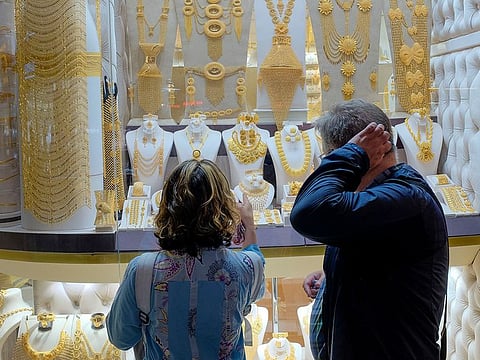
Dubai: India’s decision to raise import duties on gold and silver to 15% from 6% is reshaping buying patterns across the Gulf, with UAE jewellers expecting stronger demand from Indian residents, tourists, and investors.
For UAE residents, the change could translate into significantly lower prices compared with India, especially during the upcoming summer travel and wedding season.
Get updated faster and for FREE: Download the Gulf News app now - simply click here.
Duty-free limits
According to Shamlal Ahamed, MD of International Operations, Malabar Gold & Diamonds, in the GCC could now be roughly 12% cheaper than in India because of the widened duty gap.
He said the effect becomes even more noticeable with global gold prices already trading near record highs, since the absolute savings on each purchase increase alongside bullion prices.
That price gap matters most for UAE-based Indians travelling home during the July-August wedding season. Under India’s revised Union Budget rules effective February 2026, women can carry up to 40 grams of gold jewellery duty-free, while men can carry up to 20 grams.
Ahamed said a family of four could collectively carry up to 140 grams of jewellery duty-free when returning to India, creating what he described as “massive savings” opportunities for residents buying in the UAE before travelling home. The UAE market also benefits from other advantages beyond pricing.
For smart NRIs, tourists, and savvy investors, the message is clear - there has never been a better time to buy gold and jewellery in the UAE and across the GCC.

Stronger footfall
Investment-grade gold bars in the UAE are exempt from VAT, while tourists can reclaim VAT on jewellery purchases, widening the effective savings gap further. "With the UAE government ensuring strict gold purity standards, and the GCC offering some of the lowest making charges worldwide, customers already enjoy a major advantage," Ahamed pointed out.
He added that consumers in India may increasingly face limited access to international jewellery collections because higher duties make imported products more expensive. By contrast, GCC retailers source jewellery from more than 20 countries and offer hundreds of thousands of designs. The shift is already being watched closely by Gulf retailers.
According to Ramesh Vora, chairman of Bafleh Jewellers, the higher import duty has widened the gap between Indian domestic gold prices and international benchmarks, making Gulf markets more attractive for Indian expatriates shopping before travelling home.
"We anticipate a notable surge in gold purchasing by Indian expatriates traveling home or remitting value through jewelry. When domestic gold becomes significantly more expensive back home, the Gulf becomes an even more attractive buying destination," he said.
Economic pressures
Behind the policy shift sits a broader economic concern. Stephen Innes, Managing Partner at SPI Asset Management, said India’s move reflects mounting pressure from rising energy costs, a weakening rupee, and surging household demand for gold as a defensive asset.
"Gold demand in India is shifting from cultural consumption toward defensive investment behaviour, making it harder for policymakers to suppress through tariffs or public appeals," he said.
"The broader macro message is deeply bullish for long-term gold psychology as households increasingly treat bullion as protection against currency fragility and geopolitical instability. The gold market is no longer trading like a simple inflation hedge or a traditional safe haven. It is beginning to behave more like a pressure valve."
According to Innes, average monthly gold imports into India climbed to 83 tonnes in early 2026, up from 53 tonnes a year earlier, while first-quarter demand value nearly doubled to a record $25 billion.
He said policymakers appear increasingly concerned that strong gold imports, combined with higher oil prices, are worsening pressure on India’s current account deficit and foreign exchange reserves.
For UAE residents, the immediate impact is more practical than macroeconomic. The wider price gap means many Indian expats may increasingly choose to buy gold in Dubai and other GCC markets rather than waiting until they reach India, particularly for weddings, gifting, and investment purchases ahead of the summer travel season.